Author: Acupoint Guide Editorial Team

  • Why Does My Back Hurt? Causes and Self-Care Guide

    Why Does My Back Hurt? Causes and Self-Care Guide

    Summary: A complete guide to the 7 causes of back pain and self-care methods for each. From acupressure to stretching to lifestyle changes — all in one place.
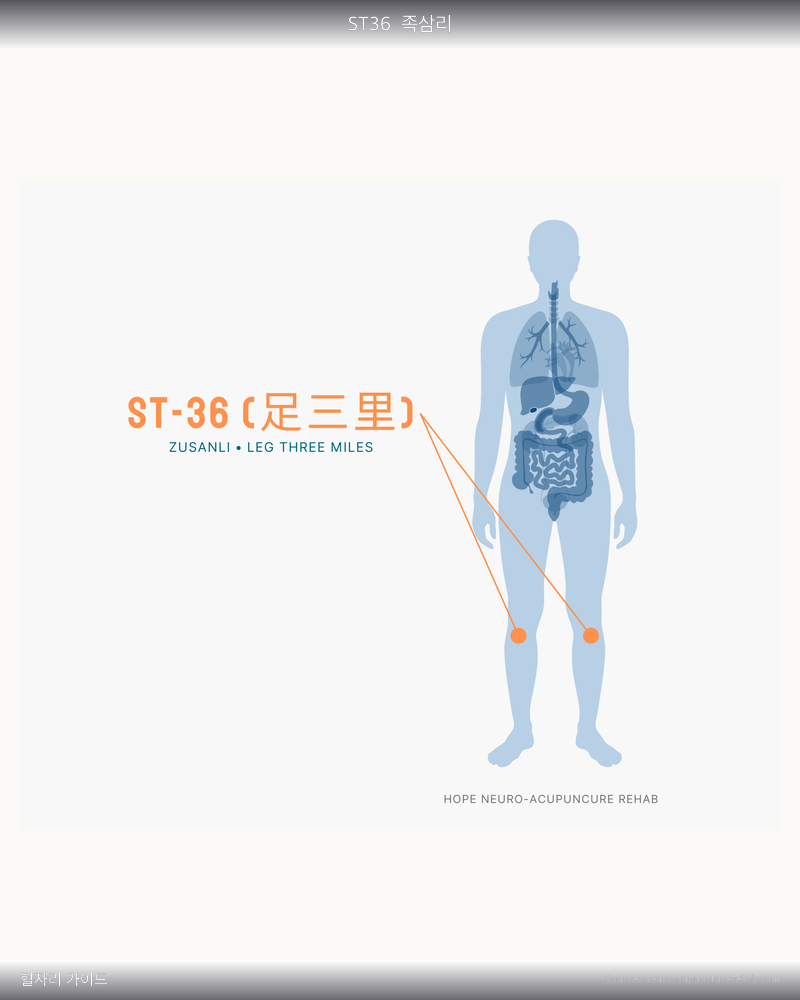
    ST36 혈자리 위치 그림

    “Why Does My Back Hurt So Much?”

    When your back is aching but you don’t know the cause, anxiety builds up. “Could it be a disc?” “Is it something serious?” You end up rubbing your sore back while searching for ‘back pain causes.’

    Back pain is incredibly common — 80% of people experience it at least once in their lifetime. It can range from sharp and electric to stiff and rigid to heavy and pressing. You need to understand the cause to address it properly.

    Here are the 7 main causes of back pain and tailored self-care for each situation.

    7 Main Causes of Back Pain

    1. Muscle & Ligament Strain (Most Common, 85-90%)

    Lifting heavy objects, sudden twisting, or repeated poor posture causes micro-tears in muscles and ligaments. Characterized by aching, sore pain.

    Self-Care: Initial cold therapy, switch to heat after 2 days, acupressure on Shenshu (BL23) and Dachangshu (BL25), gentle stretching

    2. Disc (Intervertebral Disc) Problems

    When the cushion between vertebrae (disc) herniates and presses on nerves, radiating pain shoots down to the legs.

    Self-Care: McKenzie extension exercises (prone press-ups), Weizhong (BL40) acupressure. See a specialist if leg numbness is severe

    3. Poor Posture

    Slouching, crossing legs, leaning to one side on the couch — when these become habits, spinal alignment breaks down.

    Self-Care: Posture correction every 50 minutes, desk stretches, Yaoyangguan (GV3) acupressure

    4. Weak Core Muscles

    When abdominal and back muscles are weak, they can’t properly support the spine, increasing the load on it.

    Self-Care: Core exercises 3-5 times per week — bridges, dead bugs, bird dogs

    5. Spinal Stenosis

    Mainly affects people over 50. The spinal canal narrows, causing leg numbness and heaviness when walking. Characteristically improves when sitting.

    Self-Care: Cycling (symptoms improve in forward-leaning position), Weizhong and Kunlun (BL60) acupressure. Professional consultation recommended

    6. Stress & Psychological Factors

    Stress causes unconscious tension in back muscles. If tests show nothing wrong but pain persists, consider psychological factors.

    Self-Care: Diaphragmatic breathing, meditation, light walks, Shenshu (BL23) acupressure for relaxation

    7. Referred Pain from Internal Organs

    Kidney disease, digestive disorders, and gynecological conditions can manifest as back pain.

    Self-Care: If pain is unrelated to posture, or accompanied by fever or urinary issues, a medical checkup is essential

    Acupressure Points by Cause

    Cause Recommended Acupoints Technique
    Muscle strain Shenshu (BL23), Dachangshu (BL25) Circular thumb pressure, 30 sec each
    Disc problems Weizhong (BL40), Kunlun (BL60) 5-second press x 10 reps
    Poor posture Yaoyangguan (GV3), Shenshu (BL23) Knuckle rub up and down
    Stress Shenshu (BL23), Taichong (LR3) 1 minute with deep breathing

    Daily Back Health Rules

    • Bend your knees, not your back, when lifting objects
    • Avoid staying in the same position — move every 50 minutes
    • Sleep on your side with a pillow between your knees
    • Maintain a healthy weight (excess weight dramatically increases back strain)
    • Make 5 minutes of daily core exercises and back stretching a habit

    Frequently Asked Questions

    What is the most common cause of back pain?

    Muscle and ligament strains are the most common, accounting for 85-90% of all back pain. Poor posture, sudden movements, and heavy lifting are typical triggers.

    How can I tell the difference between a disc problem and regular back pain?

    Numbness or radiating pain going down the leg suggests a disc issue. If coughing or sneezing causes tingling down to your leg, get it checked.

    Can people who exercise a lot still get back pain?

    Yes! Exercising with poor form or lifting excessive weight can actually injure your back. Proper form is most important.

    Can internal organ problems cause back pain?

    Yes, kidney stones, endometriosis, pancreatitis and others can manifest as back pain. If pain is unrelated to posture changes, or accompanied by fever or urinary issues, get a medical checkup.

    Can self-care alone cure back pain?

    Mild to moderate muscular back pain often improves within 2-4 weeks with self-care alone. But severe or long-lasting symptoms need professional evaluation.

    Medical Disclaimer: This article is for informational purposes only and does not replace professional medical diagnosis or treatment. If symptoms persist or worsen, please consult a healthcare professional.
  • Acute vs Chronic Back Pain: Which Pressure Point Is Right for You?

    Acute vs Chronic Back Pain: Which Pressure Point Is Right for You?

    Summary: Acute and chronic back pain have different causes and require different approaches. Here’s a comparison of the best acupressure, exercise, and lifestyle management for each type.

    ST36 혈자리 위치 그림

    Same Back Pain — Why Do Different Approaches Matter?

    Some people were perfectly fine yesterday, then suddenly felt a ‘pop!’ and threw out their back. Others have had a dull, persistent ache for months that just won’t go away. Both say “my back hurts,” but what’s happening inside is completely different.

    Using chronic treatments for acute pain slows recovery. Using only acute treatments for chronic pain misses the root cause. Sharp, electric-like acute pain versus heavy, dull chronic pain — let’s learn to tell them apart clearly.

    You need to know exactly which type your back pain falls under to find the right solution.

    Acute vs Chronic Back Pain at a Glance

    Category Acute Back Pain Chronic Back Pain
    Duration Within 4 weeks 12 weeks (3 months) or more
    Pain Type Sharp, stabbing, electric-like Dull, heavy, stiff
    Main Causes Muscle strain, ligament injury, sudden impact Poor posture, weak core, disc degeneration
    Heat/Cold Cold therapy (within 48 hours) Heat therapy
    Exercise Initial rest, then light walking Core strengthening, swimming, Pilates
    Recovery 2-4 weeks Long-term management needed

    Acute Back Pain — How to Manage

    Immediately After Onset (Days 1-2)

    • Don’t overdo it — rest in a comfortable position
    • Wrap an ice pack in a towel, apply for 15 minutes, repeat hourly
    • When lying down, place a cushion under your knees to reduce pressure on your back

    Acute Phase Acupressure — Weizhong (BL40) Is Key

    BL40 acupuncture point

    When acute pain is severe, press acupoints far from the back:

    • Weizhong (BL40): Press the back of the knee crease for 5 seconds, 10 times. There’s a traditional saying: “For back pain, seek Weizhong”
    • Kunlun (BL60): Press behind the outer ankle bone for 3 seconds, 10 times. Effective for pain radiating down the leg

    From Day 3 — Start Moving Gradually

    Staying in bed actually slows recovery. Start with 5-10 minutes of light walking.

    Chronic Back Pain — How to Manage

    Pain Management — Heat Therapy + Acupressure

    • Apply heat for 15 minutes to promote blood circulation, then follow with acupressure
    • Shenshu (BL23): Press both sides of the lower back with thumbs in circular motions for 1 minute each. Addresses root fatigue
    • Dachangshu (BL25): Press firmly below Shenshu to relieve lower back pain
    • Yaoyangguan (GV3): Rub up and down along the center of the spine with your knuckles

    Root Solution — Core Strengthening Is Key

    Once pain is somewhat managed, build core muscles to prevent recurrence:

    • Core training 3-5 times per week with bridges, dead bugs, and bird dogs
    • Combine with low-impact cardio like walking and swimming
    • Focus on stability exercises rather than heavy weights

    Preventing Acute from Becoming Chronic

    • After the acute phase, don’t rest too long — gradually increase activity
    • Reduce fear of pain (kinesiophobia) — “it’s okay to move”
    • Start light core exercises within 2 weeks
    • If not improving after 4 weeks, see a specialist

    Frequently Asked Questions

    Can I prevent acute back pain from becoming chronic?

    Yes! Proper management during the acute phase can prevent chronification. The key is early rest followed by a quick return to daily activities, and starting light exercise within 2 weeks.

    Is it true I should stay still and rest with acute back pain?

    Rest is needed for the first 1-2 days, but staying in bed beyond that actually slows recovery. Maintain gentle movement within your pain tolerance.

    Does back pain always mean a herniated disc?

    No. 85-90% of acute back pain is muscle or ligament strain. Most cases improve within 2-4 weeks without MRI. If you have severe leg numbness, get checked.

    Are different exercises needed for acute vs chronic pain?

    For acute: light walking and stretching only. For chronic: active exercise therapy like core strengthening, swimming, and Pilates is needed.

    When should I use pain patches or painkillers?

    Anti-inflammatory painkillers work well for acute back pain. For chronic back pain, don’t rely solely on medication — combine with exercise, acupressure, and posture correction.

    Medical Disclaimer: This article is for informational purposes only and does not replace professional medical diagnosis or treatment. If symptoms persist or worsen, please consult a healthcare professional.
  • Zusanli (ST36) Complete Guide: Location, Benefits & Acupressure

    Zusanli (ST36) Complete Guide: Location, Benefits & Acupressure

    Quick Summary: Zusanli (ST36) is a key acupoint for indigestion, fatigue, and immune boosting. Learn the exact location, benefits, and self-acupressure techniques.

    Zusanli (ST36) is one of the most important acupoints in Eastern medicine, often called the “master healing point.” As the 36th point on the Stomach Meridian, it is widely used for indigestion, fatigue recovery, immune boosting, and knee pain. There is an ancient saying: “One who does not know Zusanli should not speak of acupuncture” — that’s how essential this acupoint is.

    How to Find Zusanli

    Zusanli is located 3 cun (about 4 finger-widths) below the knee, 1 finger-width lateral to the anterior crest of the tibia (shinbone).

    Easy 3-Step Method

    1. With your knee bent, find the hollow spot on the outer side just below the kneecap (Dubi point, ST35).
    2. From that point, measure 4 finger-widths (about 3 cun) downward.
    3. Move 1 finger-width outward from the shinbone — that’s Zusanli.

    Tip: When you press firmly with your thumb at the right spot, you’ll feel a tingling sensation radiating toward the top of your foot or your second and third toes.

    Key Benefits of Zusanli

    Zusanli is the premier acupoint for tonifying qi and strengthening the body in Eastern medicine, with effects that supplement energy and enhance stamina:

    • Indigestion/Stomach issues: Relieves stomach pain, nausea, and loss of appetite
    • Fatigue recovery: Improves chronic fatigue, lethargy, and low stamina
    • Immune boosting: Activates immune function and prevents colds
    • Constipation/Diarrhea: Bidirectional regulation of intestinal function
    • Knee pain: Relieves degenerative arthritis and post-exercise knee discomfort
    • Bloating: Eases gas, fullness, and post-meal abdominal discomfort
    • High blood pressure: Helps stabilize blood pressure
    • Dizziness: Improves energy circulation to relieve vertigo

    Self-Acupressure Routine (5-Minute)

    Basic Acupressure

    1. Position: Start seated in a chair with your knees slightly bent.
    2. Thumb pressure: Place both thumbs on each Zusanli point and press straight down.
    3. Intensity: Apply enough pressure to feel a satisfying deep ache (de qi sensation).
    4. Timing: Press for 5 seconds, then release for 3 seconds. Repeat.
    5. Frequency: 2-3 minutes per side, 2-3 times daily.

    Fist Tapping Method

    Make a loose fist and tap the Zusanli area rhythmically 100-200 times. Doing this in the morning helps activate digestive function throughout the day. This method has been known since ancient times as a “longevity health practice.”

    Heat Therapy

    Apply a warm towel or hot pack to Zusanli for 5-10 minutes for effective cold constitution improvement and digestive stimulation. Especially recommended during cold seasons.

    Precautions

    • Avoid strong acupressure on an empty stomach or right after eating (within 30 minutes).
    • Do not continuously apply strong pressure for more than 5 minutes at a time.
    • Avoid areas with wounds, inflammation, or swelling.
    • Pregnant women should avoid strong stimulation; gentle pressure only.
    • Drink warm water after acupressure to promote blood circulation.

    Acupoint Information

    Category Details
    Acupoint Code ST36 (Stomach 36)
    Chinese Name Zusanli
    Meridian Stomach Meridian (Foot Yangming)
    Location 3 cun below knee, 1 finger-width lateral to tibia
    Difficulty Easy (Beginner-friendly)

    Best Partner Acupoints

    • Hegu (LI4) + Zusanli (ST36): Overall digestive system enhancement, energy recovery
    • Zhongwan (CV12) + Zusanli (ST36): Focused treatment for stomach pain and indigestion
    • Sanyinjiao (SP6) + Zusanli (ST36): Spleen-stomach function enhancement, women’s health
    • Guanyuan (CV4) + Zusanli (ST36): Whole-body tonification, chronic fatigue improvement

    Frequently Asked Questions

    Can I press Zusanli every day?

    Yes, Zusanli is safe to press daily. Doing it 2-3 times a day for 2-3 minutes each helps improve digestion and overall stamina.

    When is the best time for Zusanli acupressure?

    For digestion, 30 minutes after meals is ideal. For stamina, right after waking up is most effective. Gentle pressure before bed also helps improve sleep quality.

    Why is Zusanli called the ‘longevity point’?

    In Eastern medicine, Zusanli strengthens the spleen and stomach to promote energy and blood production. The Japanese health proverb “Do not travel with someone who hasn’t had moxibustion on Zusanli” shows its deep connection to health and longevity.

    Medical Disclaimer: This article is for informational purposes only and does not replace professional medical diagnosis or treatment. If symptoms persist or worsen, please consult a healthcare professional.
  • Zusanli (ST36) or Sanyinjiao (SP6)? How to Choose the Right Acupressure Point

    Zusanli (ST36) or Sanyinjiao (SP6)? How to Choose the Right Acupressure Point

    Quick Summary: Zusanli (ST36) vs Sanyinjiao (SP6) comparison! Location, benefits, and pressing techniques at a glance. Find out which acupoint is better for fatigue.
    At a Glance: Zusanli (ST36) is located 4 finger-widths below and to the outside of the knee, great for indigestion and fatigue. Sanyinjiao (SP6) is located 4 finger-widths above the inner ankle bone, great for menstrual pain and insomnia. Choose based on your needs!

    Why Compare Zusanli and Sanyinjiao?

    Zusanli and Sanyinjiao are both famous acupoints located below the knee on the leg. Since both are said to be good for fatigue recovery, you might wonder which one to press. Zusanli is on the outer side of the leg, powerfully boosting ‘yang energy,’ while Sanyinjiao is on the inner side, replenishing ‘yin energy.’ Same leg, opposite roles — isn’t that fascinating?

    Zusanli (ST36) — The ‘All-Purpose Leg Acupoint’ 4 Finger-Widths Below the Outer Knee

    Zusanli is located 4 finger-widths below and to the outside of the knee. It belongs to the Stomach meridian.

    How to Find It

    Find the hollow spot just below and to the outside of the kneecap. Place 4 fingers side by side downward. The point at the tip of your fourth finger, on the outer side of the shinbone, is Zusanli.

    How to Press

    Press firmly with your thumb, 2-3 minutes, until your leg feels heavy and satisfied

    Best For

    • Indigestion
    • Fatigue
    • Immunity
    • Knee pain

    Sanyinjiao (SP6) — The ‘Women’s Health Treasure’ 4 Finger-Widths Above the Inner Ankle

    Sanyinjiao is located 4 finger-widths above the inner ankle bone. It belongs to the Spleen meridian.

    How to Find It

    Place 4 fingers above the tip of the inner ankle bone (the bony bump on the inside of your ankle). The point at the tip of your fourth finger, just behind the inner edge of the shinbone, is Sanyinjiao.

    How to Press

    Press with your thumb from inside to outside, 1-2 minutes

    Best For

    • Menstrual pain
    • Insomnia
    • Fatigue
    • Digestion

    Side-by-Side Comparison!

    Category Zusanli (ST36) Sanyinjiao (SP6)
    Location 4 finger-widths below outer knee 4 finger-widths above inner ankle bone
    Key Benefits Indigestion, fatigue, immunity, knee pain Menstrual pain, insomnia, fatigue, digestion
    Difficulty Easy Easy
    Meridian Stomach Spleen
    Nickname All-Purpose Leg Acupoint Women’s Health Treasure

    Which Acupoint Is Right for You?

    • “I feel sleepy and have indigestion after eating” → Zusanli! It’s the specialist for boosting digestive power.
    • “I lose all my energy around my period” → Sanyinjiao! It specializes in women’s health and fatigue.
    • “My legs feel heavy after exercise” → Zusanli! Great for leg muscle fatigue recovery.
    • “I can’t sleep at night and I’m tired” → Sanyinjiao! It improves sleep quality.
    • “I’m always exhausted from chronic fatigue” → Both! Balance yang (Zusanli) + yin (Sanyinjiao) together.

    Even Better Together!

    Try pressing Zusanli in the morning and Sanyinjiao in the evening. Zusanli boosts your daytime energy while Sanyinjiao enhances nighttime recovery. Short on time? Just press Zusanli for 1 minute, then Sanyinjiao for 1 minute, on both legs. This also helps boost immunity, especially during seasonal transitions!

    Frequently Asked Questions

    Which one is more famous, Zusanli or Sanyinjiao?

    Zusanli is called the ‘greatest tonifying point’ and is one of the most famous acupoints in Eastern medicine. But Sanyinjiao is unmatched in the area of women’s health!

    Can men press Sanyinjiao too?

    Of course! While Sanyinjiao is famous for women’s health, it’s great for fatigue recovery and sleep for everyone.

    Are there any precautions for pregnant women?

    Sanyinjiao should be avoided by pregnant women! Zusanli is safe for pregnant women.

    Is it good for elderly people too?

    Absolutely! Zusanli has been called the ‘longevity acupoint’ since ancient times. It’s excellent for fatigue recovery in older adults.

    How long should I press each day to see results?

    2-3 times a day, 2-3 minutes each time. Consistency matters more than pressing for a long time at once!

    Pregnancy Warning: Sanyinjiao (SP6) should not be pressed by pregnant women as it may stimulate uterine contractions. If you are pregnant or may be pregnant, please avoid this acupoint.
    Medical Disclaimer: This article is for informational purposes only and does not replace professional medical diagnosis or treatment. If symptoms persist or worsen, please consult a healthcare professional.
  • Zusanli (ST36): Location, Benefits, and How to Press It

    Zusanli (ST36): Location, Benefits, and How to Press It

    Quick Summary: A complete guide to Zusanli (ST36) — how to find it, 10 benefits, and self-acupressure techniques. Effective for digestion, immunity, fatigue, and knee pain.
    Zusanli (ST36) is the He-Sea point of the Stomach meridian, located 3 cun below the knee. As the “all-purpose acupoint,” it offers whole-body benefits including improved digestion, stronger immunity, fatigue recovery, and knee pain relief. Recognized by both Donguibogam (Korean medical classic) and the WHO as one of the most important acupoints.

    What Is Zusanli (ST36)?

    Zusanli (ST36) is the 36th acupoint on the Stomach meridian and a Lower He-Sea point. The name “Sanli” means “3 cun below,” referring to its location 3 cun below the knee. The Donguibogam states that “Zusanli governs the energy of the stomach and supplements weakness throughout the entire body.” Among the WHO’s 361 standard acupoints, Zusanli is considered the most versatile.

    How to Find the Exact Location

    Here’s a 3-step method to find Zusanli precisely:

    1. Find the reference point: With your knee bent at 90 degrees, locate the outer hollow just below the kneecap (Dubi point, ST35).
    2. Measure 3 cun down: From Dubi, move down 3 cun (4 finger-widths).
    3. Move laterally: From the anterior crest of the tibia (shinbone), move 1 thumb-width outward. The spot that feels deeply achy yet satisfying when pressed is Zusanli.

    Benefits and Effects

    1. Improved digestion — Activates stomach motility to relieve indigestion, heartburn, and nausea
    2. Stronger immunity — Promotes white blood cell activity for cold prevention and faster recovery
    3. Fatigue recovery — Improves whole-body energy and blood circulation to combat chronic fatigue
    4. Knee pain relief — Improves blood flow around the knee to ease joint pain
    5. Nausea and motion sickness — Descends stomach energy to calm nausea
    6. Mental calmness — Regulates stress hormones and relieves anxiety

    Self-Acupressure Technique

    Step 1: Find the Location

    Sit in a chair with your knee bent at 90 degrees. From the outer hollow below the kneecap, move 4 finger-widths down, then press with your thumb at 1 finger-width lateral to the shinbone.

    Step 2: Basic Acupressure

    Stack both thumbs and press Zusanli firmly for 3-5 seconds, then slowly release. Repeat 10-15 times. The ideal pressure is slightly painful yet satisfying.

    Step 3: Circular Massage

    Using your thumb, massage in clockwise circles for 30 seconds to 1 minute. Alternate between both legs for a total of 2-3 minutes.

    Step 4: Tapping

    Make a loose fist and tap the Zusanli area for 30 seconds. This further promotes blood circulation.

    Synergy Combinations

    Combination Acupoints Target Symptoms
    Digestive Power Zusanli (ST36) + Zhongwan (CV12) Indigestion, stomach issues
    Immune Boost Zusanli (ST36) + Hegu (LI4) Cold prevention, immune enhancement
    Fatigue Recovery Zusanli (ST36) + Sanyinjiao (SP6) Chronic fatigue, stamina boost
    Knee Care Zusanli (ST36) + Yanglingquan (GB34) Knee pain, joint health

    Precautions

    • Avoid strong pressure on an empty stomach (may cause dizziness)
    • When there is acute inflammation in the knee, avoid stimulating the area
    • Pregnant women should consult their doctor before applying pressure

    Key Takeaway: Zusanli (ST36) is like a “multivitamin for the body” — consistent daily acupressure can help manage digestion, immunity, fatigue, and pain all at once.

    Frequently Asked Questions

    Where exactly is Zusanli located?

    It is located 3 cun (4 finger-widths) below the outer hollow just under the kneecap (patella). It sits 1 finger-width (thumb width) lateral to the anterior crest of the tibia (shinbone).

    Can I press Zusanli every day?

    Yes, it is safe to do daily. In traditional medicine, there’s a saying that ‘daily moxibustion on Zusanli helps you live to 100’ — that’s how highly recommended regular stimulation is.

    Should I press Zusanli before or after meals?

    For digestion, 30 minutes to 1 hour after eating is best. For immune boosting, right after waking up in the morning is ideal. Avoid strong pressure on an empty stomach.

    What happens when you press Zusanli and Hegu together?

    Zusanli (ST36) and Hegu (LI4) follow the traditional principle: ‘For face and mouth issues, use Hegu; for abdominal issues, use Zusanli.’ Together, they effectively promote whole-body energy circulation.

    Do athletes use Zusanli?

    Yes, Zusanli is used for post-exercise muscle fatigue recovery and knee pain relief. It’s known as the ‘all-purpose acupoint’ among marathon runners.

    Medical Disclaimer: This article is for informational purposes only and does not replace professional medical diagnosis or treatment. If symptoms persist or worsen, please consult a healthcare professional.
  • Zusanli (ST36) Acupressure Point — Complete Guide

    Zusanli (ST36) Acupressure Point — Complete Guide

    Quick Summary: Zusanli (ST36) Complete Guide — Finding Your Body’s ‘All-Purpose Acupoint’
    At a Glance: Zusanli (ST36) is an acupoint located on the outer side below the knee. Whether you have indigestion, fatigue, or want to boost your immunity — it helps in almost every situation. It’s truly the ‘all-purpose acupoint’!

    What Is Zusanli?

    Simply put, Zusanli is like your body’s ‘universal remote control’ acupoint!

    The name breaks down to ‘three measures (about 10cm) from the foot.’ There’s an ancient saying that pressing this point lets you ‘walk 10 li (about 4km) without getting tired’ — that’s how famous it is for stamina and health.

    Zusanli (ST36) is the 36th point on the Stomach meridian — an energy pathway. It’s primarily connected to the digestive system.

    How to Find Zusanli Easily

    It’s not hard! Just follow these steps:

    1. Sit with your knees bent
    2. Feel just below and to the outer side of your kneecap (patella)
    3. You’ll feel a hollow spot — that’s your starting point
    4. From there, move down by 4 finger-widths
    5. Then move 1 finger-width to the outer side of the shinbone — that’s it!
    6. If you feel a tingling or deep ache when you press firmly, you’ve found the exact spot!

    What Are the Benefits of Pressing Zusanli?

    1. Better digestion — Works wonders when you feel bloated or have indigestion!
    2. Fatigue relief — Recharges your energy when you feel heavy and exhausted
    3. Stronger immunity — Helps prevent colds
    4. Leg pain relief — Great after standing or walking for long periods
    5. Settles your stomach — Helps with nausea and upset stomach
    6. Stress reduction — Overall relaxation for both body and mind

    How to Press Zusanli — Easy 3-Step Guide

    Step 1: Get Comfortable

    Sit in a chair or on the floor comfortably. Your knees should be naturally bent.

    Step 2: Press Firmly with Your Thumb!

    Place both thumbs on each Zusanli point. Press firmly with moderate pressure. The ideal pressure is when you feel “Ah, that feels good!”

    Step 3: Press and Release, Repeat

    • Press firmly for 5 seconds
    • Release for 3 seconds
    • Repeat for 1 minute!
    • Do this 2-3 times a day

    Zusanli’s Best Partners — Better Together!

    Combination Combined Effect Best For
    Zusanli + Hegu (LI4) Digestion + headache relief together When you feel like you’ve overeaten
    Zusanli + Sanyinjiao (SP6) Digestion + energy recovery When you’re low on energy and appetite
    Zusanli + Neiguan (PC6) Digestion + nausea relief When you get motion sickness

    Important Precautions!

    • Don’t press right after eating — wait at least 30 minutes after meals
    • Avoid pressing if you have wounds on your leg
    • Don’t press too hard or you might bruise — be moderate!

    Wrapping Up

    Just pressing Zusanli consistently can improve everything from digestion to fatigue. If you’re thinking ‘Which acupoint should I try first?’ — start with Zusanli! It’s your body’s all-purpose button.

    Frequently Asked Questions

    How many times a day should I press Zusanli?

    2-3 times a day is ideal. Press for 1 minute each in the morning, after lunch, and before bed!

    My stomach makes sounds when I press it — is that normal?

    Totally normal! It’s a good sign that your intestines are starting to move.

    I can’t figure out where on my leg it is

    Find the hollow spot just below and to the outside of your kneecap. Place 4 fingers downward from there — that’s it!

    It hurts when I press — is that normal?

    A slightly achy, tingling sensation means you’ve found the right spot. If it’s too painful, reduce the pressure!

    Can pregnant women press this too?

    Yes, Zusanli is a safe acupoint for pregnant women!

    Medical Disclaimer: This article is for informational purposes only and does not replace professional medical diagnosis or treatment. If symptoms persist or worsen, please consult a healthcare professional.
  • Top 5 Acupoints for Stress Relief Relief: 5 Pressure Points That Actually Work

    Top 5 Acupoints for Stress Relief Relief: 5 Pressure Points That Actually Work

    Quick Summary: Top 5 acupoints for stress relief — learn the locations and self-acupressure techniques for Hegu, Shenmen, Neiguan, Taichong, and Baihui.
    At a Glance: When you’re stressed, pressing 5 acupoints on your hands, feet, and head for 3-5 seconds each releases tension and brings calm.
    LR3 혈자리 위치 그림

    Stress Is Your Body’s Signal

    Exam prep, work deadlines, relationships… When stress builds up, your shoulders tighten and your head starts pounding. Your body has ‘reset buttons’ that can release this tension — they’re acupoints!

    1. Hegu (LI4) — The All-Purpose Stress Relief Point

    Where Is It?

    In the webbing between your thumb and index finger. When you spread your hand, find the fleshy mound that pops up.

    How to Press

    1. Press Hegu firmly with the opposite thumb
    2. Press for 3-5 seconds, release for 3 seconds, repeat 10 times
    3. A satisfying deep ache is the right pressure

    Benefits: Excellent for headaches, stress, and tension relief. Known as the ‘master key of acupoints.’

    2. Shenmen (HT7) — Calming the Mind

    Where Is It?

    On the inner wrist crease, in the hollow just beside the tendon on the pinky finger side.

    How to Press

    1. Press gently in small circles with your thumb
    2. Press for 5 seconds, release for 3 seconds, 10 times on each wrist

    Benefits: Calms anxiety and restlessness, and helps with better sleep. The name means ‘Gate of the Spirit.’

    3. Neiguan (PC6) — Even Helps with Nausea

    Where Is It?

    3 finger-widths up from the inner wrist crease toward the elbow. Find the spot between the two tendons.

    How to Press

    1. Press straight down with your thumb
    2. 3-5 seconds per press, 10 times, on both wrists

    Benefits: Effective for stress-related nausea, heart palpitations, and anxiety.

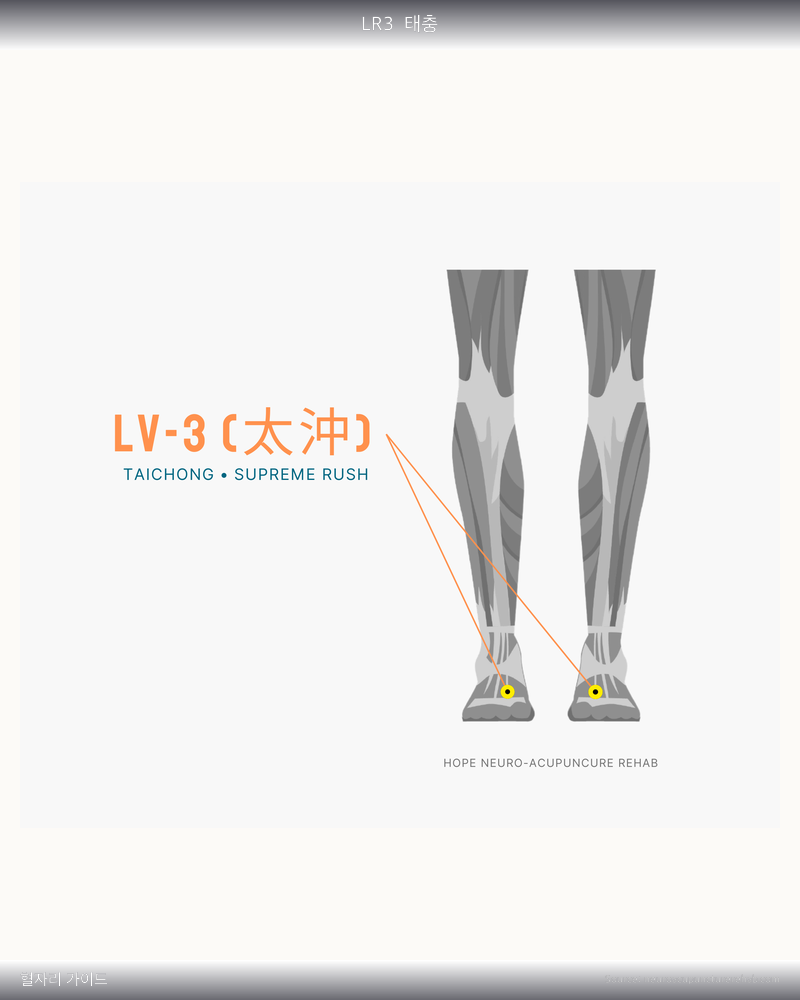
    4. Taichong (LR3) — Releases Anger and Stress

    Where Is It?

    Follow the groove between your big toe and second toe upward to where the bones meet.

    How to Press

    1. Press the hollow between the bones with your thumb
    2. Press for 5 seconds, release for 3 seconds, 10 times on each foot

    Benefits: Great for irritability, anger, and headaches. When pressed together with Hegu, this pair is called the ‘Four Gates.’

    5. Baihui (GV20) — Clears the Mind

    Where Is It?

    At the very top of your head — where the line connecting both ear tips crosses the line running up from your nose.

    How to Press

    1. Tap gently with your middle finger
    2. Tap rhythmically for 30 seconds, repeat 2-3 sets

    Benefits: Clears mental fog, improves focus, and relieves headaches and dizziness.

    Quick Comparison!

    Acupoint Location Best For Difficulty
    Hegu LI4 Hand webbing Headache + stress all-rounder Easy
    Shenmen HT7 Inner wrist Anxiety, better sleep Easy
    Neiguan PC6 3 fingers above wrist Nausea, palpitations Easy
    Taichong LR3 Top of foot, between toes Anger, irritability, headache Easy
    Baihui GV20 Top of head Focus, mental clarity Medium

    Synergy Combinations!

    • Hegu + Taichong: The ‘Four Gates’ combination. Unblocks energy circulation throughout the body.
    • Shenmen + Neiguan: Press both wrist points together to calm the heart.
    • Baihui + Shenmen: Simultaneously calms both the mind and spirit.

    Frequently Asked Questions

    Is it okay to press acupoints every day?

    Yes, pressing gently 2-3 times daily is safe. In fact, the more consistently you do it, the better the results.

    How hard should I press?

    Press until you feel a satisfying deep ache — not so hard that it hurts.

    Do acupressure effects appear immediately?

    Light stress can feel better right away. For chronic stress, try consistently for 2-3 weeks.

    When is the best time for stress acupressure?

    Before or after stressful situations, before bed, after lunch when you feel drowsy — anytime works.

    Can acupressure replace medication?

    Acupressure is a complementary therapy. For severe stress or anxiety disorders, please consult a professional.

    Pregnancy Warning: Among the acupoints in this article, Hegu (LI4) may cause stimulation in pregnant women. If you are pregnant or may be pregnant, please consult a professional before applying pressure.
    Medical Disclaimer: This article is for informational purposes only and does not replace professional medical diagnosis or treatment. If symptoms persist or worsen, please consult a healthcare professional.
  • 5-Minute Self-Acupressure Routine for Stress Relief

    5-Minute Self-Acupressure Routine for Stress Relief

    Quick Summary: A 5-minute self-acupressure routine for stress relief. Learn how to stimulate 5 acupoints — Hegu (LI4), Taichong (LR3), Shenmen (HT7), Baihui (GV20), and Neiguan (PC6) — step by step. An easy acupressure guide anyone can follow.
    LR3 혈자리 위치 그림

    5-Minute Self-Acupressure Routine for Stress Relief

    Who Is This For?

    • When work or study gives you a throbbing headache
    • When you feel irritable and can’t let go of frustration
    • When your shoulders and neck feel stiff and tense
    • When you can’t stop racing thoughts at bedtime
    • When you want to calm your nerves before an exam or interview

    Before You Start

    1. Find a comfortable position. Sit in a chair or on the floor.
    2. Rub your hands together to warm them up. Warm hands stimulate acupoints more effectively.
    3. Take 3 deep breaths. Inhale through your nose and exhale slowly through your mouth.

    Ready? Let’s get started!

    5-Minute Routine — Let’s Go!

    Spend 1 minute on each acupoint — 5 minutes total. Follow along slowly!

    Step 1 — Press Hegu (LI4) [0:00~1:00]

    LI4 acupuncture point

    Location: The webbing between your thumb and index finger

    Method: Press the webbing firmly with the opposite thumb. You’ve found the right spot when you feel a dull ache.

    Timing: Press firmly for 3-5 seconds → rest 3 seconds → repeat 5 times (about 1 minute)

    Effect: Releases tension and clears your mind.

    Step 2 — Press Taichong (LR3) [1:00~2:00]

    Location: Between the big toe and second toe, where the bones meet on top of the foot

    Method: Use your thumb to press between the bones, sliding toward the top of the foot.

    Timing: Press firmly for 3-5 seconds → rest 3 seconds → repeat 5 times (about 1 minute)

    Effect: Soothes liver energy to relieve anger and stress.

    Step 3 — Press Shenmen (HT7) [2:00~3:00]

    HT7 acupuncture point

    Location: On the inner wrist crease, in the hollow next to the tendon on the pinky side

    Method: Gently press the hollow area on the wrist crease with your opposite thumb.

    Timing: Press firmly for 3-5 seconds → rest 3 seconds → repeat 5 times (about 1 minute)

    Effect: Calms a racing heart and brings peace to your mind.

    Step 4 — Press Baihui (GV20) [3:00~4:00]

    Location: The very top center of the head (where a line connecting the ears meets the midline)

    Method: Stack your middle fingers and gently press the crown of your head. A warm sensation is a good sign.

    Timing: Press firmly for 3-5 seconds → rest 3 seconds → repeat 5 times (about 1 minute)

    Effect: Clears stagnant energy from the head and sharpens your mind.

    Step 5 — Press Neiguan (PC6) [4:00~5:00]

    PC6 acupuncture point

    Location: Three finger-widths above the inner wrist crease, toward the elbow

    Method: Press firmly between the two tendons on the inner wrist with your opposite thumb.

    Timing: Press firmly for 3-5 seconds → rest 3 seconds → repeat 5 times (about 1 minute)

    Effect: Relieves chest tightness and brings emotional comfort.

    Great job! Routine complete!

    Finish with 3 deep breaths. Can you feel your body getting lighter?

    Routine at a Glance

    Step Acupoint Location Time Effect
    1 Hegu (LI4) Webbing between thumb and index finger 0:00~1:00 Releases tension and clears the mind.
    2 Taichong (LR3) Between big toe and second toe where bones meet 1:00~2:00 Soothes liver energy to relieve anger and stress.
    3 Shenmen (HT7) Inner wrist crease, hollow next to pinky-side tendon 2:00~3:00 Calms a racing heart and brings peace of mind.
    4 Baihui (GV20) Top center of the head 3:00~4:00 Clears stagnant energy and sharpens the mind.
    5 Neiguan (PC6) Three finger-widths above inner wrist crease 4:00~5:00 Relieves chest tightness and brings emotional comfort.

    Pro Tips

    • Doing this before work or during lunch break can improve your afternoon focus.
    • Practicing 2-3 times daily can build your stress resilience.
    • Having caffeine 30 minutes after acupressure enhances the effect.
    • Combining deep breathing with acupressure doubles the benefits!

    Frequently Asked Questions

    Q. How many times a day should I do the stress acupressure routine?

    A. 2-3 times a day — morning, noon, and evening — is most effective. Especially try it right when you feel stressed.

    Q. Should it hurt when I press the acupoints?

    A. A dull ache with a “ah, that feels good” sensation is just right. Pressing too hard can tense the muscles, so keep it at a comfortable level.

    Q. Can I do this routine at the office?

    A. Of course! Hegu, Shenmen, and Neiguan are near your hands, so you can do them right at your desk. For Taichong (foot), briefly slip off your shoe, and for Baihui (crown), just lightly press.

    Q. Will I feel the effects of stress acupressure right away?

    A. Most people feel their shoulders lighten and their mind clear after just one session. With consistent practice for 2+ weeks, your overall stress management improves.

    Q. Is stress acupressure safe for pregnant women?

    A. Hegu (LI4) in this routine may cause strong stimulation for pregnant women. During pregnancy, consult a licensed practitioner before proceeding.

    Pregnancy Warning: Hegu (LI4) included in this routine may stimulate uterine contractions and is not recommended for pregnant women. During pregnancy, skip this acupoint or consult a licensed practitioner before proceeding.
    Medical Disclaimer: This article is for informational purposes only and does not replace professional medical diagnosis or treatment. If symptoms persist or worsen, please consult a healthcare professional.
  • 5 Acupoints for Headaches — Complete Self-Acupressure Guide

    5 Acupoints for Headaches — Complete Self-Acupressure Guide

    One-line summary: Headaches can be relieved by applying acupressure to 5 acupoints—Hegu, Baihui, Fengchi, Taichong, and Yifeng—for 5 minutes daily according to the cause. In particular, Hegu (LI4) is the most effective for all types of headaches.

    Why Manage Headaches with Acupressure Points

    Headaches are one of the most common symptoms experienced by modern people. They occur from various causes including stress, neck stiffness, sleep deprivation, and weather changes, and they represent not just a problem in the head itself but a signal of fatigue and imbalance throughout the body. In traditional medicine, headaches are understood as “disrupted circulation of qi and blood,” and specific acupoints are stimulated to correct this imbalance. Acupressure is a self-care method that can be performed anytime and anywhere without medication side effects, and it works by stimulating nerves and muscles to promote blood circulation and relieve muscle tension.

    5 Acupoints for Headache Relief

    1️⃣ Hegu (LI4)

    LI4 acupuncture point

    Location: The hollow between the thumb and index finger (on the back of the hand)

    Meridian: Large Intestine Meridian

    Mechanism of action: Hegu is known as the “cure-all for all headaches.” Located on the Large Intestine Meridian, which transmits nerve signals, it regulates nerve stimulation directed to the brain. It is effective for relieving nearly all types of headaches, including migraines, tension headaches, and headaches caused by colds.

    Acupressure technique: Using the thumb of the opposite hand, slowly press Hegu, maintaining stimulation at a slightly tender point for 5-10 seconds, and repeat 3 times. Massaging the wrist in counterclockwise circles is also beneficial.

    Effects: Immediate headache relief, stress relief, enhanced immunity

    2️⃣ Baihui (GV20)

    Location: The crown of the head (where the line connecting both ears intersects with the line drawn up from the bridge of the nose)

    Meridian: Governing Vessel

    Mechanism of action: The acupoint closest to the brain center that directly relieves tension in the crown area. It is particularly effective for pain in the vertex and headaches caused by brain fatigue, and also helps improve concentration and reduce anxiety.

    Acupressure technique: Place the middle and ring fingers of both hands overlapping on Baihui, press vertically downward for 5 seconds. Repeat 20 times with a gentle whole-head massage feeling.

    Effects: Vertex pain relief, brain fatigue relief, better sleep

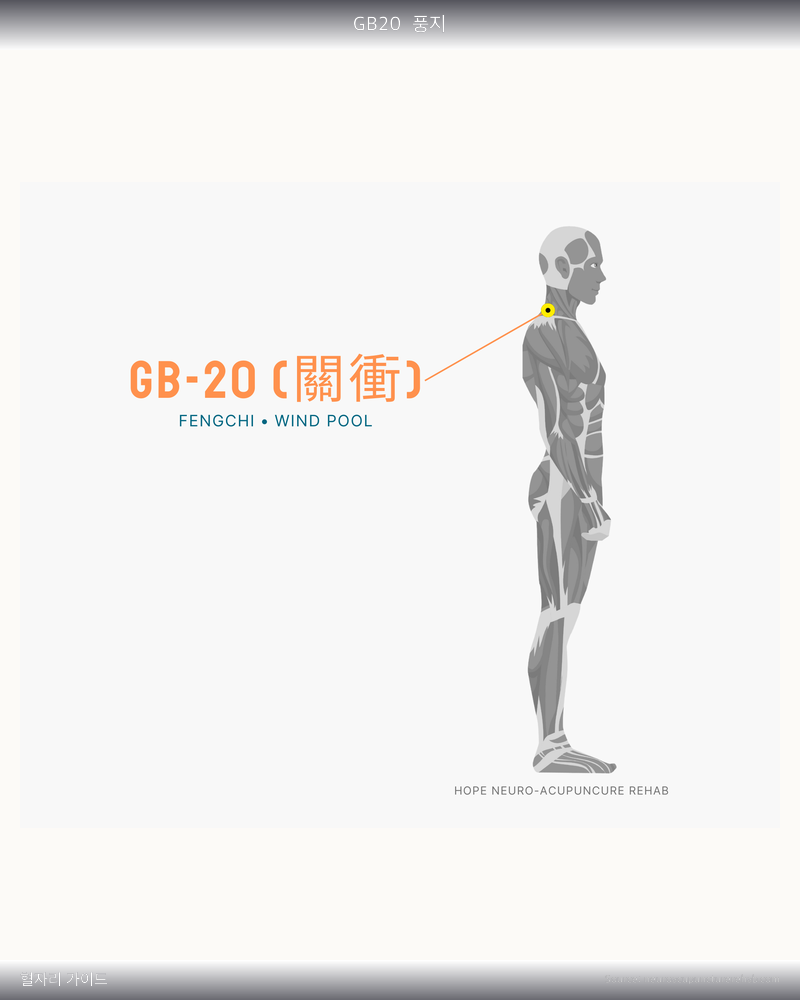
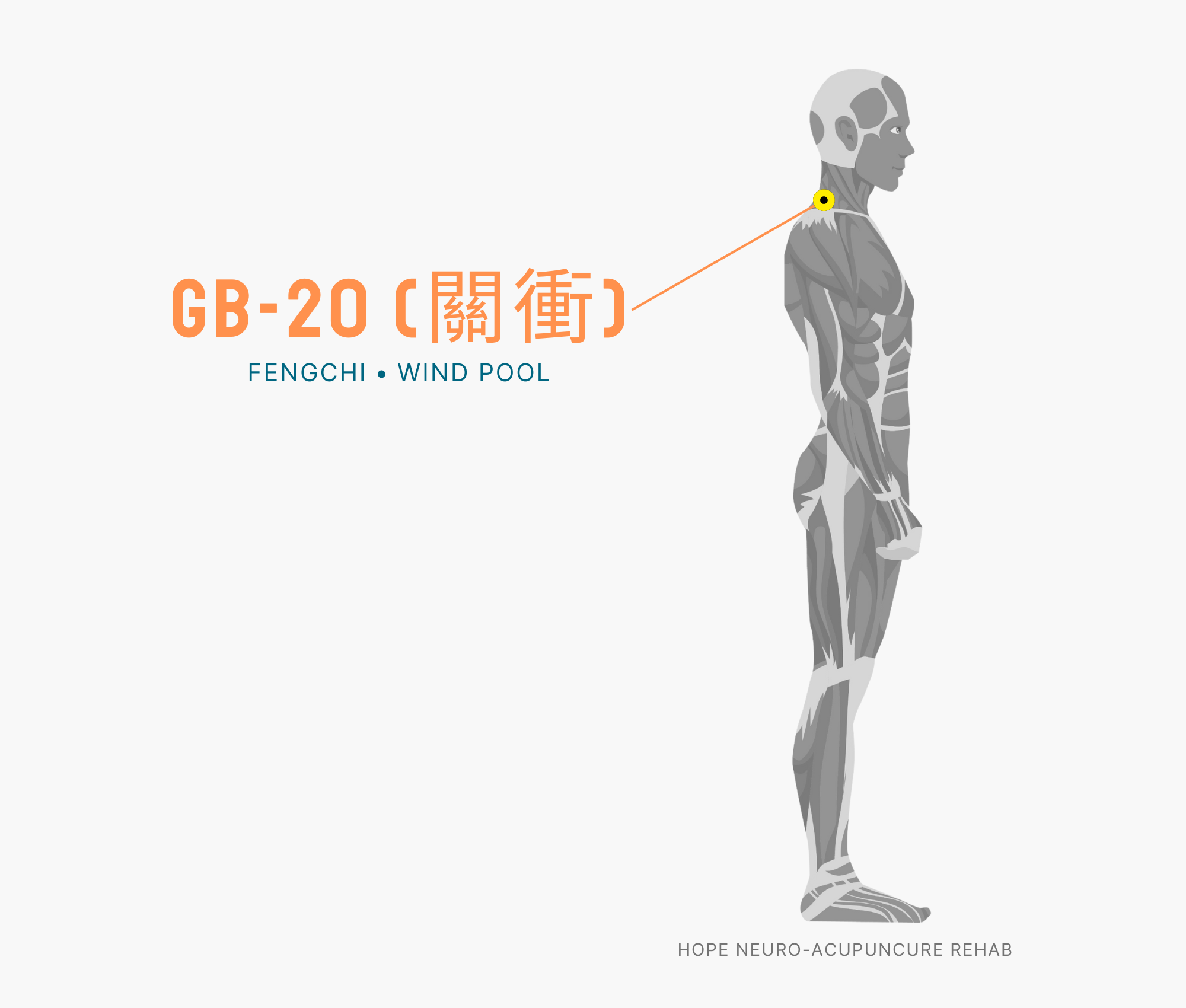
    3️⃣ Fengchi (GB20)

    GB20 acupuncture point

    Location: The hollow area on both sides of the cervical spine at the base of the skull below the occipital bone

    Meridian: Gallbladder Meridian

    Mechanism of action: Located at the junction of bone and muscle in the neck area, it is most effective for relieving headaches caused by neck stiffness and occipital tension. It helps prevent the forward neck posture and smartphone-induced neck tension common in modern people from developing into headaches.

    Acupressure technique: Use the thumbs of both hands to find Fengchi and press slowly, tilting the head slightly backward to add more stimulation. Repeat pressing for 5 seconds, 5 times, preferably starting with one side first.

    Effects: Neck stiffness and cervicogenic headache relief, stress-related headache relief, improved neck mobility

    4️⃣ Taichong (LR3)

    Location: Between the first and second toes on the dorsum of the foot (the hollow point where the bones meet)

    Meridian: Liver Meridian

    Mechanism of action: An acupoint that governs liver function and emotional stability, effective for relieving headaches and migraines caused by stress and anger. It promotes the liver’s detoxification function, helping the body eliminate toxins and fundamentally improving chronic headaches.

    Acupressure technique: Place your foot on your knee or on the ground, find Taichong with your thumb, and press slowly for 3 seconds. You can also massage between the toes in circular motions, and repeat 3 times daily.

    Effects: Stress-related and migraine relief, enhanced liver function, emotional stability

    5️⃣ Yifeng (TE17)

    TE17 acupuncture point

    Location: The hollow area below the earlobe behind the ear

    Meridian: Triple Energizer Meridian

    Mechanism of action: An area with concentrated nerves and blood vessels around the ear, specialized for relieving headaches in the temporal region and temples. Since the Triple Energizer Meridian governs metabolism and circulation throughout the body, stimulating Yifeng increases blood flow to the brain and fundamentally resolves the cause of headaches.

    Acupressure technique: Using the index and middle fingers, find the hollow area behind the ear and massage gently in circular motions. Avoid pressing too hard; apply gentle pressure for 1-2 minutes continuously.

    Effects: Migraine and temporal pain relief, relief of tension around the ear, improved cerebral blood flow

    5-Minute Self-Acupressure Routine

    Best times: After waking in the morning, during lunch, and before bed at night (3 times daily)

    1. [1 minute] Bilateral Hegu acupressure: 30 seconds each side, slow pressing
    2. [1 minute] Baihui acupressure: Vertical pressing with both middle fingers, repeat 20 times
    3. [1 minute] Bilateral Fengchi acupressure: 30 seconds each side, add stimulation by tilting head backward
    4. [1 minute] Bilateral Taichong acupressure: 30 seconds each foot, massage in circular motions
    5. [1 minute] Bilateral Yifeng acupressure: 30 seconds each side, gentle circular massage

    Additional tips: Washing your hands and feet with warm water before acupressure makes it easier to locate the acupoints. Adequate hydration after acupressure is also important.

    ⚠️ Medical Disclaimer: This article is written for informational purposes and does not replace professional medical diagnosis or treatment. If headaches persist or are severe, if you experience sudden severe headache, or if headaches are accompanied by other symptoms such as fever or stiffness, please consult with a healthcare professional. The effectiveness of acupoint acupressure may vary depending on individual health conditions.
    🤰 Pregnancy Warning: Among the acupoints above, Hegu (LI4) and Taichong (LR3) may cause uterine contractions in pregnant women. If you are pregnant or may be pregnant, consult with a professional before performing acupressure. Safe acupoints are Baihui (GV20), Fengchi (GB20), and Yifeng (TE17).
  • 5 Acupressure Points for Top 5 Acupoints for Shoulder Pain — Quick Self-Massage Guide

    5 Acupressure Points for Top 5 Acupoints for Shoulder Pain — Quick Self-Massage Guide

    Quick Summary: Top 5 acupoints for shoulder pain — learn the locations and self-acupressure techniques for Jianjing (GB21), Jianyu (LI15), Jianzhen (SI9), Jianliao (TE14), and Hegu (LI4).
    Quick Summary: When your shoulders are stiff and aching, press these 5 acupoints — Jianjing, Jianyu, Jianzhen (SI9), Jianliao, and Hegu — for 3-5 seconds each to relieve shoulder tension and pain.
    GB20 혈자리 위치 그림

    Shoulder Pain — A Modern Epidemic

    Sitting at a computer for long hours, looking down at your phone, or carrying a heavy bag — your shoulders turn hard as rock. Every time you rotate your shoulders, you hear a ‘crack,’ and just lifting your arm hurts. Acupressure can help loosen those stiff shoulders!

    1. Jianjing (GB21) — The Go-To Acupoint for Shoulder Pain

    Where Is It?

    At the highest point where the neck meets the shoulder. It’s the midpoint of a line drawn between the side of the neck and the tip of the shoulder.

    How to Press

    1. Press the top of the shoulder firmly with the middle finger of the opposite hand
    2. Hold 3-5 seconds → rest 3 seconds, repeat 10 times
    3. Tilting your head slightly to the opposite side while pressing feels even better

    Benefits: The most famous acupoint for shoulder tension and pain. You’ll immediately feel “yes, that’s the spot!”

    2. Jianyu (LI15) — Great for Front Shoulder Pain

    Where Is It?

    When you raise your arm to the side, find the hollow at the front of the shoulder. It’s the depression just in front of the shoulder bone tip.

    How to Press

    1. Press the hollow area with the opposite thumb
    2. Hold 5 seconds → rest 3 seconds, 10 times on each side
    3. Slightly raising and lowering your arm while pressing is more effective

    Benefits: Especially good for shoulders that hurt when lifting your arm. Helps smooth shoulder joint movement.

    3. Jianzhen (SI9) — Loosens Tension Behind the Shoulder

    Where Is It?

    Just above the fold behind the armpit. With your arm down, feel above the fold behind your armpit.

    How to Press

    1. Grip and press above the back of the armpit with the opposite hand
    2. Hold 3-5 seconds → rest 3 seconds, 10 times each side
    3. Slowly swing your arm back and forth while pressing

    Benefits: Releases tension behind the shoulder and between the shoulder blades. Great when your shoulders are so stiff you can’t reach behind your back.

    4. Jianliao (TE14) — Effective for Shoulder Tip Pain

    Where Is It?

    In the hollow behind the tip of the shoulder. Find the depression that forms at the back of the shoulder when you raise your arm to the side.

    How to Press

    1. Press the hollow behind the shoulder tip with the opposite thumb
    2. Hold 5 seconds → rest 3 seconds, 10 times each side
    3. Slowly raising and lowering your arm while pressing helps loosen the joint

    Benefits: Good for pain around the shoulder joint and difficulty lifting the arm. Combined with Jianyu (LI15), your entire shoulder feels more comfortable.

    5. Hegu (LI4) — A Convenient Pain Relief Point You Can Press Anywhere

    Where Is It?

    The webbing between the thumb and index finger. Find the fleshy mound when you spread the two fingers apart.

    How to Press

    1. Press Hegu firmly with the opposite thumb
    2. Hold 3-5 seconds → rest 3 seconds, repeat 10 times
    3. A dull ache with a refreshing sensation means you found the right spot

    Benefits: The Large Intestine meridian passes through the shoulder. Pressing Hegu sends energy through to the shoulder, reducing pain. Easy to do at the office too.

    Comparison at a Glance!

    Acupoint Location Best For Difficulty
    Jianjing GB21 Top of neck-shoulder Shoulder tension, general pain Easy
    Jianyu LI15 Front shoulder hollow Difficulty lifting arm Medium
    Jianzhen SI9 Above back of armpit Tension behind shoulder Medium
    Jianliao TE14 Behind shoulder tip Shoulder joint pain Medium
    Hegu LI4 Hand webbing Convenient pain relief Easy

    Synergy Combinations!

    • Jianjing (GB21) + Hegu: Releases the Large Intestine meridian line from shoulder to hand. Shoulder tension melts away.
    • Jianyu + Jianliao: Stimulates front and back of the shoulder simultaneously for smoother joint movement.
    • Jianjing (GB21) + Jianzhen (SI9): Working the top and bottom of the shoulder together makes the entire shoulder feel lighter.

    Frequently Asked Questions

    Can I do acupressure right away when my shoulders feel stiff?

    Yes, you can do it right away. However, lightly loosening the muscles first makes acupressure more effective.

    Does acupressure help with frozen shoulder?

    It can help with mild shoulder stiffness. However, frozen shoulder requires professional treatment, so combine it with medical care.

    Can I do acupressure while working at a computer?

    Yes! Hegu (LI4) can be pressed anytime easily. Pressing for 30 seconds every hour helps prevent shoulder tension.

    How often should I do shoulder acupressure?

    2-3 times a day, about 5-10 minutes each time is ideal. Especially do it right after long periods of sitting.

    Which is better, acupressure or stretching?

    Both are effective! Stretching loosens muscles, and acupressure stimulates acupoints — together they create synergy.

    Pregnancy Warning: Among the acupoints in this article, Jianjing (GB21) and Hegu (LI4) may cause stimulation for pregnant women. If you are pregnant or may be pregnant, please consult a professional before proceeding.
    Medical Disclaimer: This article is for informational purposes only and does not replace professional medical diagnosis or treatment. If symptoms persist or worsen, please consult a healthcare professional.