Author: Acupoint Guide Editorial Team

  • HT7 (Shenmen) vs PC6 (Neiguan): Which Pressure Point Is Right for You?

    HT7 (Shenmen) vs PC6 (Neiguan): Which Pressure Point Is Right for You?

    Summary: Comparing HT7 (Shenmen) and PC6 (Neiguan)! Learn their locations, benefits, and how to press them at a glance. Easily see which acupoint is better for anxiety and insomnia.
    One-line summary: HT7 (Shenmen) is located on the inner wrist on the pinky-finger side (at the wrist crease) and is good for insomnia and anxiety. PC6 (Neiguan) is located on the inner wrist, 3 finger-widths up from the wrist crease toward the elbow, and is good for nausea and anxiety. Choose the right one for the situation!

    Why Compare Shenmen and Neiguan?

    Both HT7 and PC6 are located on the inner wrist, close to each other, and both are said to bring peace of mind — which is confusing! HT7 is the ‘Gateway of the Heart,’ so it directly soothes the mind, while PC6 is the ‘Inner Gate,’ releasing the connection between body and mind. They share the same wrist, but their roles are quite different!

    HT7 (Shenmen) — The ‘Gateway of the Mind’ on the Inner Wrist at the Pinky-Finger Side

    HT7 is located on the inner wrist, on the pinky-finger side at the wrist crease. It belongs to the Heart meridian.

    How to Find It

    See the crease where your wrist bends? On that crease, find the hollow at the very end on the pinky-finger side. It’s just outside the tendon!

    How to Press It

    Press gently with the opposite thumb for 30 seconds to 1 minute at a time, repeated

    Best for

    • Insomnia
    • Anxiety
    • Stress
    • Heart palpitations

    PC6 (Neiguan) — The ‘Motion Sickness Buster’ on the Inner Wrist, 3 Finger-Widths Up from the Wrist Crease

    PC6 is located on the inner wrist, 3 finger-widths up from the wrist crease toward the elbow. It belongs to the Pericardium meridian.

    How to Find It

    Turn your palm face up, then place 3 fingers side by side starting from the wrist crease toward the elbow. The point at the tip of the third finger, between the two tendons, is PC6.

    How to Press It

    Press firmly with the opposite thumb, 1–2 minutes, with a slight tingling sensation

    Best for

    • Nausea
    • Anxiety
    • Insomnia
    • Motion sickness

    Side-by-Side Comparison!

    Category HT7 (Shenmen) PC6 (Neiguan)
    Location Inner wrist, pinky-finger side at wrist crease Inner wrist, 3 finger-widths up from wrist crease toward elbow
    Main benefits Insomnia, anxiety, stress, heart palpitations Nausea, anxiety, insomnia, motion sickness
    Ease of finding Easy Easy
    Meridian Heart meridian Pericardium meridian
    Nickname Gateway of the mind Motion sickness buster

    Which One Is Right for You?

    • “My thoughts won’t stop when I lie down to sleep” → Start with HT7! It gently calms the mind.
    • “My heart is racing and I feel anxious” → HT7! It is connected to the Heart meridian and calms palpitations.
    • “Stress makes me feel nauseous” → PC6! It tackles nausea and anxiety at the same time.
    • “I get sweaty palms and tension before exams” → Start with PC6! It’s great for releasing tension.
    • “I have chronic difficulty sleeping” → Both! Try pressing HT7 + PC6 together.

    Even Better When Used Together!

    Try this routine 30 minutes before bed: press HT7 for 1 minute → PC6 for 1 minute → 5 deep breaths. HT7 soothes the mind and PC6 releases body tension, making it much easier to prepare for sleep. Doing this as a daily habit will build up the effect over time!

    Frequently Asked Questions

    I get confused between HT7 and PC6 locations. How do I tell them apart?

    PC6 acupuncture point

    HT7 is on the wrist crease on the pinky-finger side. PC6 is 3 finger-widths up from the wrist crease toward the elbow, in the middle of the forearm. Their locations are completely different!

    Is acupressure really effective for insomnia?

    Many people feel the effect for mild insomnia. However, for severe insomnia, be sure to consult a specialist.

    Can pregnant women do this?

    Both HT7 and PC6 are relatively safe acupoints for pregnant women. PC6 in particular can also help relieve morning sickness!

    How much pressure should I apply?

    A slight aching or tingling sensation is sufficient. If it hurts, you are pressing too hard!

    Can I press it during the day instead of just before bed?

    Of course! Press it anytime you feel anxious or tense. It’s especially helpful before an exam or presentation.
    ⚠️ Medical Disclaimer: This article is for informational purposes only and does not replace professional medical diagnosis or treatment. If symptoms persist or worsen, please consult a healthcare professional.
  • Where Is Baihui (GV20)? Location, Benefits, and Technique

    Where Is Baihui (GV20)? Location, Benefits, and Technique

    Quick Summary: Baihui (GV20) acupoint location, benefits, and acupressure guide. Effective for headaches, dizziness, insomnia, low mood, and fatigue.
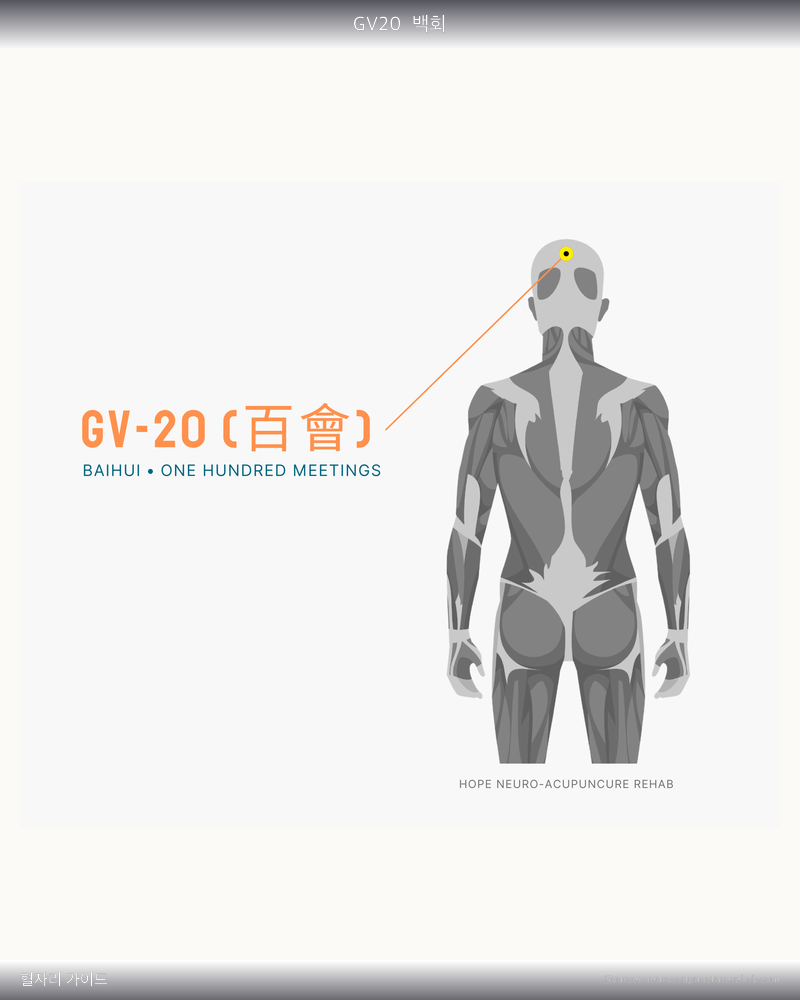
    Quick Summary: Baihui (GV20) is the ‘energy peak’ acupoint at the top of the head. As the convergence point for the body’s energy, it’s widely effective for headaches, dizziness, insomnia, and low mood. If you want a clear mind, start with Baihui!

    What Is Baihui?

    Baihui means ‘the place where a hundred (bai) energies converge (hui)’!

    Located at the very top of the crown, it’s the highest point where all yang energy in the body converges. It functions like the body’s antenna.

    It’s on the Governing Vessel (Du Mai), which runs up along the spine and over the top of the head. Baihui is at its peak.

    Since ancient times, it has been considered the most important acupoint for clearing the mind and lightening the head.

    How to Find Baihui

    It’s on the crown, so you need a little technique!

    1. Draw an imaginary line connecting the tops of both ears.
    2. Imagine a line going straight up from the tip of your nose to the crown.
    3. The exact intersection of these two lines is Baihui!
    4. Even easier: place your thumbs on the tops of your ears and extend your middle fingers upward — where they meet is the spot.
    5. If you feel a slight depression, you’ve found it!

    Tip: Sliding your fingers through your hair to press the scalp directly makes it more effective!

    Key Benefits of Baihui

    1. Relieves headaches — Especially effective for crown and frontal headaches
    2. Reduces dizziness — Improves blood flow to the brain
    3. Helps with insomnia — Cools an overheated mind to promote sleep
    4. Lifts low mood — Raises energy upward to brighten your spirits
    5. Improves concentration — Helps you focus on studying and work with a clear mind
    6. Relieves fatigue — Promotes whole-body energy circulation

    Self-Acupressure Technique for Baihui

    Preparation

    Sit comfortably and relax your shoulders.

    Step 1: Locate the Point

    Find the Baihui location with your middle finger. There’s a slight depression.

    Step 2: Press Gently

    • Press with middle finger (or index + middle) for 3-5 seconds
    • Release for 2 seconds
    • Repeat 15-20 times

    Step 3: Tapping

    • Lightly tap around Baihui with your fingertips
    • Continue rhythmically for 30 seconds to 1 minute

    Step 4: Finishing

    Place your palm over Baihui and feel the warm energy. 30 seconds is enough.

    2-3 times daily, especially in the morning for a fresh start to the day!

    Great Acupoint Combinations

    Combination Effect Best For
    Baihui + Fengchi (GB20) Crown + back-of-head headache relief When your whole head feels heavy and achy
    Baihui + Shenmen (HT7) Mental calm + sleep improvement Can’t sleep due to racing thoughts
    Baihui + Zusanli (ST36) Upper-lower energy circulation Heavy head and heavy legs

    Precautions

    • Don’t press the crown too hard — the scalp is sensitive
    • Never press on infants whose fontanelle hasn’t closed
    • Avoid if there are wounds on the head
    • If you have severe high blood pressure, use only gentle pressure
    • If headache suddenly worsens, stop acupressure and see a doctor

    Frequently Asked Questions

    Does pressing Baihui really clear the mind?

    Yes! Many people feel their mind becoming clearer as blood flow to the brain improves.

    I can’t find the location because of my hair

    Slide your fingers through your hair to feel the scalp directly. You’ll feel a slight depression!

    Is it okay to do this every day?

    Absolutely! Doing it for 1-2 minutes every morning is also great for headache prevention.

    I feel drowsy after pressing it. Is that normal?

    Yes, that’s normal! It’s a natural response as tension releases. That’s why it’s great for insomnia.

    Can I press my child’s head too?

    Only after the fontanelle has fully closed (after age 2), and use very gentle pressure only!

    Medical Disclaimer: This article is for informational purposes only and does not replace professional medical diagnosis or treatment. If symptoms persist or worsen, please consult a healthcare professional.
  • Jianjing (GB21) vs Fengchi (GB20): Which Pressure Point Is Right for You?

    Jianjing (GB21) vs Fengchi (GB20): Which Pressure Point Is Right for You?

    Quick Summary: Jianjing (GB21) vs Fengchi (GB20) comparison! See the locations, benefits, and techniques at a glance. Find out which acupoint is better for neck or shoulder pain.
    Quick Summary: Jianjing (GB21) is on the top of the shoulder (midway between the neck and shoulder tip) and is great for shoulder stiffness and neck pain. Fengchi (GB20) is in the hollows at the base of the skull and is great for headaches and stiff neck. Choose based on your situation!

    Why Compare Jianjing and Fengchi?

    Jianjing (GB21) and Fengchi (GB20) are neighboring acupoints on the same Gallbladder meridian. Jianjing sits on top of the shoulder releasing shoulder tension, while Fengchi sits at the base of the skull releasing neck tension. Both are essential for modern people who use computers and smartphones frequently! Your choice depends on whether the problem is more in the shoulders or the neck.

    Jianjing (GB21) — The ‘Shoulder Liberator’ at the Top of the Shoulder

    Jianjing is located on the top of the shoulder (midway between the neck and shoulder tip). It belongs to the Gallbladder meridian.

    How to find it

    Tilt your head forward and you’ll feel a bone protruding at the back of the neck. The exact midpoint between that bone (C7 vertebra) and the tip of the shoulder (acromion) is Jianjing. The highest point of the shoulder!

    How to press

    Grip the shoulder with the opposite hand and press firmly with your middle finger or thumb, 1-2 minutes

    Best for

    • Shoulder stiffness
    • Neck pain
    • Headaches
    • Stress

    Fengchi (GB20) — The ‘Back-of-Head Guardian’ at the Base of the Skull

    Fengchi is located in the hollow depressions at the base of the skull (both sides of the back of the neck). It belongs to the Gallbladder meridian.

    How to find it

    There are two large muscles at the back of the head. On the outer side of these muscles, under the skull bone, you’ll find hollow depressions. Press upward with both thumbs.

    How to press

    Press upward toward the head with both thumbs, 1-2 minutes

    Best for

    • Headaches
    • Stiff neck
    • Dizziness
    • Eye fatigue

    Quick Comparison!

    Category Jianjing (GB21) Fengchi (GB20)
    Location Top of shoulder (between neck and shoulder tip) Hollows at base of skull (both sides of neck)
    Key Benefits Shoulder stiffness, neck pain, headaches, stress Headaches, stiff neck, dizziness, eye fatigue
    Finding Difficulty Medium Medium
    Meridian Gallbladder meridian Gallbladder meridian
    Nickname Shoulder Liberator Back-of-Head Guardian

    Which Acupoint Is Right for Me?

    • “My shoulders are hard as rock” — Jianjing first! It directly loosens shoulder muscles.
    • “I can’t turn my neck” — Fengchi first! It releases the muscles at the back of the neck.
    • “Long computer sessions make my neck and shoulders both hurt” — Both! Try Jianjing then Fengchi in sequence.
    • “My shoulders tense up when I’m stressed” — Jianjing! It brings down tension-raised shoulders.
    • “My headache seems to start from the neck” — Fengchi! It tackles headaches caused by neck tension.

    Pressing Both Together Is Even Better!

    Try pressing Jianjing (shoulder) then Fengchi (base of skull) in sequence. Release the shoulder knots first, then move up to the neck to open up the energy flow. Since they’re on the same Gallbladder meridian line, the synergy is excellent! Doing this routine every 2 hours at the office also helps prevent turtle neck posture.

    Frequently Asked Questions

    Jianjing and Fengchi are both on the same meridian (Gallbladder). What’s the difference?

    They’re on the same meridian but have different locations and roles. Jianjing works directly on the shoulder muscles, while Fengchi works on the neck-head junction. Think of them as different stops on the same road!

    It really hurts when I press Jianjing. Is that okay?

    If your shoulders are very tense, it can hurt at first. Don’t press too hard — start gently and gradually increase the pressure.

    Can pregnant women do this?

    Jianjing is an acupoint that pregnant women should avoid! Fengchi is relatively safe, but during pregnancy, use only light pressure.

    I’m at the computer all day. Can I do this preventively?

    Absolutely! Pressing Jianjing and Fengchi once every 2 hours is great for preventing neck and shoulder pain.

    Can I use a massage gun?

    Jianjing is fine with a massage gun. Fengchi is near the skull, so using your fingers directly is safer and more effective.

    Pregnancy Warning: Jianjing (GB21) is an acupoint that pregnant women should avoid. If you are pregnant or may be pregnant, please do not press this point.
    Medical Disclaimer: This article is for informational purposes only and does not replace professional medical diagnosis or treatment. If symptoms persist or worsen, please consult a healthcare professional.