Author: Acupoint Guide Editorial Team

  • Fatigue Recovery Self-Acupressure Routine 5 Minutes

    Fatigue Recovery Self-Acupressure Routine 5 Minutes

    Summary: A 5-minute self-acupressure routine for fatigue relief. Learn how to stimulate 5 acupoints in order: ST36, SP6, CV6, GV20, and KI3. An easy acupressure guide anyone can follow without photos.
    ST36 혈자리 위치 그림

    🎯 Fatigue Recovery Self-Acupressure Routine 5 Minutes

    🙋 Recommended For You If…

    • Chronic fatigue makes it hard to get up in the morning
    • You feel your energy drain away as the afternoon arrives
    • Coffee no longer fights off drowsiness
    • Your body seems slow to recover after exercise
    • Your stamina is depleted during exam periods or late-night work shifts

    🧘 Before You Begin

    1. Find a comfortable position. You can sit on a chair or comfortably on the floor.
    2. Rub your hands together to warm them up. Warm hands stimulate acupoints more effectively.
    3. Take 3 deep breaths in and out. Inhale through your nose and exhale slowly through your mouth.

    Ready? Let’s get started! 💪

    ⏱️ Start the 5-Minute Routine!

    Spend 1 minute on each acupoint — 5 minutes total. Follow along slowly!

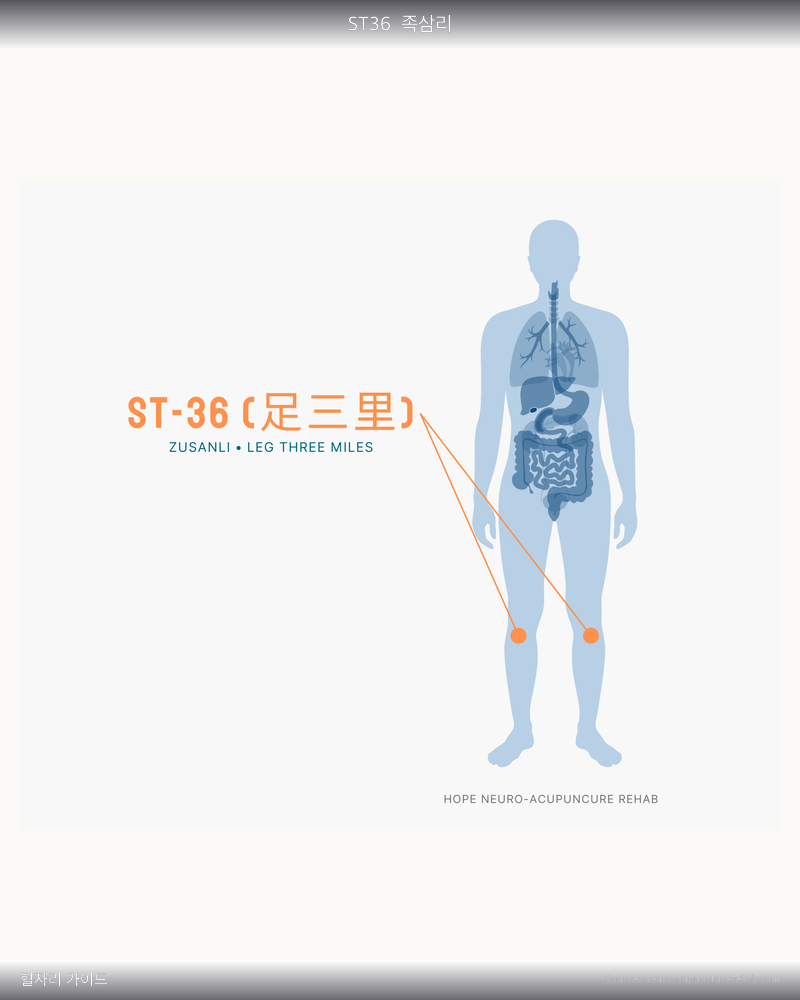
    Step 1 — Press ST36 (Zusanli) [0:00~1:00]

    ST36 acupuncture point

    📍 Location: 4 finger-widths below the knee, on the outer side

    👆 Method: Use your thumb to press firmly on the outer side of the shinbone. A heavy, full sensation means you’ve found the right spot.

    ⏱️ Time: Press firmly for 3–5 seconds → Rest for 3 seconds → Repeat 5 times (about 1 minute)

    ✨ Effect: The all-purpose point! Simultaneously boosts digestion and physical stamina.

    Step 2 — Press SP6 (Sanyinjiao) [1:00~2:00]
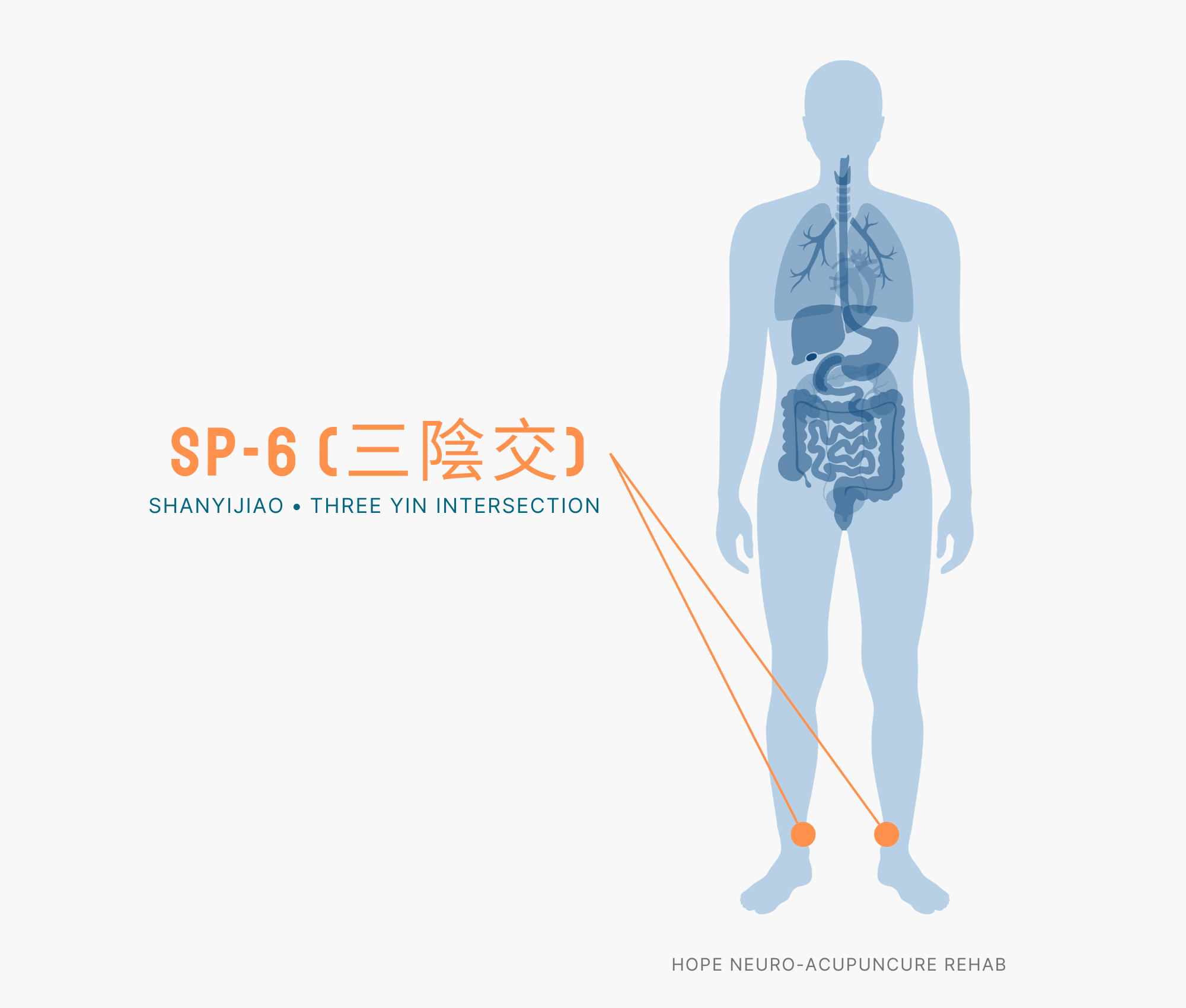
    SP6 acupuncture point

    📍 Location: 4 finger-widths above the inner ankle bone

    👆 Method: Use the opposite thumb to press the inner side of the shin, pushing upward along the bone.

    ⏱️ Time: Press firmly for 3–5 seconds → Rest for 3 seconds → Repeat 5 times (about 1 minute)

    ✨ Effect: Stimulates three meridians at once to help generate Qi and blood.

    Step 3 — Press CV6 (Qihai) [2:00~3:00]

    📍 Location: 2 finger-widths below the navel

    👆 Method: Overlap both hands and place them below the navel, pressing gently. It is good when it feels warm.

    ⏱️ Time: Press firmly for 3–5 seconds → Rest for 3 seconds → Repeat 5 times (about 1 minute)

    ✨ Effect: The “Sea of Qi”! Restores vitality and recharges energy.

    Step 4 — Press GV20 (Baihui) [3:00~4:00]

    📍 Location: The center of the top of the head (the highest point on the line connecting both ears)

    👆 Method: Overlap the middle fingers of both hands and lightly press the crown of the head. A warm sensation is a good sign.

    ⏱️ Time: Press firmly for 3–5 seconds → Rest for 3 seconds → Repeat 5 times (about 1 minute)

    ✨ Effect: Raises yang energy to clear the head and restore vitality.

    Step 5 — Press KI3 (Taixi) [4:00~5:00]
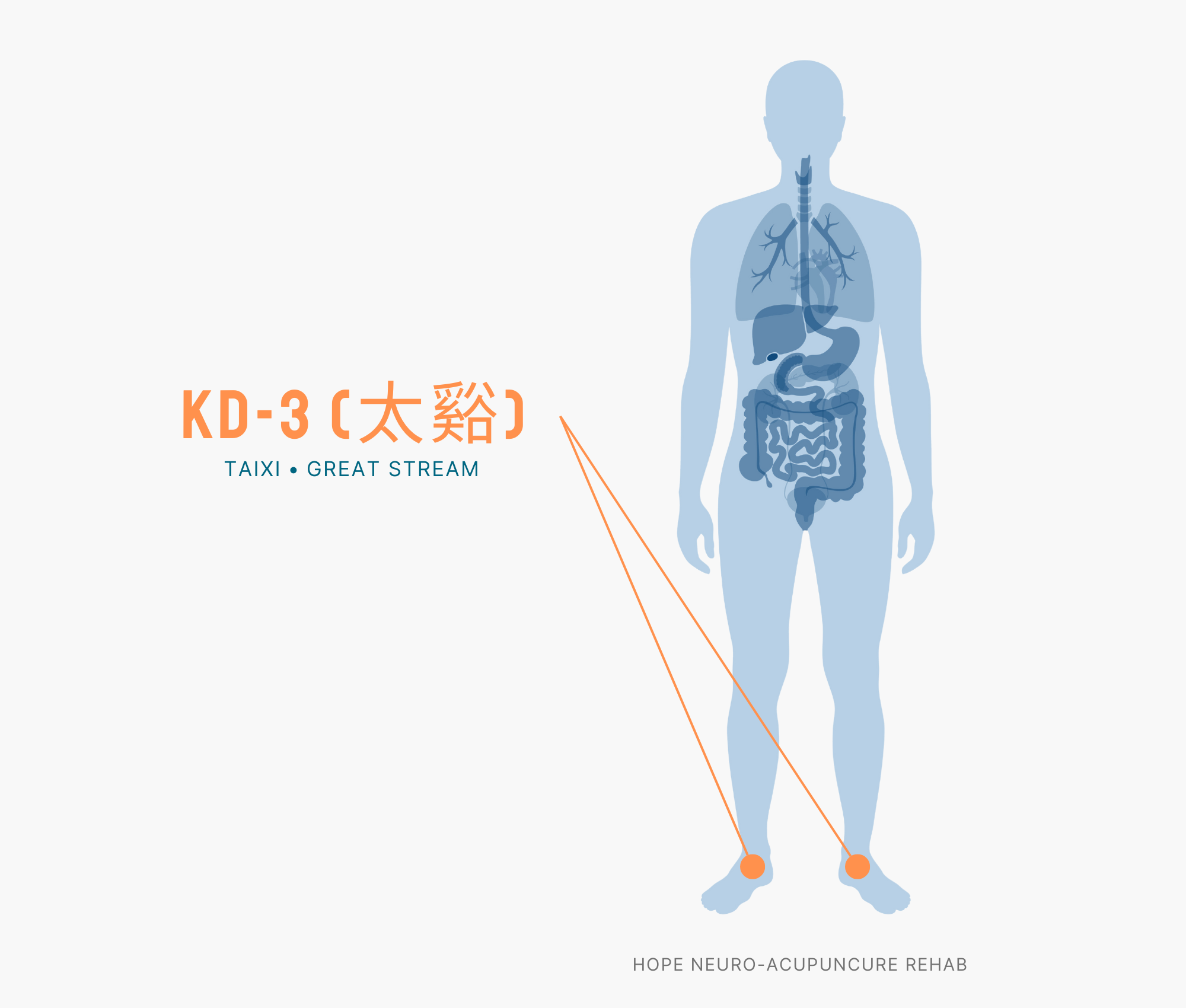
    KI3 acupuncture point

    📍 Location: Between the inner ankle bone and the Achilles tendon

    👆 Method: Use the opposite thumb to press into the hollow between the inner ankle bone and the Achilles tendon.

    ⏱️ Time: Press firmly for 3–5 seconds → Rest for 3 seconds → Repeat 5 times (about 1 minute)

    ✨ Effect: Replenishes kidney energy to address deep-seated fatigue.

    🎉 Great job! Routine complete!

    Finish with 3 deep breaths. Do you feel lighter?

    📋 Quick-Reference Routine Chart

    Step Acupoint Location Time Effect
    1 ST36 (Zusanli) 4 finger-widths below the knee, on the outer side 0:00~1:00 The all-purpose point! Simultaneously boosts digestion and physical stamina.
    2 SP6 (Sanyinjiao) 4 finger-widths above the inner ankle bone 1:00~2:00 Stimulates three meridians at once to help generate Qi and blood.
    3 CV6 (Qihai) 2 finger-widths below the navel 2:00~3:00 The “Sea of Qi”! Restores vitality and recharges energy.
    4 GV20 (Baihui) Center of the top of the head (highest point on the line connecting both ears) 3:00~4:00 Raises yang energy to clear the head and restore vitality.
    5 KI3 (Taixi) Between the inner ankle bone and the Achilles tendon 4:00~5:00 Replenishes kidney energy to address deep-seated fatigue.

    🍯 Tips

    • Doing it after waking up in the morning and during the sluggish afternoon hours (2–4 pm) is most effective.
    • Practicing consistently 5 or more times per week, you will notice your baseline energy levels rising.
    • Combine acupressure with 7+ hours of sleep per night and a balanced diet.
    • ST36 is called the “all-purpose point” for a reason — press it whenever you get the chance!

    ❓ Frequently Asked Questions

    Q. Does acupressure really help with chronic fatigue?

    A. In Traditional Chinese Medicine, fatigue is a state of Qi deficiency. Stimulating ST36 and CV6 replenishes Qi and helps with fatigue recovery. Try it consistently for at least 2 weeks.

    Q. Can acupressure replace energy drinks?

    A. It doesn’t provide the sudden alertness of caffeine, but with consistent practice your baseline stamina improves. You’ll be able to maintain a clear mind without caffeine.

    Q. Can I do this before and after exercise?

    A. Doing it before exercise helps warm up the body, and doing it after helps speed up recovery. ST36 and KI3 are especially good for muscle recovery.

    Q. Should I see a doctor if my fatigue is very severe?

    A. If extreme fatigue persists for more than 2 weeks, it may be worth checking for thyroid function or anemia. Use acupressure as a supplement and seek professional care.

    Q. Should pregnant women avoid SP6 (Sanyinjiao)?

    A. Yes, SP6 can stimulate the uterus, so pregnant women should skip this point and do only the remaining 4 acupoints.

    ⚠️ Pregnancy Warning: Pregnant women should avoid pressing this acupoint as it may stimulate uterine contractions.
    ⚠️ Medical Disclaimer: This article is for informational purposes only and does not replace professional medical diagnosis or treatment. If symptoms persist or worsen, please consult a healthcare professional.
  • Back Pain Self-Acupressure Routine 5 Minutes

    Back Pain Self-Acupressure Routine 5 Minutes

    Summary: A 5-minute self-acupressure routine for back pain relief. Learn how to stimulate 5 acupoints in order: BL23, BL40, GV4, BL25, and KI3. An easy acupressure guide anyone can follow without photos.
    ST36 혈자리 위치 그림

    🎯 Back Pain Self-Acupressure Routine 5 Minutes

    • ⏱️ Duration: 5 minutes
    • 📍 Number of acupoints: 5
    • 🔄 Order: BL23 (Shenshu) → BL40 (Weizhong) → GV4 (Mingmen) → BL25 (Dachangshu) → KI3 (Taixi)
    • 💡 Benefits: Back pain relief and improvement

    🙋 Recommended For You If…

    • Your back is stiff after sitting for long periods
    • Your back feels sore and tight when you wake up in the morning
    • Your back aches after driving for a long time
    • Your back feels fatigued after carrying heavy loads
    • Your back feels cold and chilly

    🧘 Before You Begin

    1. Find a comfortable position. You can sit on a chair or comfortably on the floor.
    2. Rub your hands together to warm them up. Warm hands stimulate acupoints more effectively.
    3. Take 3 deep breaths in and out. Inhale through your nose and exhale slowly through your mouth.

    Ready? Let’s get started! 💪

    ⏱️ Start the 5-Minute Routine!

    Spend 1 minute on each acupoint — 5 minutes total. Follow along slowly!

    Step 1 — Press BL23 (Shenshu) [0:00~1:00]

    BL23 acupuncture point

    📍 Location: Between the 2nd and 3rd lumbar vertebrae, 2 finger-widths on either side of the spine

    👆 Method: Place both fists against both sides of your lower back and rub up and down. Keep going until it feels warm!

    ⏱️ Time: Press firmly for 3–5 seconds → Rest for 3 seconds → Repeat 5 times (about 1 minute)

    ✨ Effect: Strengthens kidney energy to address the root cause of back pain.

    Step 2 — Press BL40 (Weizhong) [1:00~2:00]

    BL40 acupuncture point

    📍 Location: The center of the back of the knee crease

    👆 Method: Sit in a chair with your knee slightly bent, and press the center of the knee crease with the middle fingers of both hands.

    ⏱️ Time: Press firmly for 3–5 seconds → Rest for 3 seconds → Repeat 5 times (about 1 minute)

    ✨ Effect: Relieves pain that radiates from the back down to the legs.

    Step 3 — Press GV4 (Mingmen) [2:00~3:00]

    📍 Location: On the spine at the level of the navel (on the back)

    👆 Method: Overlap both hands and place them on the spine at the back, then rub in circular motions.

    ⏱️ Time: Press firmly for 3–5 seconds → Rest for 3 seconds → Repeat 5 times (about 1 minute)

    ✨ Effect: Replenishes yang energy in the lower back, warming a cold, aching back.

    Step 4 — Press BL25 (Dachangshu) [3:00~4:00]

    BL25 acupuncture point

    📍 Location: Between the 4th and 5th lumbar vertebrae, 2 finger-widths on either side

    👆 Method: Place both thumbs on the upper part of the pelvis at the lower back and press firmly.

    ⏱️ Time: Press firmly for 3–5 seconds → Rest for 3 seconds → Repeat 5 times (about 1 minute)

    ✨ Effect: Directly relieves lower back pain and stiffness.

    Step 5 — Press KI3 (Taixi) [4:00~5:00]

    KI3 acupuncture point

    📍 Location: Between the inner ankle bone and the Achilles tendon

    👆 Method: Use the opposite thumb to press into the hollow between the inner ankle bone and the Achilles tendon.

    ⏱️ Time: Press firmly for 3–5 seconds → Rest for 3 seconds → Repeat 5 times (about 1 minute)

    ✨ Effect: Nourishes kidney energy to build foundational stamina for the back.

    🎉 Great job! Routine complete!

    Finish with 3 deep breaths. Do you feel lighter?

    📋 Quick-Reference Routine Chart

    Step Acupoint Location Time Effect
    1 BL23 (Shenshu) Between the 2nd and 3rd lumbar vertebrae, 2 finger-widths on either side of the spine 0:00~1:00 Strengthens kidney energy to address the root cause of back pain.
    2 BL40 (Weizhong) The center of the back of the knee crease 1:00~2:00 Relieves pain that radiates from the back down to the legs.
    3 GV4 (Mingmen) On the spine at the level of the navel (on the back) 2:00~3:00 Replenishes yang energy in the lower back, warming a cold, aching back.
    4 BL25 (Dachangshu) Between the 4th and 5th lumbar vertebrae, 2 finger-widths on either side 3:00~4:00 Directly relieves lower back pain and stiffness.
    5 KI3 (Taixi) Between the inner ankle bone and the Achilles tendon 4:00~5:00 Nourishes kidney energy to build foundational stamina for the back.

    🍯 Tips

    • Doing it right after waking up in the morning and before bed is most effective.
    • Warming your lower back with a warm towel before acupressure makes it even more effective.
    • For acute back pain (e.g., a sudden strain), do not push through — visit a doctor first.
    • Combining acupressure with gentle back stretches afterward creates a synergistic effect.

    ❓ Frequently Asked Questions

    Q. Can people with a herniated disc do this acupressure routine?

    A. It may help with mild disc symptoms, but if you have leg numbness or severe pain, please see an orthopedic specialist or traditional medicine practitioner first.

    Q. Can I do back acupressure on my own?

    A. Yes! BL23 and BL25 can easily be done alone by rubbing with your fists. BL40 and KI3 can be comfortably reached in a seated position.

    Q. Can I use a tennis ball?

    A. That’s a great idea! Lying on the floor with a tennis ball placed under your lower back is an effective way to stimulate BL23 and BL25.

    Q. How often should I do back acupressure?

    A. For chronic back pain, try doing it 2–3 times a day for at least 2 weeks. You will gradually feel the pain diminishing.

    Q. Is it okay to exercise after back acupressure?

    A. Light stretching or walking is fine. However, for high-intensity exercise such as heavy weightlifting, it is safer to wait at least 30 minutes after acupressure.

    ⚠️ Medical Disclaimer: This article is for informational purposes only and does not replace professional medical diagnosis or treatment. If symptoms persist or worsen, please consult a healthcare professional.
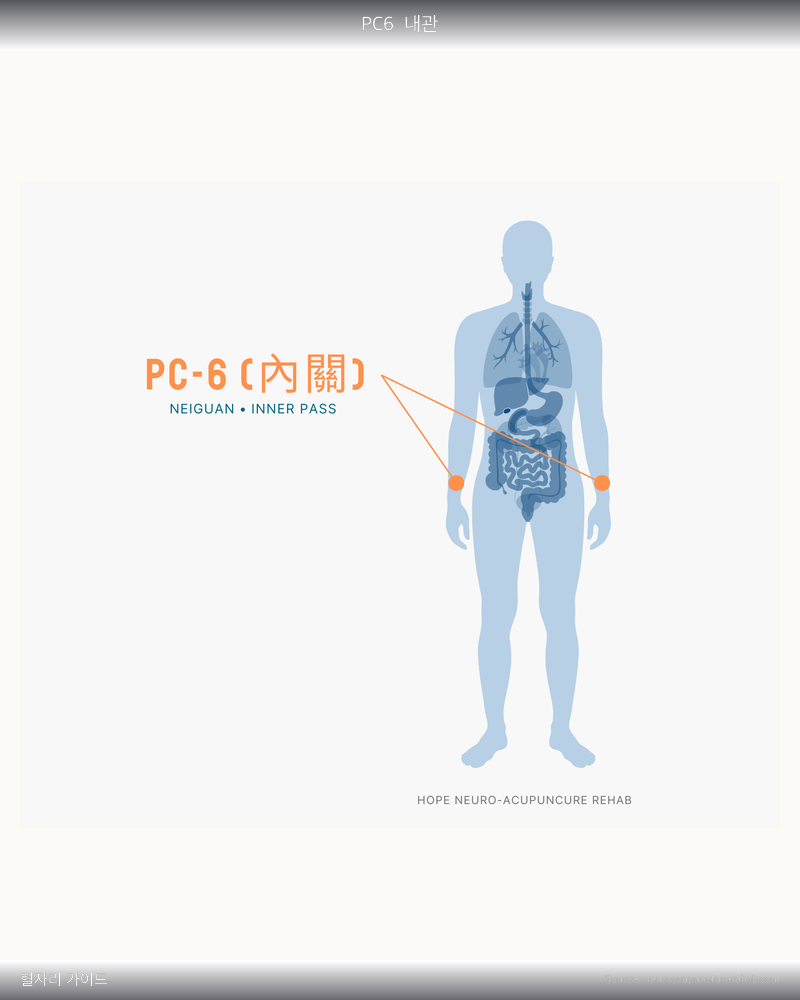
  • Neiguan (PC6) Acupressure Point — Complete Guide

    Neiguan (PC6) Acupressure Point — Complete Guide

    Quick Summary: Complete guide to Neiguan (PC6) acupoint: location, benefits, and acupressure techniques. An effective wrist acupoint for nausea, motion sickness, insomnia, and anxiety. A must-know before flying or driving!
    Quick Summary: Neiguan (PC6) is the ‘anti-nausea’ acupoint on the inner wrist. It’s the best for dealing with nausea, queasiness, and chest tightness. A great acupoint to remember before traveling!

    What Is Neiguan?

    Neiguan means ‘inner gate’!

    It’s an acupoint on the Pericardium meridian that serves as an important link between the chest and stomach. Think of it as a brake that stops queasiness.

    It’s one of the most studied acupoints even in Western research. Anti-nausea wristbands actually work by pressing this exact Neiguan location!

    Beyond nausea, it’s also good for anxiety, palpitations, and insomnia — a truly multi-talented acupoint.

    How to Find Neiguan

    Easy to find on the wrist!

    1. Turn your palm face up and look at your wrist.
    2. Find the wrist crease. Bending your wrist makes the crease more visible.
    3. Place 3 fingers side by side from the crease toward the elbow.
    4. Where your third finger ends, between the two tendons — that’s Neiguan!
    5. Make a fist and you’ll see two tendon lines. It’s right in the center between them.

    Tip: When you press firmly, if you feel a tingling sensation spreading through the inner arm, you’ve found the right spot!

    Key Benefits of Neiguan

    1. Stops nausea — Best for motion sickness, morning sickness, and queasiness
    2. Calms palpitations — Steadies a racing heart
    3. Helps with insomnia — Brings peace of mind for easier sleep
    4. Reduces anxiety — Effective when nervous or restless
    5. Relieves stress — Refreshing when your chest feels tight
    6. Aids digestion — Supports stomach function

    Self-Acupressure Technique for Neiguan

    Preparation

    Sit comfortably with your palm facing up.

    Step 1: Find the Exact Location

    Place the opposite thumb on the Neiguan location.

    Step 2: Press Firmly

    • Press with your thumb for 5 seconds
    • Release for 3 seconds
    • Repeat 10–15 times

    Step 3: Rub Gently

    • Press your thumb and rub up and down
    • Gently for 30 seconds to 1 minute

    Step 4: Do Both Wrists

    Do both wrists. 2–3 times daily is sufficient.

    In a rush: If you feel motion sickness coming on, press even just one wrist right away!

    Acupoints That Pair Well with Neiguan

    Combination Effect Best For
    Neiguan + Zusanli (ST36) Anti-nausea + improved digestion When nauseous and food won’t digest
    Neiguan + Shenmen (HT7) Heart stabilization + anxiety relief When nervous with racing heart
    Neiguan + Hapgok (LI4) Full-body relaxation + pain relief When you have a headache and upset stomach

    Precautions

    • If you have weak wrists, press gently
    • Consult a doctor first if you have carpal tunnel syndrome
    • Don’t press for too long — 2–3 minutes is enough
    • Pressing too hard when it doesn’t seem to work can cause bruising

    Frequently Asked Questions

    Is Neiguan only good for motion sickness?

    Not at all! Besides motion sickness, it’s also great for anxiety, insomnia, and chest tightness. It’s a truly versatile acupoint!

    Do anti-nausea wristbands actually work?

    They work on the principle of pressing Neiguan, so they do help to some degree. However, pressing directly with your thumb is more accurate and effective!

    Is it safe for morning sickness during pregnancy?

    Yes! Neiguan is safe for pregnant women. Try pressing it gently when morning sickness is severe.

    Can I press it before getting on a plane?

    Absolutely! Pressing it starting 30 minutes before boarding has a preventive effect.

    Can children do this too?

    Yes, children can do it too. Just use softer, shorter pressure than for adults — about 30 seconds to 1 minute.

    Medical Disclaimer: This article is for informational purposes only and does not replace professional medical diagnosis or treatment. If symptoms persist or worsen, please consult a healthcare professional.
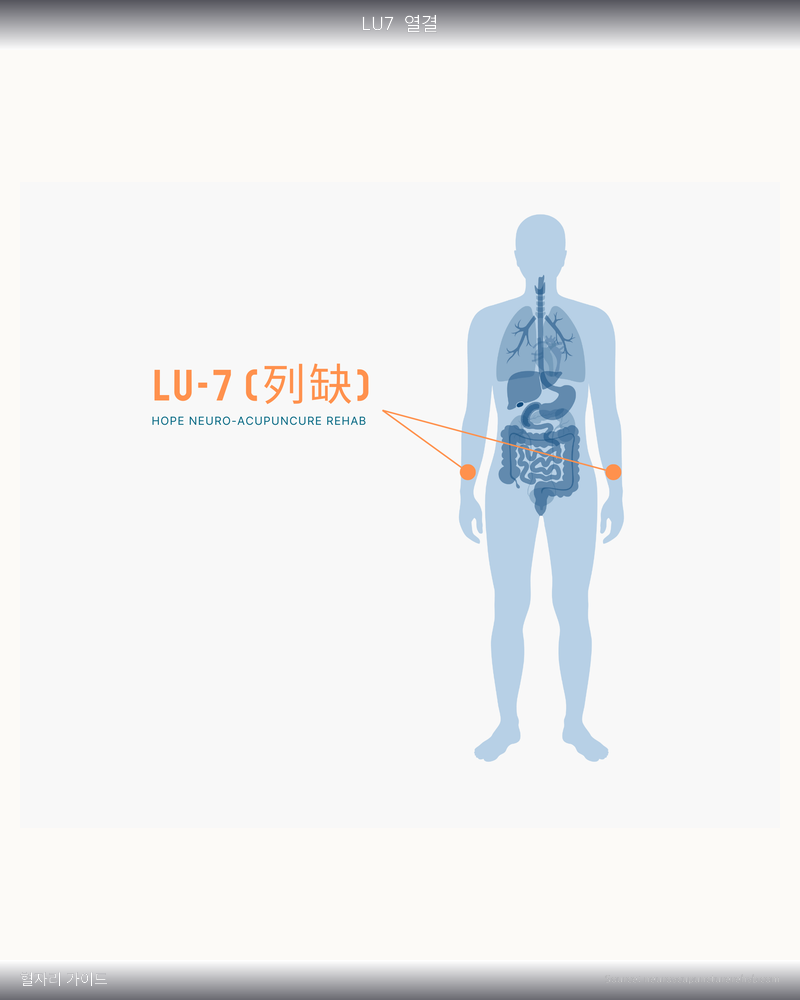
  • Where Is Lieque (LU7)? Location, Benefits, and Technique

    Where Is Lieque (LU7)? Location, Benefits, and Technique

    Quick Summary: Complete guide to Lieque (LU7) acupoint: location, benefits, and acupressure techniques. An effective Lung meridian acupoint for coughs, colds, headaches, sore throat, and asthma.
    Quick Summary: Lieque (LU7) is a ‘respiratory guardian’ acupoint located above the wrist on the thumb side. It’s exceptionally effective for coughs, colds, and sore throats. A must-know acupoint if you catch colds every season!

    What Is Lieque?

    Lieque means ‘a broken sequence’ or ‘a split in the line’!

    It’s an important acupoint on the Lung meridian that serves as the key point for managing the lungs and respiratory system. Think of it as a shield that drives away throat colds.

    In traditional medicine, it’s one of the ‘Four Command Points’ — the 4 most important acupoints in the body — and Lieque is in charge of the head and neck.

    When you have a cold, when your cough won’t stop, when your throat feels scratchy — Lieque will be your lifesaver!

    How to Find Lieque

    There’s a fun method to find it!

    1. Cross the webbing between thumb and index finger of both hands together (like a tiger’s mouth).
    2. Find where one index finger tip touches the opposite wrist.
    3. That’s the approximate location of Lieque!
    4. More precisely: from the wrist crease, go two finger-widths toward the elbow.
    5. It’s just above the bony prominence on the thumb side, in a slight depression.

    Tip: When you extend your thumb, you can see a tendon. The depression between that tendon and the bone is the spot!

    Key Benefits of Lieque

    1. Reduces coughing — Good for both productive and dry coughs
    2. Speeds cold recovery — Relieves early cold symptoms
    3. Relieves headaches — Especially effective for headaches at the back of the head and neck
    4. Soothes sore throat — Effective when your throat feels scratchy or painful
    5. Eases breathing — Helps with asthma and breathing difficulties
    6. Clears nasal congestion — Also good for stuffy nose and runny nose

    Self-Acupressure Technique for Lieque

    Preparation

    Sit comfortably and extend one arm.

    Step 1: Find the Location

    Use the opposite thumb to locate Lieque.

    Step 2: Press Firmly

    • Press with your thumb for 3–5 seconds
    • Release for 2 seconds
    • Repeat 10–15 times

    Step 3: Rub Side to Side

    • Rub side to side at the Lieque location
    • Gently for 30 seconds to 1 minute
    • A slightly warm sensation means you’re doing it right

    Step 4: Do Both Arms

    Do both sides. 3–4 times daily is recommended.

    When you have a cold: Do it more frequently than usual — try every 2 hours!

    Acupoints That Pair Well with Lieque

    Combination Effect Best For
    Lieque + Hapgok (LI4) Activates Lung + Large Intestine meridians When cold causes severe cough + runny nose
    Lieque + Fengchi (GB20) Cold + headache relief simultaneously When a cold causes headache in early stage
    Lieque + Tiantu (CV22) Direct throat + bronchial care When coughing won’t stop

    Precautions

    • The wrist area is delicate, so don’t press too hard
    • Avoid if you have wounds on the arm
    • If coughing persists for more than 2 weeks, be sure to see a doctor
    • During asthma attacks, use medication first rather than acupressure

    Frequently Asked Questions

    Is Lieque also good for cold prevention?

    Yes! Pressing Lieque daily during seasonal transitions helps with immune support.

    Can I press it right when I’m coughing?

    Of course! When you feel a cough coming on, press Lieque firmly. You may feel the coughing subside.

    My child has a cold — can I do this for them?

    Yes, you can. For children, use gentle pressure and keep it to 30 seconds to 1 minute.

    Which is better — Lieque or Hapgok?

    Lieque is better for coughs and sore throat; Hapgok is better for headaches and toothaches. Using both together is ideal!

    Does it work for nasal congestion too?

    Yes! It helps with nasal congestion and runny nose too. Combined with Hapgok, it clears the nasal passages even better.

    Medical Disclaimer: This article is for informational purposes only and does not replace professional medical diagnosis or treatment. If symptoms persist or worsen, please consult a healthcare professional.
  • 5 Acupressure Points for Top 5 Acupoints for Menstrual Pain — Quick Self-Massage Guide

    5 Acupressure Points for Top 5 Acupoints for Menstrual Pain — Quick Self-Massage Guide

    Quick Summary: Top 5 acupoints for menstrual pain — learn the locations and self-acupressure techniques for Sanyinjiao (SP6), Guanyuan (CV4), Taechung (LR3), Diji (SP8), and Zusanli (ST36).
    Quick Summary: When menstrual cramps strike, pressing these 5 acupoints on the legs and abdomen can significantly ease lower abdominal pain.

    That Monthly Pain Can Be Reduced

    Once a month, like clockwork, menstrual pain arrives. The lower abdomen feels like it’s being wrung out, and the lower back seems about to break, right? There’s a way to reduce pain even without painkillers — acupoint acupressure!

    1. Sanyinjiao (SP6) — The Premier Acupoint for Women’s Health

    Where Is It?

    Four finger-widths above the inner ankle bone. Feel just behind the shinbone.

    How to Press

    1. Use your thumb to find the depression just behind the shinbone
    2. Press for 3-5 seconds → rest for 3 seconds, repeat 10 times
    3. Do both legs. A slightly achy sensation means you’ve found the right spot

    Benefits: The “queen of women’s acupoints.” Effective for menstrual pain, irregular periods, and cold sensitivity. A special point where three meridians converge.

    2. Guanyuan (CV4) — Warming the Lower Abdomen

    Where Is It?

    Four finger-widths below the navel. It’s the midpoint between the navel and the pubic bone.

    How to Press

    1. Overlap your fingers and place them on Guanyuan
    2. Gently press for 3-5 seconds → rest for 3 seconds, repeat 10 times
    3. Rubbing in clockwise circles also works well

    Benefits: Warms the lower abdomen and promotes blood circulation. Addresses the root cause of menstrual pain — cold sensitivity.

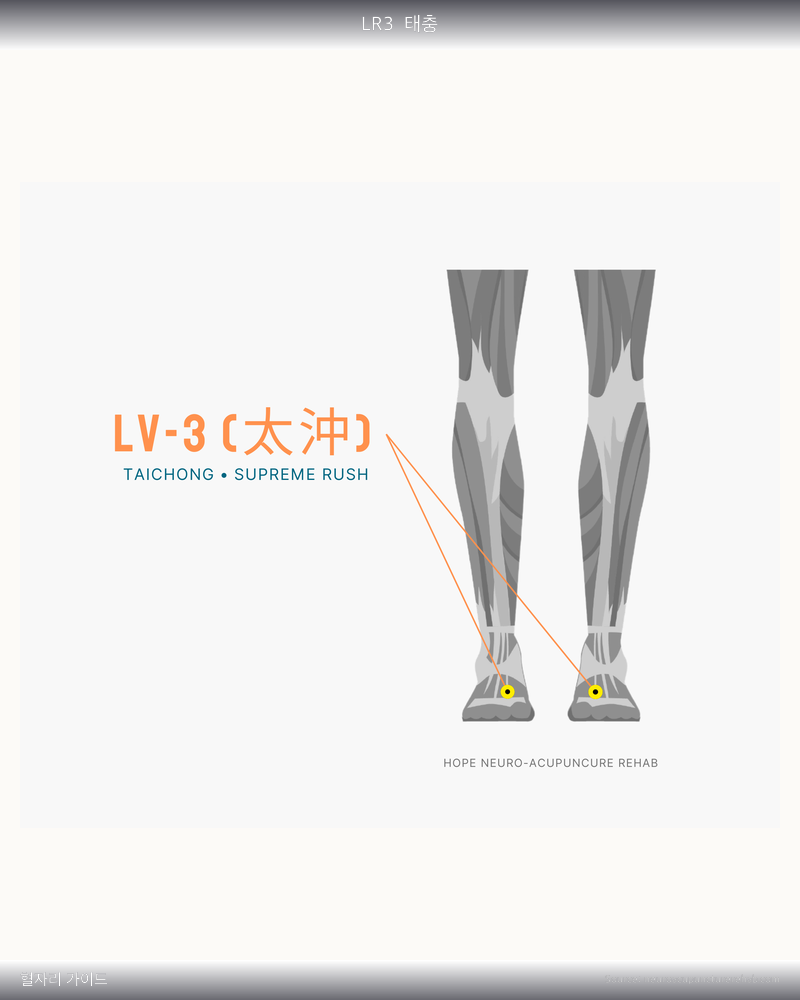
    3. Taechung (LR3) — Unblocking Qi and Blood Flow

    Where Is It?

    Follow the gap between the big toe and second toe upward to where the two bones meet. It’s in the V-shaped split.

    How to Press

    1. Press firmly in the depression between the bones with your thumb
    2. Press for 5 seconds → rest for 3 seconds, 10 times on each foot
    3. A slightly achy yet refreshing sensation means you’ve found the right spot

    Benefits: Stimulates the Liver meridian to promote smooth qi and blood circulation. Especially effective for stress-related menstrual pain.

    4. Diji (SP8) — The Special Point for Acute Menstrual Pain

    Where Is It?

    Four finger-widths below the inner side of the knee. Find it by following the inner edge of the shinbone downward.

    How to Press

    1. Press the depression on the inner edge of the shinbone with your thumb
    2. Press somewhat firmly for 3-5 seconds → rest for 3 seconds, 10 times
    3. Do both legs

    Benefits: An acupoint that responds quickly to acute menstrual pain. As the Xi-cleft point of the Spleen meridian, it reduces pain rapidly.

    5. Zusanli (ST36) — Restoring Overall Condition

    Where Is It?

    Four finger-widths below the outer side of the kneecap. It’s on the muscle on the outer side of the shinbone.

    How to Press

    1. Press the depression on the outer side of the shinbone with your thumb
    2. Press for 3-5 seconds → rest for 3 seconds, 10 times on each side
    3. A slightly tingling sensation spreading to the toes means you’ve found the right spot

    Benefits: Aids digestion to reduce bloating during periods. Replenishes overall energy to help relieve period fatigue.

    At-a-Glance Comparison

    Acupoint Location Best For Difficulty
    Sanyinjiao SP6 4 fingers above inner ankle All-around women’s health Easy
    Guanyuan CV4 4 fingers below navel Lower abdominal cold relief Easy
    Taechung LR3 Between toes on foot Qi-blood flow, stress-related Easy
    Diji SP8 4 fingers below inner knee Acute pain relief Medium
    Zusanli ST36 4 fingers below outer knee Digestion + energy boost Easy

    Synergistic Combinations

    • Sanyinjiao + Guanyuan: Warms the lower abdomen while reducing pain. The fundamental combination for menstrual pain acupressure.
    • Taechung + Sanyinjiao: Unblocks qi and blood flow, effective for stress-related menstrual pain.
    • Diji + Zusanli: Stimulates the Spleen-Stomach meridians simultaneously to also address indigestion during periods.

    Frequently Asked Questions

    Is it okay to do acupressure during my period?

    Yes, it’s actually more effective during your period. Press the points right when the pain starts.

    When should I start acupressure for menstrual pain?

    Starting 3-5 days before your period has a preventive effect. Of course, it still helps after the pain has begun.

    Does warmth make acupressure more effective?

    Yes! Applying acupressure with warm hands or placing a heat pad on the Guanyuan (CV4) area while pressing doubles the effect.

    My menstrual pain is severe — is acupressure enough?

    Acupressure is a complementary therapy. If your menstrual pain is severe enough to disrupt daily life, please see a gynecologist first.

    Can men also press these acupoints?

    Absolutely! These acupoints help with abdominal blood circulation and qi-blood regulation, so they can be used by everyone.

    Pregnancy Warning: Among the acupoints mentioned in this article, Sanyinjiao (SP6) may cause stimulation during pregnancy. If you are pregnant or may be pregnant, please consult a qualified practitioner before applying acupressure.
    Medical Disclaimer: This article is for informational purposes only and does not replace professional medical diagnosis or treatment. If symptoms persist or worsen, please consult a healthcare professional.
  • Taechung (LR3) vs Baihui (GV20) — A Complete Comparison Guide

    Taechung (LR3) vs Baihui (GV20) — A Complete Comparison Guide

    Quick Summary: Taechung (LR3) vs Baihui (GV20) comparison! Location, benefits, and acupressure techniques at a glance. Find out which acupoint is better for stress relief.
    Quick Summary: Taechung (LR3) is located between the big toe and second toe bones and is great for stress and headaches. Baihui (GV20) is located at the center of the crown of the head and is excellent for headaches and dizziness. Choose based on your situation!

    Why Compare Taechung and Baihui?

    When you’re stressed, your head feels like it’s about to explode and your chest feels tight, right? Taechung draws rising heat and anger downward from the feet, while Baihui unblocks stuck energy from the very top of the head. One “sends energy down” while the other “sends energy up” — completely opposite approaches. Which method suits your stress better?

    Taechung (LR3) — The ‘Anger Extinguisher’ Between the Big Toe and Second Toe

    Taechung is located between the big toe and second toe bones on the top of the foot. It belongs to the Liver meridian.

    How to Find It

    On the top of the foot, find where the big toe and second toe split apart and slide your finger about two finger-widths toward the ankle. It’s in the depression between the bones!

    How to Press

    Press firmly with your thumb, 1–2 minutes

    Best For

    • Stress
    • Headaches
    • Anger
    • Eye fatigue

    Baihui (GV20) — The ‘Crown Energy Hub’ at the Top of the Head

    Baihui is located at the very center of the crown of the head. It belongs to the Governing Vessel (Du Mai).

    How to Find It

    Where the line connecting the tops of both ears meets the line running from the nose over the head to the back — that’s the very top of the crown! You can feel a slight depression.

    How to Press

    Gently tap or press steadily with your fingertip, 1 minute

    Best For

    • Headaches
    • Dizziness
    • Insomnia
    • Concentration

    Side-by-Side Comparison

    Category Taechung (LR3) Baihui (GV20)
    Location Between big and second toe bones on the foot Center of the crown of the head
    Key Benefits Stress, headaches, anger, eye fatigue Headaches, dizziness, insomnia, concentration
    Difficulty Easy Medium
    Meridian Liver Governing Vessel
    Nickname Anger Extinguisher Crown Energy Hub

    Which Acupoint Is Right for You?

    • “I’m so angry my face is red and my head hurts” → Taechung first! It draws rising heat and anger downward.
    • “Stress is making my head foggy and I can’t concentrate” → Baihui first! It opens up the energy flow in the head for clarity.
    • “I keep getting irritated and can’t hold it in” → Taechung! It’s the specialist for calming Liver fire.
    • “Stress makes me dizzy with a heavy head” → Baihui! Stimulating the crown brings clarity.
    • “Chronic stress has exhausted both my body and mind” → Both! Use Taechung to lower the heat and Baihui to raise the energy.

    Even Better When Pressed Together!

    When stress is severe, try pressing in this order: Taechung (foot) → Baihui (head). First, release the heat from below with Taechung, then ventilate the energy from above with Baihui — like throwing open a window in a stuffy room. Your head will feel refreshingly clear. Just 5 minutes is enough!

    Frequently Asked Questions

    Which is easier to press — Taechung or Baihui?

    Taechung is easier. It’s on the top of the foot so your hand can reach it anytime. Baihui is on the crown of the head, which can be slightly awkward to reach.

    Can I press them every time I feel stressed?

    Absolutely! Press them right when you feel stressed. It’s perfectly fine to do it multiple times a day.

    Are there any precautions for pressing Baihui?

    Don’t press too hard! Gently tap or press steadily with your fingertip.

    Can pregnant women do this?

    Taechung should be avoided during pregnancy! Baihui is relatively safe, but it’s best to consult a practitioner during pregnancy.

    Can this help with children’s stress too?

    Yes! For children, gentle rubbing is sufficient. Softly stroking Baihui is also said to help with concentration.

    Pregnancy Warning: Among the acupoints mentioned in this article, Taechung (LR3) may cause stimulation during pregnancy. If you are pregnant or may be pregnant, please consult a qualified practitioner before applying acupressure.
    Medical Disclaimer: This article is for informational purposes only and does not replace professional medical diagnosis or treatment. If symptoms persist or worsen, please consult a healthcare professional.
  • Top 5 Acupoints for Neck Pain Relief: 5 Pressure Points That Actually Work

    Top 5 Acupoints for Neck Pain Relief: 5 Pressure Points That Actually Work

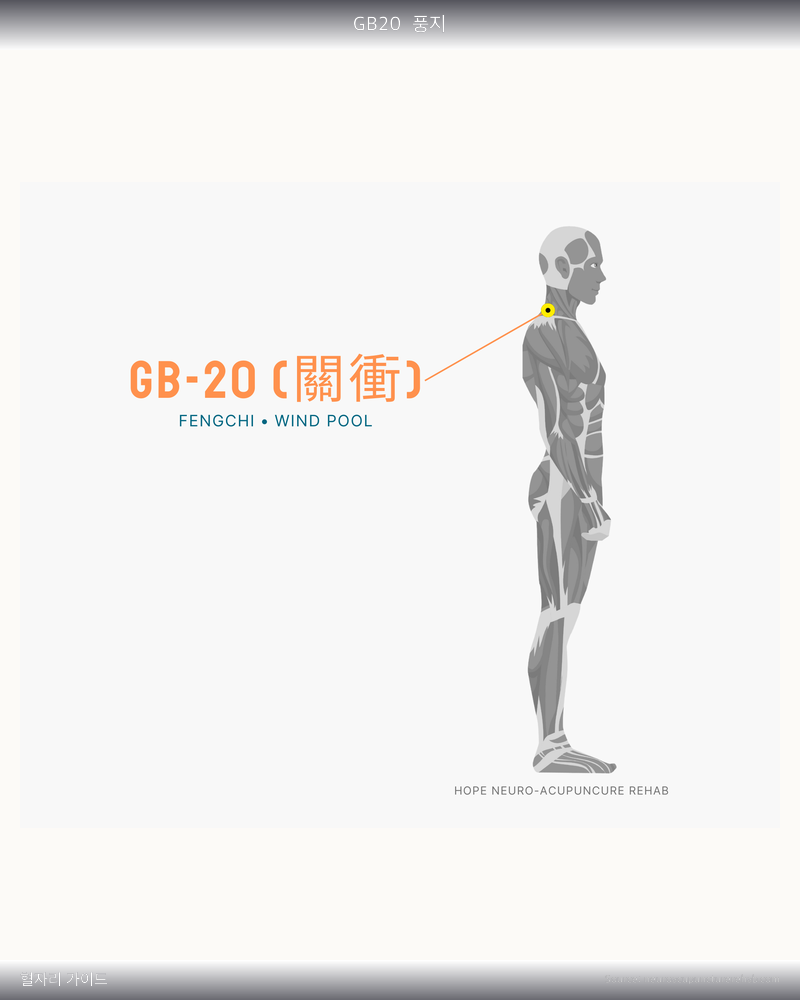
    Quick Summary: Top 5 acupoints for neck pain — learn the locations and self-acupressure techniques for Fengchi (GB20), Jianjing (GB21), Houxi (SI3), Tianzhu (BL10), and Dazhui (GV14).
    Quick Summary: Pressing these 5 acupoints for 3-5 seconds each can release stiffness from the back of the neck all the way to the shoulders.
    GB20 혈자리 위치 그림

    Neck Pain — Is It the Modern Curse?

    Staring at monitors all day, looking down at smartphones… by the end of the day, your neck feels as stiff as stone, right? Over 80% of adults experience neck pain. Our bodies have acupoints that can release this stiffness!

    1. Fengchi (GB20) — The Solution for Back-of-Neck Tension

    Where Is It?

    In the depressions on both sides below the base of the skull. Slide your fingers up from the back of the neck to where they meet the skull bone — youu2019ll feel a depression.

    How to Press

    1. Place both thumbs on Fengchi and wrap the rest of your fingers around your head
    2. Press upward firmly with your thumbs for 3-5 seconds
    3. Repeat 10 times while slowly turning your head left and right

    Benefits: Releases tension throughout the back of the neck. A versatile acupoint that addresses headaches, dizziness, and eye fatigue all at once.

    2. Jianjing (GB21) — The Neck-Shoulder Knot Specialist

    Where Is It?

    At the highest point where the neck meets the shoulder. Press the center of the shoulder at the highest point and youu2019ll feel an achy sensation right away.

    How to Press

    1. Grasp the top of your shoulder with the opposite hand
    2. Press firmly with your middle finger for 3-5 seconds
    3. 10 times on each side, tilting your neck slightly to the opposite side while pressing

    Benefits: Releases trapezius muscle knots running from the neck to the shoulder. Especially good for those with severe shoulder stiffness.

    3. Houxi (SI3) — The Neck Treatment Point on Your Hand

    Where Is It?

    At the border between the palm and back of the hand below the pinky finger. When you make a loose fist, itu2019s just below the protruding bone.

    How to Press

    1. Press the depression below the bone with the opposite thumb
    2. Press for 3-5 seconds u2192 rest for 3 seconds, repeat 10 times
    3. Slowly rotating your neck left and right while pressing doubles the effect

    Benefits: Easy to press anytime at the office. Releases stiffness in the back of the neck and even provides relief to the lower back.

    4. Tianzhu (BL10) — Reaching Deep Neck Muscles

    Where Is It?

    Slightly below and inward from Fengchi (GB20) at the back of the head. Find it by following the thick muscles on each side of the center of the back of the neck upward.

    How to Press

    1. Place both thumbs on Tianzhu and tilt your head slightly backward
    2. Use the weight of your head to naturally press for 3-5 seconds
    3. Repeat 10 times with a rhythmic press-and-release motion

    Benefits: Releases tension in the deep muscles of the neck. Effective for chronic back-of-neck pain, headaches, and shoulder stiffness.

    5. Dazhui (GV14) — The Crossroads of Neck and Back

    Where Is It?

    When you tilt your head forward, youu2019ll feel the most prominent bone at the base of the neck. Dazhui is right below that bone.

    How to Press

    1. Press below the protruding bone with your middle finger
    2. Press firmly for 5 seconds u2192 rest for 3 seconds, repeat 10 times
    3. Applying a warm towel and then pressing enhances the effect

    Benefits: Releases stiffness where the neck meets the upper back. Also helps with early cold symptoms and immune strengthening.

    At-a-Glance Comparison

    Acupoint Location Best For Difficulty
    Fengchi GB20 Both sides below skull base Neck tension + headache relief Medium
    Jianjing GB21 Top of neck-shoulder junction Shoulder stiffness, trapezius Easy
    Houxi SI3 Below pinky finger Easy desk-side acupressure Easy
    Tianzhu BL10 Inner back of head Deep muscle relaxation Medium
    Dazhui GV14 Below prominent bone at neck base Neck-back junction relief Easy

    Synergistic Combinations

    • Fengchi + Tianzhu: A combination that surrounds the entire back of the neck. Best for chronic neck pain.
    • Jianjing + Houxi: Releases pain that extends from the shoulder downward.
    • Dazhui + Fengchi: Circulates the entire back of the neck area for thorough stiffness relief.

    Frequently Asked Questions

    Which acupoint should I press first when my neck is stiff?

    Try Fengchi (GB20) first. Itu2019s the go-to acupoint for releasing tension throughout the back of the neck.

    How many times a day should I do neck acupressure?

    2-3 times a day, about 3-5 minutes each time is ideal. Itu2019s especially effective after waking up and during work breaks.

    Can I do acupressure while working at the computer?

    Yes! Houxi (SI3) is on the hand, so you can easily press it while working. Press for 30 seconds every hour.

    Is acupressure alone enough for neck pain?

    It helps with mild muscle tension. However, if pain persists for more than 2 weeks or you have numbness in your arms, see a doctor.

    Can I do acupressure even with a neck disc problem?

    If you have been diagnosed with a cervical disc issue, avoid strong pressure. Only attempt gentle pressure after consulting your doctor.

    Pregnancy Warning: Among the acupoints mentioned in this article, Jianjing (GB21) may cause stimulation during pregnancy. If you are pregnant or may be pregnant, please consult a qualified practitioner before applying acupressure.
    Medical Disclaimer: This article is for informational purposes only and does not replace professional medical diagnosis or treatment. If symptoms persist or worsen, please consult a healthcare professional.
  • Hapgok (LI4) or Zusanli (ST36)? How to Choose the Right Acupressure Point

    Hapgok (LI4) or Zusanli (ST36)? How to Choose the Right Acupressure Point

    Quick Summary: Hapgok (LI4) vs Zusanli (ST36) comparison! Location, benefits, and acupressure techniques at a glance. Find out which acupoint is better for boosting immunity.
    Quick Summary: Hapgok (LI4) is located in the webbing between the thumb and index finger and is great for headaches and colds. Zusanli (ST36) is located four finger-widths below the outer knee and is excellent for indigestion and fatigue. Choose based on your situation!

    Why Compare Hapgok and Zusanli?

    Hapgok and Zusanli are known as the “king of the hand” and “king of the leg” respectively. Both are renowned for boosting immunity, but their approaches differ. Hapgok works by “expelling harmful energy outward,” while Zusanli “replenishes good energy from within.” Defense vs. recharging — which do you need right now?

    Hapgok (LI4) — The ‘All-Purpose Problem Solver’ in the Webbing Between Thumb and Index Finger

    Hapgok is located in the webbing between the thumb and index finger. It belongs to the Large Intestine meridian.

    How to Find It

    Spread one hand wide and press the most fleshy spot between the thumb and index finger firmly with the opposite thumb.

    How to Press

    Press firmly with your thumb, 1–2 minutes. A slightly achy sensation means you’ve found the right spot.

    Best For

    • Headaches
    • Colds
    • Toothaches
    • Shoulder and neck stiffness

    Zusanli (ST36) — The ‘Cure-All Leg Point’ Below the Outer Knee

    Zusanli is located four finger-widths below the outer knee. It belongs to the Stomach meridian.

    How to Find It

    Find the depression just below the outer kneecap and place four fingers side by side downward. The point at the tip of your fourth finger, on the outer side of the shinbone, is Zusanli.

    How to Press

    Press firmly with your thumb, 2–3 minutes. A heavy sensation in the leg is normal.

    Best For

    • Indigestion
    • Fatigue
    • Immunity
    • Knee pain

    Side-by-Side Comparison

    Category Hapgok (LI4) Zusanli (ST36)
    Location Webbing between thumb and index finger Four finger-widths below the outer knee
    Key Benefits Headaches, colds, toothaches, shoulder/neck stiffness Indigestion, fatigue, immunity, knee pain
    Difficulty Easy Easy
    Meridian Large Intestine Stomach
    Nickname All-Purpose Problem Solver Cure-All Leg Point

    Which Acupoint Is Right for You?

    • “I feel a cold coming on” → Hapgok first! It helps expel early cold symptoms.
    • “I’ve been getting sick often and feel run down” → Zusanli! It builds foundational stamina and immunity.
    • “I have a runny or stuffy nose” → Hapgok! Especially effective for nasal symptoms.
    • “I have no appetite and poor digestion” → Zusanli! Restoring digestive power is the first step to better immunity.
    • “I get sick every change of season” → Both! Hapgok (defense) + Zusanli (recharge) = full immune armor!

    Even Better When Pressed Together!

    Create an “immunity routine” for seasonal changes: press Hapgok for 1 minute each hand in the morning → press Zusanli for 2 minutes each leg in the evening. Hapgok blocks external invaders while Zusanli replenishes internal energy — like building fortress walls while stocking up on supplies, making your immunity rock-solid!

    Frequently Asked Questions

    Which is more famous — Hapgok or Zusanli?

    Both are among the first acupoints recommended to beginners! If we had to pick, Zusanli is so famous it has the nickname “the greatest acupoint under heaven.”

    Does acupressure really help with immunity?

    This method has been used for thousands of years in Eastern medicine. Modern studies also show that acupressure can have positive effects on immune function.

    Can pregnant women press Hapgok?

    No! Hapgok must be avoided during pregnancy. Zusanli is safe to use.

    How should I press for best results?

    Press Hapgok firmly with your thumb for 1–2 minutes; press Zusanli a bit harder for 2–3 minutes. The right intensity is when you feel a slightly achy sensation.

    Does it still work after catching a cold?

    It works best in the early stages, but it can also support recovery after you’ve caught a cold. However, for severe colds, be sure to see a doctor!

    Pregnancy Warning: Among the acupoints mentioned in this article, Hapgok (LI4) may cause stimulation during pregnancy. If you are pregnant or may be pregnant, please consult a qualified practitioner before applying acupressure.
    Medical Disclaimer: This article is for informational purposes only and does not replace professional medical diagnosis or treatment. If symptoms persist or worsen, please consult a healthcare professional.
  • Taechung (LR3): Location, Benefits, and How to Press It

    Taechung (LR3): Location, Benefits, and How to Press It

    Quick Summary: Complete guide to Taechung (LR3) acupoint: location, benefits, and acupressure techniques. An effective foot acupoint for headaches, stress, anger, dizziness, and high blood pressure.
    Quick Summary: Taechung (LR3) is the ‘stress relief’ acupoint on the top of the foot. As a key point on the Liver meridian, it works wonders when you’re angry, have a headache, or are stressed out. It’s an essential acupoint for modern-day stress management!

    What Is Taechung?

    Taechung means ‘the place of great surging’!

    It’s the point on the Liver meridian where energy surges up powerfully. In traditional medicine, the Liver is the organ that manages emotions and stress.

    Simply put, Taechung acts like a fire extinguisher for anger! It draws rising heat and anger back downward.

    When combined with Hapgok (LI4), they form the ‘Four Gates Points’. It’s the ultimate combination for unblocking energy throughout the body!

    How to Find Taechung

    It’s on the top of the foot, so it’s easy to locate!

    1. Look at the top of your foot. You’ll need to take off your socks!
    2. Find the gap between your big toe and second toe.
    3. Slide your finger up along that gap toward the top of the foot.
    4. You’ll reach a point where two bones meet and your finger stops.
    5. That depression is Taechung!

    Tip: It’s right where your finger can’t slide any further up and hits the bone!

    Key Benefits of Taechung

    1. Relieves headaches — Especially effective for side and top-of-head headaches
    2. Reduces stress — Releases accumulated tension and frustration
    3. Calms anger — Helps with anger management
    4. Eases dizziness — Brings rising energy back down
    5. Supports blood pressure management — Helps stabilize elevated blood pressure
    6. Soothes tired eyes — The liver and eyes are connected, so it also relieves eye redness

    Self-Acupressure Technique for Taechung

    Preparation

    Sit comfortably and place one foot on the opposite knee.

    Step 1: Locate the Point

    Use your thumb to precisely locate Taechung.

    Step 2: Press Firmly

    • Press firmly with your thumb for 3–5 seconds
    • Release for 2 seconds
    • Repeat 15–20 times

    Step 3: Stroke Upward

    • Stroke upward from between the toes toward the top of the foot
    • Repeat for 1 minute

    Step 4: Do Both Feet

    Do both feet. 2–3 times daily is recommended.

    When angry: Press Taechung firmly right away while taking 5 deep breaths!

    Acupoints That Pair Well with Taechung

    Combination Effect Best For
    Taechung + Hapgok (LI4) Four Gates Points! Whole-body energy circulation When you feel stagnant and blocked
    Taechung + Fengchi (GB20) Headache + stress relief simultaneously When you have a stress-related headache
    Taechung + Sanyinjiao (SP6) Liver + Spleen function improvement When PMS irritability is severe

    Precautions

    • The top of the foot can be sensitive, so start gently
    • Avoid if you have wounds or inflammation on the foot
    • Those with low blood pressure should not press too hard
    • Wait at least 30 minutes after eating before applying acupressure

    Frequently Asked Questions

    Does pressing Taechung really calm anger?

    Yes! In traditional medicine, the liver manages emotions, and Taechung stabilizes the Liver meridian to help control anger.

    What are the benefits of pressing it together with Hapgok?

    Hapgok (hand) + Taechung (foot) = Four Gates Points! It unblocks energy throughout the entire body, releasing feelings of stagnation.

    Does it mean something is wrong if Taechung is very painful?

    It could be a sign that you have accumulated significant stress. Gently pressing it daily will gradually reduce the tenderness.

    Does it really help with high blood pressure?

    It can help as a complementary approach. However, it does not replace blood pressure medication. Always follow your doctor’s prescriptions!

    Can children have Taechung pressed too?

    Yes, it’s possible! Just use gentle pressure on children and keep sessions short, under 1 minute.

    Medical Disclaimer: This article is for informational purposes only and does not replace professional medical diagnosis or treatment. If symptoms persist or worsen, please consult a healthcare professional.
  • Hapgok (LI4) vs Taechung (LR3) Complete Comparison — A Complete Comparison Guide

    Hapgok (LI4) vs Taechung (LR3) Complete Comparison — A Complete Comparison Guide

    Quick Summary: A complete comparison of Hapgok (LI4) and Taechung (LR3) — differences, benefits, and the Four Gates combination technique. Find out which acupoint is more effective for headaches, stress, and high blood pressure.
    Hapgok (LI4) is the source point of the Large Intestine meridian located on the hand, effective for headaches, colds, and pain relief. Taechung (LR3) is the source point of the Liver meridian located on the foot, effective for stress, high blood pressure, and emotional regulation. Stimulating both together creates the Four Gates Points, opening the gates of qi and blood circulation for exceptional whole-body health benefits.

    Why Compare Hapgok and Taechung?

    Hapgok (LI4) and Taechung (LR3) form what is called the “Four Gates Points” in traditional East Asian medicine — the ultimate acupoint combination. Hapgok governs Yang energy while Taechung governs Yin energy, creating the quintessential pairing for balancing Yin and Yang. Both are source points (Yuan points), but they belong to different meridians and treat different primary conditions.

    Hapgok (LI4) — The Master Key of the Large Intestine Meridian

    Hapgok (LI4) is the source point of the Large Intestine meridian, representing the body’s Yang energy.

    • Location: In the depression between the thumb and index finger, at the midpoint of the 2nd metacarpal bone
    • Key Benefits: Headaches, toothaches, colds, fever, constipation, facial conditions
    • Acupressure Method: Press firmly with the opposite thumb for 3–5 seconds, release, repeat 10–15 times
    • Special Feature: “For the face and mouth, seek Hapgok” — the #1 treatment point for all conditions of the face and mouth area

    Taechung (LR3) — The Emotional Regulator of the Liver Meridian

    Taechung (LR3) is the source point and stream point of the Liver meridian, governing the body’s Yin energy and emotions.

    • Location: On the dorsum of the foot, in the depression between the 1st and 2nd metatarsal bones
    • Key Benefits: Stress, anger, high blood pressure, dizziness, eye fatigue, menstrual pain
    • Acupressure Method: Press with thumb toward the dorsum of the foot for 3–5 seconds, release, repeat 10–15 times
    • Special Feature: Resolves Liver Qi stagnation — an outlet for suppressed emotions and stress

    Hapgok vs Taechung Comparison Table

    Category Hapgok (LI4) Taechung (LR3)
    Meridian Large Intestine (Yangming) Liver (Jueyin)
    Location Hand (between thumb and index finger) Foot (between big toe and second toe)
    Nature Yang — disperses energy Yin — promotes energy flow
    Core Effect Pain relief, colds Emotional regulation, blood pressure
    Headache Tension and frontal headaches Stress-related and temporal headaches
    Difficulty Easy Easy
    Pregnancy Contraindicated Caution (consult specialist)

    When Should You Choose Which Acupoint?

    • Colds, fever, or toothache → Hapgok (LI4) first
    • Stress, anger, or high blood pressure → Taechung (LR3) first
    • Headache (unknown cause) → Four Gates (Hapgok + Taechung together)
    • Menstrual pain → Taechung (LR3) + Sanyinjiao (SP6)
    • Constipation or indigestion → Hapgok (LI4) + Zusanli (ST36)

    Four Gates — The Synergy of Two Acupoints

    When you stimulate both Hapgok and Taechung on both sides, you activate a total of 4 points, completing the “Four Gates Points”.

    1. First, apply acupressure to Hapgok (LI4) on both hands for 1 minute each (top-to-bottom principle)
    2. Then apply acupressure to Taechung (LR3) on both feet for 1 minute each
    3. It takes just 4 minutes — opening the gates of qi and blood circulation throughout the body

    Key Takeaway: Hapgok is the “pain circuit breaker of the body” and Taechung is the “calming switch for the mind” — pressing both together creates the Four Gates Points that care for body and mind simultaneously.

    Frequently Asked Questions

    Which acupoint is more effective for headaches — Hapgok or Taechung?

    Hapgok (LI4) is more effective for tension headaches, while Taechung (LR3) works better for headaches caused by stress or anger. Pressing both together (Four Gates) creates a synergistic effect.

    What are the Four Gates Points?

    The Four Gates Points is a 4-point combination that stimulates both Hapgok (LI4) and Taechung (LR3) on both sides. It means “opening the gates of qi and blood circulation” and is one of the most famous acupoint combinations in traditional East Asian medicine.

    Can I press Hapgok and Taechung at the same time?

    Yes, you can press them simultaneously or alternate between them. Traditionally, it is recommended to stimulate from top to bottom: Hapgok (hand) first, then Taechung (foot).

    Should pregnant women avoid Hapgok or Taechung?

    Hapgok (LI4) must be avoided during pregnancy as it may induce uterine contractions. Taechung (LR3) is relatively safe, but consult a specialist before performing acupressure during pregnancy.

    Which acupoint is better for high blood pressure?

    Taechung (LR3) is more effective for high blood pressure. As the source point of the Liver meridian, it is especially beneficial for hypertension and dizziness caused by Liver Yang rising.

    Pregnancy Warning: Among the acupoints mentioned in this article, Hapgok (LI4) may cause stimulation during pregnancy. If you are pregnant or may be pregnant, please consult a qualified practitioner before applying acupressure.
    Medical Disclaimer: This article is for informational purposes only and does not replace professional medical diagnosis or treatment. If symptoms persist or worsen, please consult a healthcare professional.