Author: Acupoint Guide Editorial Team

  • How to Relieve Top 5 Acupoints for Lower Back Pain Naturally with These 5 Pressure Points

    How to Relieve Top 5 Acupoints for Lower Back Pain Naturally with These 5 Pressure Points

    Quick Summary: Top 5 acupoints for lower back pain — learn the locations and self-acupressure techniques for Shenshu (BL23), Weizhong (BL40), Mingmen (GV4), Dachangshu (BL25), and Taixi (KI3).
    Quick Summary: When your lower back feels stiff, pressing these 5 acupoints — Shenshu, Weizhong, Mingmen, Dachangshu, and Taixi — for 3-5 seconds each can reduce pain and make your back feel lighter.
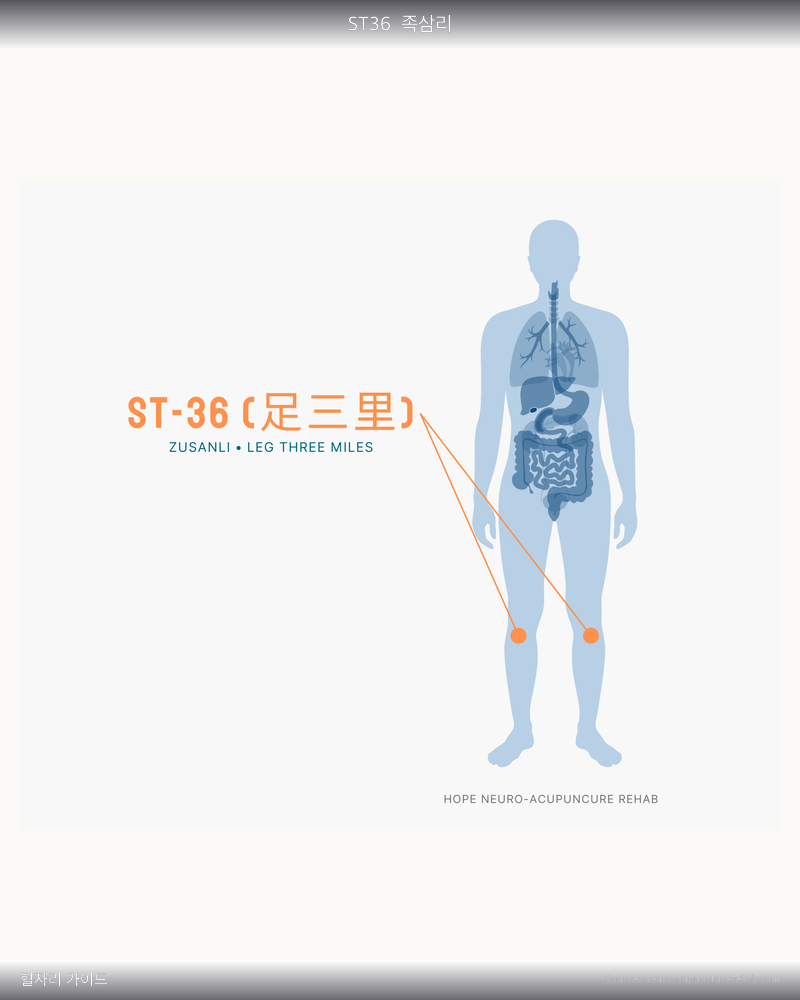
    ST36 혈자리 위치 그림

    Lower Back Pain — Something Everyone Experiences

    Whether from sitting at a desk all day, lifting heavy objects, or that “ugh” moment getting out of bed in the morning — lower back pain is incredibly common and can really disrupt your daily life. Acupressure can help loosen tight back muscles and improve blood circulation!

    1. Shenshu (BL23) — The Core Acupoint for Back Health

    Where Is It?

    Located about two finger-widths to each side of the 2nd-3rd lumbar vertebrae. At about belt height, feel along each side of the spine for a tender spot.

    How to Press

    1. Make fists with both hands and press Shenshu with the second knuckle
    2. Press for 3-5 seconds → rest for 3 seconds, repeat 10 times
    3. Pressing in circular motions feels even more relieving

    Benefits: Supports kidney function and is excellent for chronic lower back pain and fatigue relief. The name means “the transport point of the kidney.”

    2. Weizhong (BL40) — The Miracle Point for Lower Back Pain

    Where Is It?

    Right in the center of the back of the knee (popliteal crease). Slightly bend your knee and find the middle of the crease that forms on the back.

    How to Press

    1. Sit on the floor with knees slightly bent
    2. Press the center of the popliteal crease firmly with both thumbs
    3. Press for 5 seconds → rest for 3 seconds, repeat 10 times on each side

    Benefits: In traditional medicine, there’s a saying: “For back and lower back pain, seek Weizhong.” You can feel immediate effects for acute lower back pain.

    3. Mingmen (GV4) — The Gate of Vitality

    Where Is It?

    Located directly on the spine at navel height on the back side. Feel for the center of the spine at belt height.

    How to Press

    1. Make a fist and rub the Mingmen area up and down with the back of your hand
    2. Rub for 30 seconds to 1 minute until it feels warm
    3. Then press firmly with your thumb for 3-5 seconds, 10 times

    Benefits: Warms the lower back and replenishes vital energy. Especially good for chronic lower back pain and cold sensitivity.

    4. Dachangshu (BL25) — Improves Lower Body Circulation

    Where Is It?

    Located about two finger-widths to each side of the 4th-5th lumbar vertebrae. Find it at the height of the top of the iliac crest (hip bone).

    How to Press

    1. Place both thumbs on your lower back and press on Dachangshu
    2. Press for 3-5 seconds → rest for 3 seconds, repeat 10 times
    3. Leaning slightly backward while pressing is even more effective

    Benefits: Great for lower back pain and improving intestinal function. This acupoint regulates the energy of the large intestine.

    5. Taixi (KI3) — From Ankle to Lower Back

    Where Is It?

    In the depression between the inner ankle bone (medial malleolus) and the Achilles tendon. Feel behind the ankle bone to find it easily.

    How to Press

    1. Use your thumb to find the depression behind the inner ankle bone
    2. Press firmly for 3-5 seconds → rest for 3 seconds, 10 times on each side
    3. The exact location is where you can feel a pulse

    Benefits: Strengthens the lower back through the Kidney meridian. Also effective for chronic lower back pain and cold knees.

    At-a-Glance Comparison

    Acupoint Location Best For Difficulty
    Shenshu BL23 Both sides of lumbar spine Chronic back pain, fatigue Medium
    Weizhong BL40 Back of knee crease Acute back pain (miracle point) Easy
    Mingmen GV4 Center of back spine Cold sensitivity, vitality Medium
    Dachangshu BL25 Both sides of lower spine Lower body circulation, intestinal function Medium
    Taixi KI3 Behind inner ankle bone Back strengthening, cold knees Easy

    Synergistic Combinations

    • Shenshu + Weizhong: The golden combination for lower back pain. Unblocks the meridian from top to bottom.
    • Mingmen + Shenshu: Stimulates the center and both sides of the lower back simultaneously for overall relief.
    • Taixi + Shenshu: Connects the Kidney meridian from bottom to top, strengthening the foundation of your back.

    Frequently Asked Questions

    How many times a day should I do acupressure for lower back pain?

    2-3 times a day, morning and evening is ideal. About 5-10 minutes per session is enough.

    Can I directly press my lower back when it hurts?

    Yes, but don’t press the painful area too hard. Find the exact acupoint location and apply moderate pressure.

    Can acupressure alone cure a herniated disc?

    Acupressure can help relieve mild lower back pain. However, for conditions like herniated discs, you must seek proper medical treatment.

    What position should I be in for lower back acupressure?

    Lying face down or on your side is ideal. When sitting, keep your back straight while applying acupressure.

    Is it okay to combine exercise with acupressure?

    Yes! Doing acupressure after light stretching is even more effective. Pressing acupoints when muscles are relaxed enhances the benefits.
    Medical Disclaimer: This article is for informational purposes only and does not replace professional medical diagnosis or treatment. If symptoms persist or worsen, please consult a healthcare professional.
  • Hapgok (LI4) vs Neiguan (PC6) — A Complete Comparison Guide

    Hapgok (LI4) vs Neiguan (PC6) — A Complete Comparison Guide

    Quick Summary: Hapgok (LI4) vs Neiguan (PC6) comparison! Location, benefits, and acupressure techniques at a glance. Find out which versatile acupoint suits you best.
    Quick Summary: Hapgok (LI4) is located in the webbing between the thumb and index finger and is great for headaches and colds. Neiguan (PC6) is located on the inner wrist, three finger-widths toward the elbow from the wrist crease, and is excellent for nausea and anxiety. Choose based on your situation!

    Why Compare Hapgok and Neiguan?

    Hapgok and Neiguan are both located near the hand and wrist, making them easy to press anytime, anywhere. Plus, they’re both famous as “do-it-all” versatile acupoints! Hapgok tackles pain and colds from the back of the hand, while Neiguan handles nausea and anxiety from the wrist. They may seem similar, but their specialties are quite different!

    Hapgok (LI4) — The ‘All-Purpose Problem Solver’ in the Webbing Between Thumb and Index Finger

    Hapgok is located in the webbing between the thumb and index finger. It belongs to the Large Intestine meridian.

    How to Find It

    Spread one hand wide and press the most fleshy spot between the thumb and index finger firmly with the opposite thumb.

    How to Press

    Press firmly with your thumb, 1–2 minutes. A slightly achy sensation means you’ve found the right spot.

    Best For

    • Headaches
    • Colds
    • Toothaches
    • Shoulder and neck stiffness

    Neiguan (PC6) — The ‘Anti-Nausea Point’ on the Inner Wrist

    Neiguan is located on the inner wrist, three finger-widths toward the elbow from the wrist crease. It belongs to the Pericardium meridian.

    How to Find It

    Turn your palm face up and place three fingers side by side starting from the wrist crease toward the elbow. The point at the tip of your third finger, between the two tendons, is Neiguan.

    How to Press

    Press firmly with the opposite thumb, 1–2 minutes. A slightly tingling sensation is normal.

    Best For

    • Nausea
    • Anxiety
    • Insomnia
    • Motion sickness

    Side-by-Side Comparison

    Category Hapgok (LI4) Neiguan (PC6)
    Location Webbing between thumb and index finger Inner wrist, 3 finger-widths from wrist crease
    Key Benefits Headaches, colds, toothaches, shoulder/neck stiffness Nausea, anxiety, insomnia, motion sickness
    Difficulty Easy Easy
    Meridian Large Intestine Pericardium
    Nickname All-Purpose Problem Solver Anti-Nausea Point

    Which Acupoint Is Right for You?

    • “I have a headache or toothache” → Hapgok! It’s the ace of pain relief.
    • “I feel nauseous or queasy” → Neiguan! Nausea is Neiguan’s specialty.
    • “I feel a cold coming on” → Hapgok! Great for early cold symptoms.
    • “I feel anxious and my heart is racing” → Neiguan! It calms the mind.
    • “Everything feels off” → Both! Hapgok + Neiguan covers most issues.

    Even Better When Pressed Together!

    This is the easiest combination to do during your commute or on the go. Hapgok for 1 minute (both hands) → Neiguan for 1 minute (both hands) — just 4 minutes total! Especially great when flying — the ultimate combo for tackling motion sickness (Neiguan) + headache (Hapgok) simultaneously.

    Frequently Asked Questions

    They’re both near the hand — can I press them together?

    Absolutely! They actually create a synergistic effect. You can alternate between pressing Hapgok and Neiguan on one hand.

    Which one is easier to find?

    Hapgok is slightly easier. The spot between the thumb and index finger is immediately visible. Neiguan requires measuring three finger-widths from the wrist crease, which can be slightly confusing at first.

    Are there precautions for pregnant women?

    Hapgok must be avoided during pregnancy! Neiguan, on the other hand, can actually help relieve morning sickness.

    Can I do this on children?

    Yes! Both can be used on children. However, apply much gentler pressure than you would on adults — use a soft rubbing motion.

    Is it okay to press them habitually every day?

    No worries! Pressing them consistently at moderate intensity every day is actually the best approach.

    Pregnancy Warning: Among the acupoints mentioned in this article, Hapgok (LI4) may cause stimulation during pregnancy. If you are pregnant or may be pregnant, please consult a qualified practitioner before applying acupressure.
    Medical Disclaimer: This article is for informational purposes only and does not replace professional medical diagnosis or treatment. If symptoms persist or worsen, please consult a healthcare professional.
  • LI4 (Hegu) Location, Benefits, and Acupressure Complete Guide

    LI4 (Hegu) Location, Benefits, and Acupressure Complete Guide

    Summary: Learn the precise location, 5 key benefits, and self-acupressure technique for LI4 (Hegu). A complete guide to the Hegu acupoint, effective for headaches, toothache, and colds.
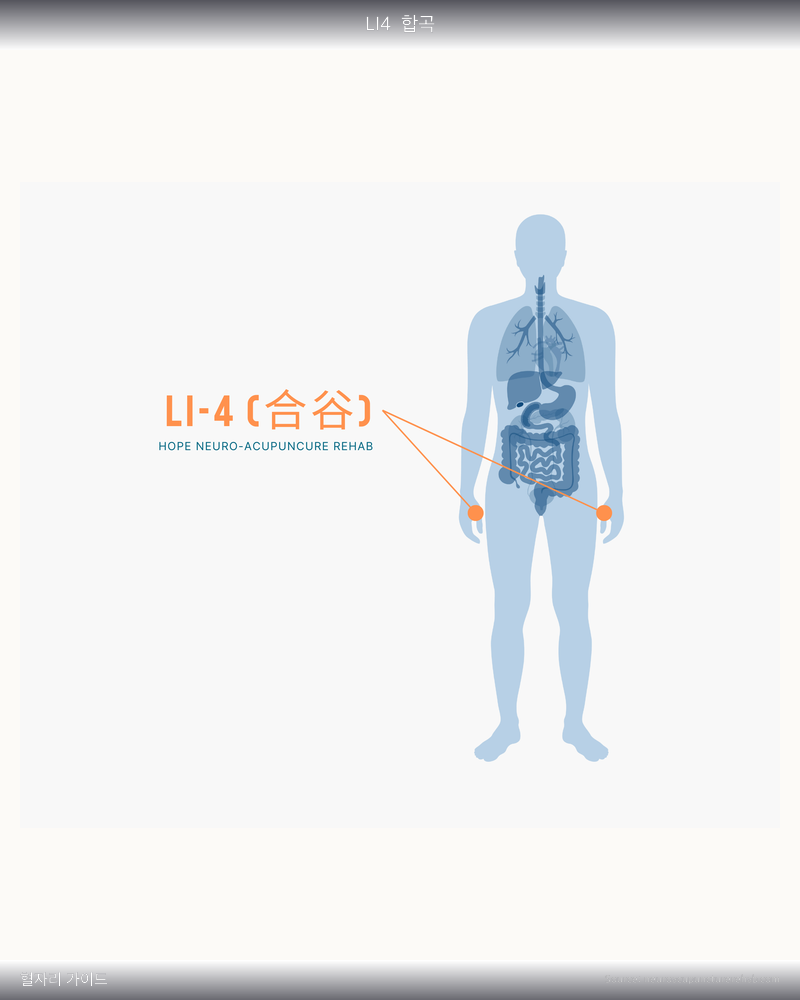
    LI4 (Hegu) is the representative acupoint of the Large Intestine meridian, located between the thumb and index finger. It has outstanding effects for relieving headaches, toothaches, colds, and stress. It is the most popular acupoint that even beginners can easily find and press.

    What Is LI4 (Hegu)?

    LI4 (Hegu, 合谷) is the 4th acupoint of the Large Intestine meridian under WHO standard meridian point nomenclature. In traditional Chinese medicine, it is referred to as “Hegu for the face and mouth” and is used as the representative treatment point for diseases around the face and mouth.

    Precise Location

    With the thumb and index finger spread apart, it is located in the hollow on the thumb side, at the midpoint of the 2nd metacarpal (index finger bone). When grasped between the thumb and index finger of the other hand, the most tender spot is Hegu.

    Benefits and Effects

    1. Headache relief — Reduces pain with 3–5 minutes of acupressure for migraines and tension headaches
    2. Toothache relief — Used for emergency pain relief before dental treatment
    3. Improvement of cold symptoms — Relieves nasal congestion and sore throat
    4. Stress relief — Relaxation effect through autonomic nervous system regulation
    5. Promotes digestion — As a Large Intestine meridian acupoint, helps with constipation

    Acupressure Technique Guide

    Step 1: Locate LI4

    LI4 acupuncture point

    Spread your thumb and index finger apart and find the highest point of the muscle between them. Press with the opposite thumb to find the spot that feels sore and achy — that’s Hegu.

    Step 2: Press with Your Thumb

    Press LI4 firmly with the opposite thumb for 3–5 seconds, then release slowly. Apply medium pressure (slightly sore).

    Step 3: Repeat with Breathing

    Press while exhaling, release while inhaling. Do 10–15 times per hand, alternating both hands, 2–3 times daily.

    Synergistic Combinations

    Combination Acupoints Target Symptoms
    Four Gates (Siguan) LI4 (Hegu) + LR3 (Taichong) Headaches, stress, high blood pressure
    Cold combo LI4 (Hegu) + GB20 (Fengchi) Cold, nasal congestion, fever
    Digestion combo LI4 (Hegu) + ST36 (Zusanli) Indigestion, constipation

    Precautions

    LI4 can stimulate uterine contractions in pregnant women — absolutely do not press it during pregnancy. Avoid areas with skin wounds, and refrain from strong acupressure within 30 minutes after a meal.

    Frequently Asked Questions

    Where is LI4 (Hegu) located?

    LI4 acupuncture point

    LI4 (Hegu) is located in the hollow between the thumb and index finger, at the midpoint of the 2nd metacarpal bone.

    How many times a day should I press LI4?

    LI4 acupuncture point

    Press 2–3 times a day, alternating both hands for 30 seconds to 1 minute each time.

    Can pregnant women press LI4?

    LI4 acupuncture point

    LI4 can stimulate uterine contractions in pregnant women and should be avoided during pregnancy.

    What acupoints work well with LI4?

    LI4 acupuncture point

    Pressing it together with LR3 (Taichong) forms the ‘Four Gates’ (Siguan) combination, which is effective for headaches and stress.

    Are there any side effects of pressing LI4?

    LI4 acupuncture point

    There are almost no side effects with appropriate pressure, but excessive stimulation may cause bruising.

    ⚠️ Medical Disclaimer: This article is for informational purposes only and does not replace professional medical diagnosis or treatment. If symptoms persist or worsen, please consult a healthcare professional.
  • LI4 (Hegu) or LR3 (Taichong)? How to Choose the Right Acupressure Point

    LI4 (Hegu) or LR3 (Taichong)? How to Choose the Right Acupressure Point

    Summary: LI4 (Hegu) vs LR3 (Taichong) — Which acupoint is right for you?
    One-line summary: LI4 (Hegu) is on the hand and is good for headaches and colds. LR3 (Taichong) is on the foot and is good for stress and when you’re feeling angry. Pressing both together? The ultimate combination!

    Why Are Hegu and Taichong Often Compared?

    In traditional Chinese medicine, Hegu and Taichong are called the ‘Four Gates’ (四關穴, Siguan). ‘Siguan’ means ‘four gates,’ referring to 2 on the hands (Hegu) + 2 on the feet (Taichong) = 4, hence the name.

    Both are remarkable acupoints on their own, but pressing them together creates a synergistic effect that is immense! It’s like superheroes teaming up.

    LI4 (Hegu) — The ‘All-Purpose Problem Solver’ on the Back of the Hand

    Hegu is located in the webbing between the thumb and index finger. Its name means ‘where the valleys converge,’ and it is indeed found in the valley between the two fingers.

    How to Find It

    1. Open one hand wide
    2. Look at the area between the thumb and index finger — you can see a web-like part, right?
    3. Press the highest point (the most prominent part) there with the opposite thumb!
    4. If you feel an achy sensation, you’ve got it!

    When to Press It

    • When you have a headache
    • When your nose is congested or you feel a cold coming on
    • When you have a toothache
    • When your shoulders or neck are stiff

    LR3 (Taichong) — The ‘Stress Relief Button’ on the Top of the Foot

    Taichong is located on the top of the foot, between the big toe and second toe. ‘Tai’ (太) means ‘greatly rising,’ implying that it powerfully releases blocked energy.

    How to Find It

    1. Look at the top of your foot
    2. From where the big toe and second toe diverge…
    3. Go 2 finger-widths toward the ankle
    4. There is a hollow between the bones — that’s the spot!

    When to Press It

    • When anger is rising
    • When stress is so bad your head feels like it might explode
    • When your eyes are bloodshot or fatigued
    • When menstrual cramps are severe

    Side-by-Side Comparison!

    Category LI4 (Hegu) LR3 (Taichong)
    Where? Back of hand, between thumb and index finger Top of foot, between big toe and second toe
    Good for what? Headache, cold, toothache Stress, anger, eye fatigue
    Energy direction Lifting up (yang energy) Bringing down (yin energy)
    Ease of finding Very easy Easy
    In one word All-purpose body problem solver Extinguishing emotional fire

    Which Is Right for Me?

    • “My head feels foggy and heavy” → LI4 first!
    • “I’m angry and getting a headache” → LR3 first!
    • “I’m feeling a cold coming on” → LI4!
    • “Stress is keeping me awake” → LR3!
    • “Everything hurts” → Both!

    What Happens If You Press Both? — The Power of the Four Gates!

    Pressing LI4 (yang energy) + LR3 (yin energy) together balances the energy of your entire body. In traditional Chinese medicine, this is called ‘opening the Four Gates.’

    Four Gates Routine (5 minutes)

    1. Press LI4 (Hegu) for 1 minute on each hand (2 minutes total)
    2. Press LR3 (Taichong) for 1 minute on each foot (2 minutes total)
    3. Take 3 deep breaths at the end

    This is the best combination for stress relief, headache alleviation, and overall condition recovery!

    In Closing

    LI4 resolves ‘physical problems’ and LR3 resolves ’emotional problems.’ If you’re unsure, press both — the Four Gates will never let you down!

    Frequently Asked Questions

    Can I press both LI4 and LR3 together?

    Of course! Pressing both together is called the ‘Four Gates’ (Siguan), which doubles the effect!

    I have a headache — which one should I press?

    For a stiff, tension headache, LI4 is a better fit. For a stress-induced headache from anger, LR3 is better.

    I’m pregnant — can I press them?

    No! Both LI4 and LR3 are acupoints that pregnant women must avoid.

    How many times a day should I press?

    2–3 times a day for each point, about 1–2 minutes each time is sufficient!

    Can children do this?

    Yes! However, for children, press much more gently, as if lightly rubbing.

    ⚠️ Pregnancy Warning: Pregnant women should avoid pressing this acupoint as it may stimulate uterine contractions.
    ⚠️ Medical Disclaimer: This article is for informational purposes only and does not replace professional medical diagnosis or treatment. If symptoms persist or worsen, please consult a healthcare professional.
  • Insomnia Relief: 5 Pressure Points That Actually Work

    Insomnia Relief: 5 Pressure Points That Actually Work

    Summary: Introducing 5 acupoints effective for insomnia. Acupressure techniques for insomnia recommended by sleep specialists, including HT7, GV20, and SP6, plus combination tips.
    TOP 5 Acupoints for Insomnia: HT7 (Shenmen), GV20 (Baihui), SP6 (Sanyinjiao), PC6 (Neiguan), and EX-HN5 (Anmian). Pressing each acupoint for 30 seconds to 1 minute, 20–30 minutes before bed, activates the parasympathetic nervous system and helps induce natural sleep.

    Why Is Acupressure Effective for Insomnia?

    The World Health Organization (WHO) has recognized that stimulating acupoints is effective in regulating the autonomic nervous system. Acupressure activates the parasympathetic nervous system and lowers cortisol (stress hormone) levels, creating a natural sleep environment. Unlike sleeping pills, it has almost no side effects and can be performed safely every day.

    1. HT7 (Shenmen) — The Core Acupoint for Sleep

    HT7 (Shenmen, 神門) is the source point (yuan-source) of the Heart meridian, a representative acupoint for calming the mind and inducing sleep. In the Dongui Bogam (Korean traditional medicine text), it is recorded that “Shenmen governs the heart’s qi to treat anxiety and insomnia.”

    • Location: On the inner wrist crease, in the hollow just beside the flexor carpi ulnaris tendon on the ulnar (pinky-finger) side
    • Technique: Press firmly with the opposite thumb for 3–5 seconds, then release. Repeat 10–15 times. Alternate both hands.
    • Best time: 30 minutes before bed, 2–3 times daily

    Key point: HT7 is the easiest to find and fastest-acting among insomnia acupoints.

    2. GV20 (Baihui) — The Calming Switch at the Crown

    GV20 (Baihui, 百會) is the 20th acupoint of the Governing Vessel (Du Mai), meaning “where a hundred meridians converge.” It improves cerebral blood flow and calms excessive mental activity, making it effective for inducing sleep.

    • Location: At the very top of the skull, where the line connecting the tips of both ears meets the midline
    • Technique: Gently massage in circles with the middle finger for 30 seconds to 1 minute. Do not press too hard.
    • Best time: Right before bed, combined with meditation

    Key point: GV20 is a multi-purpose acupoint that addresses headaches and insomnia simultaneously.

    3. SP6 (Sanyinjiao) — The Crossroads of 3 Meridians

    SP6 (Sanyinjiao, 三陰交) is a special acupoint where the three yin meridians of the spleen, liver, and kidney intersect. It regulates hormonal balance and is particularly effective for insomnia, menstrual pain, and menopausal symptoms in women.

    • Location: 3 cun (4 finger-widths) above the tip of the inner ankle bone (medial malleolus), behind the posterior border of the tibia
    • Technique: Press for 5 seconds, rest for 3 seconds. Repeat for 1 minute on both legs.
    • Best time: 1 hour after dinner in the evening, or before bed

    Key point: SP6 is an acupoint that helps improve overall constitution, not just sleep.

    4. PC6 (Neiguan) — Specialized in Anxiety Relief

    PC6 (Neiguan, 內關) is the connecting point (luo-connecting) of the Pericardium meridian, outstanding for calming anxiety, restlessness, and heart palpitations. Motion sickness wristbands work on the principle of stimulating this very acupoint.

    • Location: 2 cun (3 finger-widths) above the inner wrist crease, between the two tendons (palmaris longus and flexor carpi radialis)
    • Technique: Massage in circles with the thumb for 30 seconds to 1 minute. Apply moderate pressure (slightly sore feeling).
    • Best time: Before sleep or anytime you feel anxious

    Key point: PC6 is especially effective for those who cannot sleep due to anxiety.

    5. EX-HN5 (Anmian) — An Extra Point for Sleep Induction

    EX-HN5 (Anmian, 安眠) is an extra acupoint whose very name means “peaceful sleep.” It improves blood flow in the occipital region and relieves cervical tension to induce deep sleep.

    • Location: In the hollow below the mastoid process (the protruding bone behind the ear)
    • Technique: Simultaneously massage both sides gently in circles with the middle fingers for 1 minute
    • Best time: Right before bed, while lying on a pillow

    Key point: Anmian is an acupoint dedicated to insomnia — its name promises a peaceful sleep.

    Acupoint Comparison Chart

    Acupoint Location Key Effect Difficulty Recommended for
    HT7 (Shenmen) Inner wrist Calms mind, induces sleep Easy All types of insomnia
    GV20 (Baihui) Crown of head Calms brain, relieves headache Easy Overthinking insomnia
    SP6 (Sanyinjiao) Above inner ankle Hormone regulation Moderate Women’s insomnia
    PC6 (Neiguan) Inner wrist Anxiety relief Easy Anxiety-type insomnia
    EX-HN5 (Anmian) Behind the ear Induces deep sleep Moderate Sleep onset disorder

    Acupoint Combination Tips

    Combining acupoints produces better results than using a single point:

    1. Basic combination (3 min): HT7 (Shenmen) + GV20 (Baihui) — the simplest and most effective sleep routine
    2. Anxiety-type combination (5 min): HT7 (Shenmen) + PC6 (Neiguan) + EX-HN5 (Anmian) — for severe anxiety and restlessness
    3. Women’s combination (5 min): SP6 (Sanyinjiao) + HT7 (Shenmen) + PC6 (Neiguan) — effective for premenstrual insomnia

    In Closing

    Acupressure for insomnia is a natural sleep therapy that can be practiced daily without side effects. The most important factor is consistency — performing it with deep breathing in a quiet environment, 20–30 minutes before bed, will yield the best results.

    Frequently Asked Questions

    What is the most effective acupoint for insomnia?

    HT7 (Shenmen) is the most representative. It is easy to find on the wrist and belongs to the Heart meridian, making it outstanding at calming the mind. Pressing both sides for 1 minute each, 30 minutes before bed, can help induce sleep.

    How many minutes before bed should I do acupressure for insomnia?

    20–30 minutes before bed is most ideal. Pressing acupoints slowly while breathing in a quiet environment activates the parasympathetic nervous system and naturally transitions to sleep mode.

    Is it safe to do insomnia acupressure every day?

    Yes, it is safe to do every day. In fact, the more consistently you do it, the better the results. However, pregnant women should avoid pressing SP6, and avoid areas with skin wounds.

    What is the difference between acupressure and taking sleeping pills?

    Acupressure has the advantage of having almost no side effects and not creating dependency. However, for serious chronic insomnia, it is recommended to also consult a specialist.

    Can children also do insomnia acupressure?

    Yes. However, children should be massaged more gently than adults (just enough to lightly rub), focusing mainly on HT7 (Shenmen) and GV20 (Baihui).

    ⚠️ Pregnancy Warning: Pregnant women should avoid pressing this acupoint as it may stimulate uterine contractions.
    ⚠️ Medical Disclaimer: This article is for informational purposes only and does not replace professional medical diagnosis or treatment. If symptoms persist or worsen, please consult a healthcare professional.
  • LI4 (Hegu) Complete Guide: Location, Benefits, and Acupressure

    LI4 (Hegu) Complete Guide: Location, Benefits, and Acupressure

    Summary: LI4 (Hegu) is the representative acupoint effective for headaches, toothaches, and stress. Learn the precise location, benefits, and self-acupressure technique.

    LI4 (Hegu, 合谷) is one of the most widely known acupoints in traditional East Asian medicine. As the 4th acupoint of the Large Intestine Meridian, it is used to relieve various symptoms including headaches, toothaches, colds, and stress. It is known as an “all-purpose acupoint” because even beginners can find it easily.

    How to Find LI4 (Hegu)

    Hegu is located in the hollow between the thumb and index finger, at the midpoint of the 2nd metacarpal bone (index finger bone).

    3 Easy Steps to Find It

    1. Open your hand and spread your thumb and index finger apart.
    2. Press the V-shaped area between the thumb and index finger with the opposite thumb.
    3. While pushing toward the index finger bone (2nd metacarpal), the most achy spot is Hegu.

    Tip: When you press your thumb and index finger together, the highest point of the muscle that bulges up is Hegu.

    Main Benefits of LI4 (Hegu)

    In traditional East Asian medicine, Hegu is known as the representative acupoint for “face and mouth” (面口) conditions. It is used for the following symptoms:

    • Headache/migraine: Effective for relieving tension headaches, frontal headaches, and temporal headaches
    • Toothache: Relieves pain in upper and lower teeth and gum swelling
    • Early cold symptoms: Runny nose, nasal congestion, sore throat, mild fever
    • Stress/tension: Autonomic nervous system regulation, psychological calming
    • Facial pain: Assist treatment for trigeminal neuralgia and facial paralysis
    • Constipation: Promotes intestinal motility
    • Eye fatigue: Relieves eye fatigue after prolonged screen use

    Self-Acupressure Technique (5-Minute Routine)

    Basic Acupressure

    1. Position: Sit comfortably and take a few calming breaths.
    2. Thumb pressure: Find Hegu with the opposite thumb and press perpendicularly.
    3. Intensity: Press to the point where you feel a slightly achy yet refreshing sensation (de-qi sensation).
    4. Timing: Press for 3–5 seconds, then rest for 2 seconds. Repeat.
    5. Repetitions: 1–2 minutes per side, apply to both hands.

    Circular Massage Technique

    While pressing Hegu with the thumb, draw small circles clockwise for 30 seconds. This method is particularly effective for headache relief.

    Precautions

    ⚠️ Pregnancy Warning: Pregnant women should avoid pressing this acupoint as it may stimulate uterine contractions.
    • Do not apply continuous stimulation for more than 5 minutes at once.
    • Avoid areas with wounds, inflammation, or infection.
    • After acupressure, drink plenty of water to help flush out waste products.

    Acupoint Information

    Category Details
    Acupoint Code LI4 (Large Intestine 4)
    Chinese Name 合谷 (Hegu)
    Meridian Hand Yangming Large Intestine meridian
    Location Between thumb and index finger, midpoint of 2nd metacarpal
    Difficulty Easy (recommended for beginners)

    Frequently Asked Questions

    Can I press LI4 (Hegu) every day?

    LI4 acupuncture point

    Yes, for healthy adults it is safe to press 2–3 times a day, for 1–2 minutes each time. However, avoid excessive stimulation.

    When is the best time to press LI4 (Hegu)?

    LI4 acupuncture point

    It’s best to apply it right when you feel a headache or stress. For preventive purposes, include it in your morning and evening routine.

    What acupoints work well together with LI4 (Hegu)?

    LI4 acupuncture point

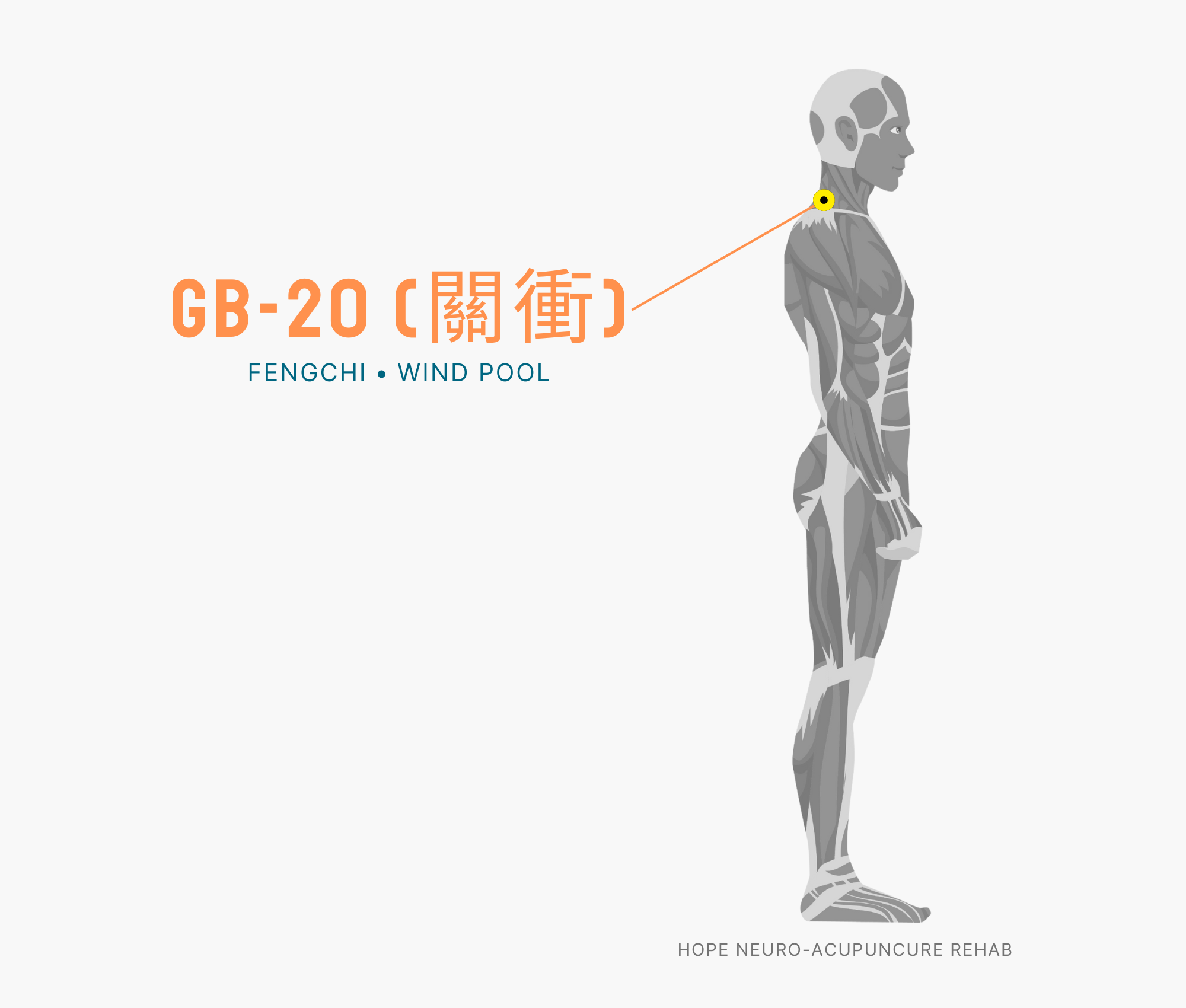
    For headaches, pressing with LR3 (Taichong) is effective (Four Gates combination). For colds, use it together with GB20 (Fengchi).

    ⚠️ Medical Disclaimer: This article is for informational purposes only and does not replace professional medical diagnosis or treatment. If symptoms persist or worsen, please consult a healthcare professional.
  • LI4 (Hegu) or GB20 (Fengchi)? How to Choose the Right Acupressure Point

    LI4 (Hegu) or GB20 (Fengchi)? How to Choose the Right Acupressure Point

    Summary: Comparing LI4 (Hegu) and GB20 (Fengchi)! Learn their locations, benefits, and how to press them at a glance. Easily see which acupoint is better for headaches.
    One-line summary: LI4 (Hegu) is located in the webbing between the thumb and index finger and is good for headaches and colds. GB20 (Fengchi) is located in the hollows below the base of the skull (both sides of the back of the neck) and is good for headaches and neck stiffness. Choose the right one for the situation!

    Why Compare Hegu and Fengchi?

    When a headache strikes, we usually clutch our heads. But the acupoints good for headaches are not on the head — they’re on the hand and neck! LI4 relieves headaches from the hand, and GB20 does it from the back of the neck. Both are good for headaches, but what’s the difference between them?

    LI4 (Hegu) — The ‘All-Purpose Problem Solver’ in the Webbing Between Thumb and Index Finger

    LI4 is located in the webbing between the thumb and index finger. It belongs to the Large Intestine meridian.

    How to Find It

    Open one hand wide and press the most prominent part between the thumb and index finger with the opposite thumb.

    How to Press It

    Press firmly with the thumb, 1–2 minutes, a slightly sore feeling is fine

    Best for

    • Headache
    • Cold
    • Toothache
    • Shoulder and neck stiffness

    GB20 (Fengchi) — The ‘Back-of-Head Guardian’ in the Hollows Below the Skull Base

    GB20 is located in the hollows below the base of the skull, on both sides of the back of the neck. It belongs to the Gallbladder meridian.

    How to Find It

    There are two large muscles on both sides of the back of the head. Outside those muscles, below the skull bone, press upward with both thumbs into the hollows.

    How to Press It

    Press upward toward the head with both thumbs, 1–2 minutes

    Best for

    • Headache
    • Neck stiffness
    • Dizziness
    • Eye fatigue

    Side-by-Side Comparison!

    Category LI4 (Hegu) GB20 (Fengchi)
    Location Webbing between thumb and index finger Hollows below skull base, both sides of back of neck
    Main benefits Headache, cold, toothache, shoulder/neck stiffness Headache, neck stiffness, dizziness, eye fatigue
    Ease of finding Easy Moderate
    Meridian Large Intestine meridian Gallbladder meridian
    Nickname All-purpose problem solver Back-of-head guardian

    Which One Is Right for You?

    • “My forehead is throbbing” → Start with LI4! Effective for frontal headaches.
    • “The back of my head feels heavy and my neck is stiff” → Start with GB20! The specialist for back-of-head and neck headaches.
    • “My eyes hurt and I have a headache from too much screen time” → GB20! It tackles eye fatigue and headaches at the same time.
    • “I have a hazy, foggy headache with cold symptoms” → LI4! It relieves cold symptoms and headaches together.
    • “I get frequent headaches” → Both! Try pressing LI4 → GB20 in sequence.

    Even Better When Used Together!

    Do LI4 first for 1 minute on each hand, then GB20 for 1 minute on each side — in this order, energy flows from the hand (lower) to the head (upper), and the headache becomes noticeably lighter. This combination is the best, especially for tension headaches!

    Frequently Asked Questions

    Can I press LI4 and GB20 together?

    GB20 acupuncture point

    Of course! In fact, pressing both together gives a much better headache relief effect. It’s recommended to do LI4 first, then GB20.

    Which is better for migraines?

    GB20 is better suited for migraines. Releasing the muscles around GB20 improves blood circulation and reduces migraines.

    Can acupressure be used instead of headache medication?

    Acupressure is a supplementary method. If you get severe headaches frequently, be sure to see a doctor. It can be a great help for mild headaches!

    How many times per day is recommended?

    2–3 times per day for each point, 1–2 minutes per session is sufficient. You can also apply it right when a headache comes on.

    Can I use this for my child when they complain of a headache?

    Yes! However, press much more gently than you would for an adult, just rubbing lightly. 30 seconds to 1 minute is enough.

    ⚠️ Pregnancy Warning: Pregnant women should avoid pressing this acupoint as it may stimulate uterine contractions.
    ⚠️ Medical Disclaimer: This article is for informational purposes only and does not replace professional medical diagnosis or treatment. If symptoms persist or worsen, please consult a healthcare professional.
  • HT7 (Shenmen) Location, Benefits, and Acupressure Guide

    HT7 (Shenmen) Location, Benefits, and Acupressure Guide

    Summary: Complete guide to HT7 (Shenmen) acupoint location, benefits, and acupressure technique. Effective for insomnia, anxiety, stress, and heart palpitations — the calming acupoint for your mind.
    One-line summary: HT7 (Shenmen) is the ‘Gateway of the Mind’ acupoint located on the inner wrist. Belonging to the Heart meridian, it is excellent for soothing anxiety, insomnia, and stress. It is the first acupoint to reach for when you cannot fall asleep!

    What is Shenmen?

    Shenmen (神門) literally means ‘the gateway of the spirit (mind)’!

    It is an important point on the Heart meridian that governs the heart and spirit. It acts like a reset button for the mind.

    It is one of the most frequently used acupoints by people in modern times. It can help calm sleepless nights caused by smartphone use, pre-exam jitters, and workplace stress.

    Because it is on the wrist, a major advantage is that you can easily press it anytime, anywhere!

    How to Find HT7

    It is on the wrist, so it is very easy to find!

    1. Turn your palm face up and look at your wrist.
    2. You can see the wrist crease, right? It is on that line.
    3. On the pinky-finger side, find the tendon. When you make a fist, the tendon pops out.
    4. The thumb-side of that tendon is HT7!
    5. When you press it firmly, you will feel a tingling yet refreshing sensation.

    Tip: Look for the slight hollow where the wrist crease meets the tendon!

    Key Benefits of HT7

    1. Improves insomnia — Calms the brain and promotes deep sleep
    2. Reduces anxiety — Eases nervousness and restlessness
    3. Relieves stress — Stabilizes the Heart meridian for overall relaxation
    4. Calms palpitations — Effective when your heart is racing
    5. Lifts low mood — Feels like sunshine breaking through the clouds
    6. Improves concentration — A calm mind leads to better focus

    Self-Acupressure Technique for HT7

    Preparation

    Sit comfortably with one hand facing palm-up.

    Step 1: Locate the Point

    Use the opposite thumb to find HT7.

    Step 2: Press Gently

    • Press gently with your thumb for 3 seconds
    • Release for 2 seconds
    • Repeat 15–20 times

    Step 3: Circular Massage

    • Place your thumb on the point and draw small circles
    • Rotate gently for 1 minute

    Step 4: Both Hands

    Do both wrists. This is especially effective before bed!

    2–3 times per day, especially 30 minutes before sleep, is ideal.

    Acupoints That Work Well Together

    Combination Effect Best for
    HT7 + PC6 (Neiguan) Heart stabilization + anxiety relief When the heart is racing
    HT7 + GV20 (Baihui) Mental calm + sleep improvement When the mind is cluttered and sleep won’t come
    HT7 + SP6 (Sanyinjiao) Mind calming + full-body relaxation When the whole body is tense and fatigued

    Precautions

    • Do not press too hard — the wrist is a sensitive area
    • Avoid if you have pain or an injury in the wrist
    • Start lightly and gradually increase the pressure
    • Drinking a glass of water after acupressure is even better

    Frequently Asked Questions

    Does pressing HT7 make you fall asleep right away?

    HT7 acupuncture point

    Results vary by individual. If you press it consistently for 5–10 minutes before bed, you will gradually feel the effect!

    Can I press it at the office?

    Absolutely! It’s on your wrist, so no one will even notice. Try pressing it lightly before a presentation or whenever you feel tense.

    Do I need to press both sides?

    Yes, it’s best to do both sides. One side still works, but both sides together is even better!

    How long do I need to press to feel the effect?

    1–2 minutes is enough. Pressing consistently is more effective than pressing for a long time all at once.

    What is the difference between HT7 (Shenmen) and PC6 (Neiguan)?

    PC6 acupuncture point

    HT7 specializes in ‘calming the mind,’ while PC6 is better for ‘nausea and chest tightness.’ Both are on the wrist, so using them together is a perfect combination!

    ⚠️ Medical Disclaimer: This article is for informational purposes only and does not replace professional medical diagnosis or treatment. If symptoms persist or worsen, please consult a healthcare professional.
  • Where Is Yanglingquan (GB34)? Location, Benefits, and Technique

    Where Is Yanglingquan (GB34)? Location, Benefits, and Technique

    Quick Summary: Yanglingquan (GB34) acupoint location, benefits, and acupressure guide. Effective for knee pain, leg pain, muscle soreness, and indigestion.
    Quick Summary: Yanglingquan (GB34) is the ‘commander-in-chief of muscles and tendons’ acupoint located on the outer side of the knee. It has remarkable effects on knee pain, leg pain, and muscle tension. An essential point for athletes and anyone with joint discomfort!

    What Is Yanglingquan?

    Yanglingquan means ‘spring at the yang mound’!

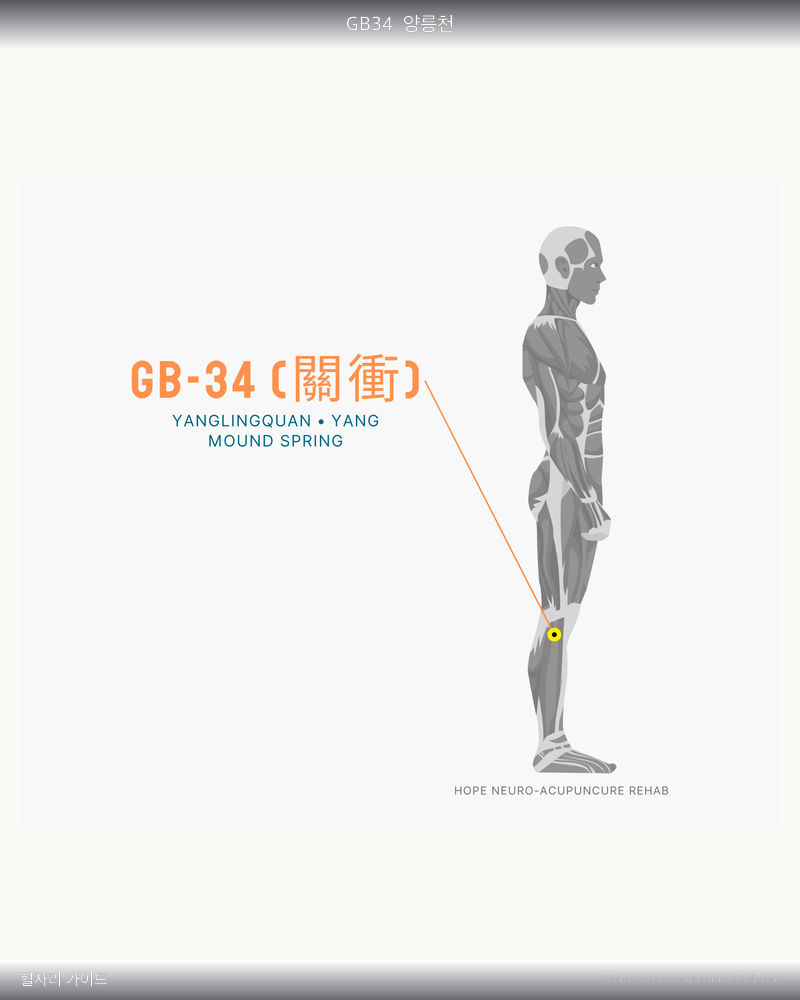
    Located below the outer knee bone (fibular head), it belongs to the Gallbladder meridian. In traditional Chinese medicine, it’s called the Influential Point of Sinews (Jin Hui Xue).

    This means it’s the representative acupoint for all the body’s muscles, tendons, and ligaments! Like a commander-in-chief of muscles, it influences the entire musculoskeletal system.

    When your knee hurts, your legs feel stiff, or you have post-workout soreness — Yanglingquan will be your go-to solution.

    How to Find Yanglingquan

    It’s next to the knee, so it’s easy to find!

    1. Sit in a chair and feel the outer side of your knee.
    2. Below and to the outside of the knee, you’ll feel a round bone protruding. This is the ‘fibular head.’
    3. Press just below and slightly in front of that bone.
    4. The hollow depression is Yanglingquan!
    5. If you feel a dull ache or refreshing sensation when pressing with your thumb, you’ve found it.

    Tip: Bend your knee and trace down the outer side of the leg — the first round bone you meet, Yanglingquan is just below it!

    Key Benefits of Yanglingquan

    1. Relieves knee pain — Directly addresses pain around the knee joint
    2. Eases leg pain — Relieves calf and thigh pain
    3. Aids digestion — Supports gallbladder function to help digest greasy foods
    4. Good for shoulder pain — Though distant, the Gallbladder meridian passes through the shoulder
    5. Releases muscle tension — Relaxes muscles and tendons throughout the body
    6. Reduces flank pain — The Gallbladder meridian passes through the flanks

    Self-Acupressure Technique for Yanglingquan

    Preparation

    Sit comfortably in a chair with knees naturally bent.

    Step 1: Locate the Point

    Find the hollow spot below the fibular head with your thumb.

    Step 2: Press Firmly

    • Press with your thumb for 5 seconds
    • Release for 3 seconds
    • Repeat 10-15 times

    Step 3: Circular Motion

    • Make small circles with your thumb
    • Continue gently for 1-2 minutes

    Step 4: Both Legs

    Do both legs. 2-3 times daily is ideal.

    Before and after exercise: Light pressure before exercise, more thorough pressure after exercise helps prevent muscle soreness!

    Great Acupoint Combinations

    Combination Effect Best For
    Yanglingquan + Zusanli (ST36) Inner + outer knee care Overall knee pain
    Yanglingquan + Hegu (LI4) Muscle pain + whole body relaxation Post-workout whole body soreness
    Yanglingquan + Taichong (LR3) Gallbladder + Liver meridian harmony Flank stiffness and irritability

    Precautions

    • If you have severe knee injury or inflammation, consult a doctor first!
    • After joint replacement surgery, confirm with a specialist first
    • Pressing too hard may cause bruising
    • If blood clots in the leg are suspected, do not do acupressure
    • Stop immediately if pain worsens

    Frequently Asked Questions

    Is Yanglingquan really good for knee pain?

    Yes! As the Influential Point of Sinews, it’s especially effective for musculoskeletal pain including the knees.

    Can I press it before exercise?

    Absolutely! Lightly pressing for 1-2 minutes before exercise helps prevent muscle injuries.

    What’s the difference between Zusanli and Yanglingquan?

    Zusanli specializes in digestion and fatigue, while Yanglingquan specializes in muscles and joints. Both are near the knee but have different roles!

    Why press near the knee for shoulder pain?

    The Gallbladder meridian connects from the shoulder to the leg, so pressing Yanglingquan at the knee can affect the shoulder too. Amazing, right?

    Is it okay to do this every day?

    Yes, daily is fine! Especially if you have weak knees or exercise frequently, daily maintenance is recommended.

    Medical Disclaimer: This article is for informational purposes only and does not replace professional medical diagnosis or treatment. If symptoms persist or worsen, please consult a healthcare professional.
  • 5 Acupoints to Press When You Can’t Sleep

    5 Acupoints to Press When You Can’t Sleep

    Summary: When you can’t sleep, try pressing HT7, GV20, SP6, KI1, and PC6 acupoints. Just 10 minutes lying down and your body will gradually melt into relaxation.
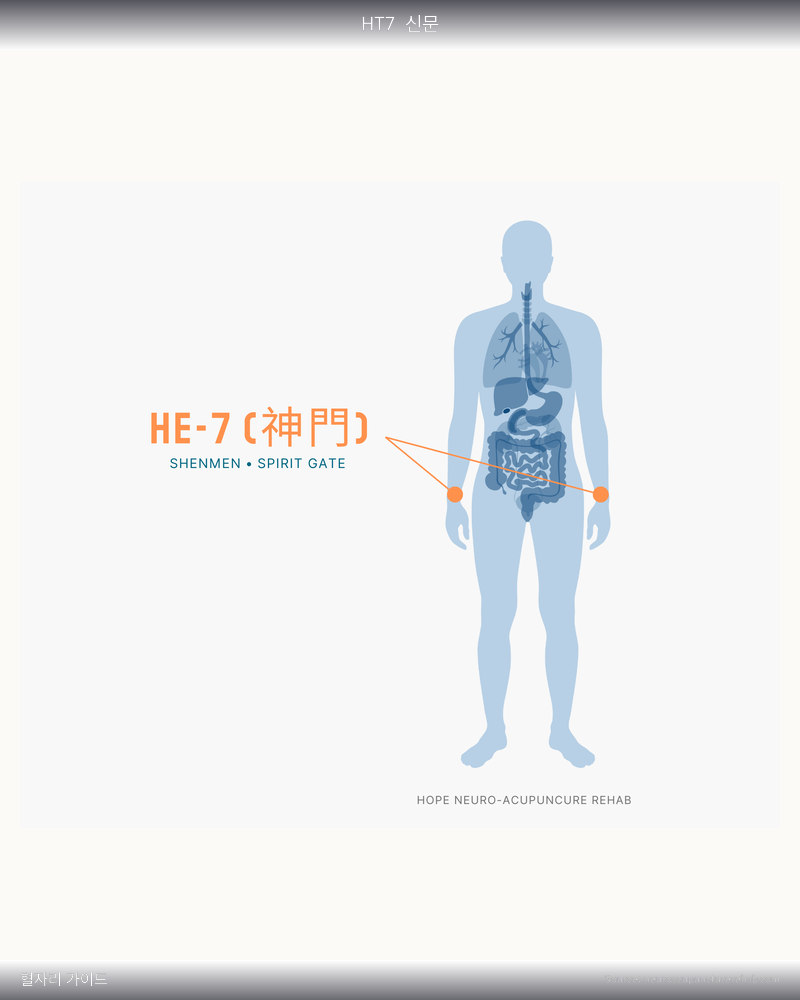
    HT7 혈자리 위치 그림

    Are You Staring at the Ceiling Again Tonight?

    You’ve been in bed for over an hour but your eyes are wide open. Picking up and putting down your phone, tossing and turning… the thought of being tired tomorrow only makes the anxiety worse. You don’t want to resort to sleeping pills, and you wish there was a more natural way to fall asleep.

    Our bodies have acupoints that function like ‘sleep switches,’ activating the parasympathetic nervous system and releasing tension. Gently pressing these points before bed stabilizes the heart rate and signals the brain that ‘it’s time to sleep.’

    1. HT7 (Shenmen) — The Sleep Button on Your Wrist

    Where is it?

    On the inner wrist crease, in the hollow just inside the tendon on the pinky-finger side.

    How to press it

    1. Find HT7 with the opposite thumb and press it firmly
    2. Press for 5 seconds → rest for 3 seconds, repeat 10 times
    3. Do both hands (about 1 minute per side)
    4. Exhaling slowly while pressing is even more effective

    Why does it work? HT7 is the source point (yuan-source) of the Heart meridian. It stabilizes the heart’s qi and calms the mind. It’s especially helpful when you can’t sleep due to anxiety or heart palpitations.

    2. GV20 (Baihui) — Tranquility Descending from the Crown

    Where is it?

    At the very top of the skull, where the line connecting the tips of both ears meets the midline running up from the nose.

    How to press it

    1. Lightly tap GV20 with your middle finger (30 seconds)
    2. Then press firmly with your fingertip for 5 seconds → rest for 3 seconds, 8 times
    3. You will feel a hazy relaxation spreading through your whole head

    Why does it work? GV20 means ‘the place where all meridians meet.’ It lifts yang energy to clear the mind and calms excessive thinking.

    3. SP6 (Sanyinjiao) — The Relaxation Point Where Three Meridians Meet

    Where is it?

    4 finger-widths above the tip of the inner ankle bone, on the inner edge of the shinbone.

    How to press it

    1. Use your thumb to find the sore spot along the inner edge of the shinbone
    2. Press for 5 seconds → rest for 3 seconds, 10 times on each foot
    3. It’s more comfortable to do this lying in bed

    Why does it work? This acupoint is where the three yin meridians of the spleen, liver, and kidney intersect. It replenishes yin energy throughout the body and releases tension. It is also widely beneficial for women’s health.

    4. KI1 (Yongquan) — The Sleep-Inducing Switch on the Sole

    Where is it?

    At the front one-third of the sole, in the hollow that forms when you curl your toes.

    How to press it

    1. Press KI1 firmly with your thumb, repeatedly
    2. Press for 5 seconds → rest for 3 seconds, 10 times on each foot
    3. You will feel your feet warming up as the heat descends from your upper body

    Why does it work? KI1 is the starting point of the Kidney meridian and brings excess heat downward. Cool head, warm feet — the state of ‘cool head and warm feet’ is the ideal condition for sleep.

    5. PC6 (Neiguan) — The Calming Point to Press When Your Chest Feels Tight

    Where is it?

    3 finger-widths up from the inner wrist crease toward the elbow, between two tendons.

    How to press it

    1. Press firmly between the two tendons with the opposite thumb
    2. Press for 5 seconds → rest for 3 seconds, 10 times, both hands
    3. Your chest opens up and breathing becomes easier

    Why does it work? PC6 is the connecting point (luo-connecting) of the Pericardium meridian. It calms chest tightness and nausea. When you can’t sleep from anxiety or tension, pressing it together with HT7 (Shenmen) creates a synergistic effect.

    Quick Overview: 5 Sleep Acupoints

    Acupoint Location Best for Time needed
    HT7 (Shenmen) Inner wrist Anxiety, palpitations 2 min
    GV20 (Baihui) Crown of head Overthinking, racing thoughts 1 min
    SP6 (Sanyinjiao) Above inner ankle Full-body tension, women’s health 2 min
    KI1 (Yongquan) Sole of foot Heat sensation, cooling down 2 min
    PC6 (Neiguan) Inner wrist, higher up Chest tightness, nausea 2 min

    Pre-Sleep Acupressure Routine (10 minutes)

    1. Dim the lights and lie down comfortably
    2. HT7 (Shenmen) 1 minute each hand → calming the mind
    3. PC6 (Neiguan) 1 minute each hand → relaxing the chest
    4. GV20 (Baihui) 1 minute → clearing the mind
    5. SP6 (Sanyinjiao) 1 minute each foot → full-body relaxation
    6. KI1 (Yongquan) 1 minute each foot → releasing heat
    7. Close your eyes and focus on your breathing… 😴

    Frequently Asked Questions

    Can acupressure really help you fall asleep?

    For mild insomnia, many people feel drowsy within 15–20 minutes after acupressure. For chronic insomnia, use it as a supplementary measure and also consult a sleep specialist.

    Do I have to press all 5 points?

    No! Choosing 2–3 points in a comfortable position is sufficient. You can even see results with just HT7 (Shenmen) and KI1 (Yongquan).

    Can I do this lying in bed?

    Yes, it’s actually better to do it lying down. Dimming the lights and breathing slowly while pressing the acupoints increases the relaxation effect.

    Is it okay to do this every day?

    Yes, making it a daily pre-sleep routine makes it even more effective. It becomes a signal to the body that ‘it’s time to sleep.’

    Can pregnant women do this?

    SP6 (Sanyinjiao) can stimulate uterine contractions and is not recommended for pregnant women. The remaining acupoints may be acceptable with light stimulation, but always consult your doctor first.

    ⚠️ Pregnancy Warning: Pregnant women should avoid pressing this acupoint as it may stimulate uterine contractions.
    ⚠️ Medical Disclaimer: This article is for informational purposes only and does not replace professional medical diagnosis or treatment. If symptoms persist or worsen, please consult a healthcare professional.