Author: Acupoint Guide Editorial Team

  • Calf Cramps Relief: 5 Pressure Points That Actually Work

    Calf Cramps Relief: 5 Pressure Points That Actually Work

    One-Line Summary: Calf cramps can be relieved within 3-5 minutes through acupressure on Chengshan, Kunlun, and Yanglingquan points, and daily 5-minute routines can prevent recurrence.

    Introduction

    Most of us have experienced sudden calf cramps at night, jolting us awake with sharp pain. Though momentary, the discomfort is intense. This condition is especially common among adults over 30, pregnant women, and those who exercise frequently.

    Traditional Chinese medicine views calf cramps as a result of “imbalanced qi and blood circulation” and “meridian stagnation.” This aligns with modern medicine’s diagnosis of calcium and magnesium deficiency, muscle fatigue, and reduced blood circulation. The good news is that precise stimulation of specific acupoints can rapidly relieve cramps, and regular acupressure can prevent recurrence at its root.

    This article introduces the 5 most effective acupoints for calf cramps and a simple 5-minute self-massage routine you can start at home right away.

    Five Acupoints Explained

    1. Chengshan (承山) — BL57

    BL57 acupuncture point

    Location: The center of the calf, at the midpoint between the heel and below the knee. It’s the most prominent bulging part of the gastrocnemius muscle on the back of the calf. To find it precisely, lift your toes and a depression will appear on the back of the calf—that’s Chengshan.

    Acupressure Technique: Press firmly with your thumb or finger joint for 3-5 seconds, then release for 2-3 seconds. Repeat 10 times. When a cramp occurs, press Chengshan firmly while slowly stretching your calf for rapid relief.

    Benefits: Chengshan is the “miracle point” for calf cramps. Located directly above the cramping muscle, it sends an immediate relaxation signal. It also relieves leg fatigue and reduces ankle swelling effectively.

    2. Kunlun (昆侖) — BL60

    BL60 acupuncture point

    Location: On the outer side of the foot, at the midpoint between the lateral malleolus (ankle bone) and the heel. Trace along the outside of your ankle with your finger to find the depression behind the ankle bone.

    Acupressure Technique: Press firmly with your thumb for 3-5 seconds, then release for 2 seconds. Repeat 15 times. Stimulate both ankles the same way. This is especially effective when done in the evening or before bed as a daily habit.

    Benefits: Kunlun regulates cramps, pain, and swelling in the ankle and lower leg. By promoting meridian flow, it relieves not only calf cramps but also lower back pain and heavy headedness.

    ⚠️ Warning for Pregnant Women: Kunlun can trigger uterine contractions. Please avoid this acupoint during pregnancy.

    3. Yanglingquan (陽陵泉) — GB34

    GB34 acupuncture point

    Location: On the outer side of the calf, in the depression in front of the fibula (the outer bone below the knee). This point is easiest to find when the knee is bent.

    Acupressure Technique: Press slowly with your thumb for 10-15 seconds, rest for 2 seconds, and repeat. Stimulate 2-3 times daily (morning, afternoon, and evening) for 1 minute each time to optimize cramp prevention.

    Benefits: Yanglingquan is known as the “muscle acupoint,” relieving cramps and stiffness not only in the calf but throughout the leg. As it governs the gallbladder meridian, it also improves digestion and reduces stress.

    4. Weizhong (委中) — BL40

    BL40 acupuncture point

    Location: Behind the knee, at the center of the crease that forms when the knee is bent. Pressing with your finger creates a slight depression.

    Acupressure Technique: Press firmly with your thumb or middle finger for 3-5 seconds, rest for 2 seconds, and repeat 10 times. This is easier to perform when the knee is slightly bent.

    Benefits: Weizhong is a major acupoint on the bladder meridian, excellent for relieving cramps and pain throughout the leg. It’s especially effective for cramps in the entire posterior leg from calf to thigh. It’s also widely used to improve lower back pain and leg numbness symptoms.

    5. Zusanli (足三里) — ST36

    ST36 acupuncture point

    Location: Below the knee on the outer side, along the outer edge of the shinbone (tibia). It’s located about 10cm (four finger widths) below the hollow area beneath the knee.

    Acupressure Technique: Press slowly downward with your thumb for 10-20 seconds. Practice 1-2 times daily for 3-5 minutes each session. Benefits accumulate with consistent acupressure.

    Benefits: Zusanli is called the “universal healing point,” enhancing overall vitality and immunity. Beyond preventing calf cramps, it accelerates leg fatigue recovery, promotes digestion, and increases whole-body energy. With regular long-term practice, overall qi and blood circulation improves, reducing cramps naturally.

    5-Minute Self-Massage Routine

    Goal: Practicing this routine for 5 minutes each evening or before bed will noticeably reduce calf cramp frequency within 1-2 weeks. When cramps occur, immediately focus on pressing Chengshan and Kunlun.

    5-Minute Routine Sequence:

    1. Preparation (30 seconds): Sit comfortably and gently massage both calves and ankles to activate blood circulation.
    2. Chengshan Acupressure (1 minute): Press Chengshan on your left calf firmly with your thumb for 3-5 seconds each time, repeating 10 times. Do the same on the right side.
    3. Yanglingquan Acupressure (1 minute): Slowly press and massage Yanglingquan below the left knee. Do the same on the right side.
    4. Weizhong Acupressure (1 minute): Press Weizhong behind the left knee for 3-5 seconds, release, and repeat. Do the same on the right side.
    5. Zusanli + Kunlun (1 minute): Press both Zusanli points for 10 seconds each, then gently press Kunlun on the outside of the ankle for 20 seconds.
    6. Closing (30 seconds): Lightly brush down the entire calf with your fingers to allow the acupoint stimulation to spread throughout your body.

    Additional Tips:

    • Warm your calf for about 30 seconds with a heating pad or warm cloth before acupressure for better muscle relaxation and effectiveness.
    • Drinking lukewarm water after acupressure promotes meridian circulation.
    • Combined with stretching, cramp prevention effectiveness increases by over 30%.
    • If nighttime cramps occur frequently, try dividing the routine into three sessions: 2:00 PM, 6:00 PM, and before bed.
    ⚠️ Medical Disclaimer: This article is provided for informational purposes only and does not replace professional medical diagnosis or treatment. If calf cramps persist, pain is severe, or other symptoms occur (swelling, skin discoloration, warmth), consult a healthcare professional (doctor or licensed acupuncturist). Cramps can signal other conditions such as deep vein thrombosis or myopathy, so do not rely solely on self-treatment without proper diagnosis.
    🤰 Warning for Pregnant Women: The acupoints Kunlun (BL60), Yanglingquan (GB34), and Weizhong (BL40) in this article can trigger uterine contractions in pregnant women. If you are pregnant or may be pregnant, perform only Zusanli (ST36) and Chengshan (BL57), or consult a licensed acupuncturist before proceeding.
  • 5 Acupressure Points for Abdominal Bloating — Quick Self-Massage Guide

    5 Acupressure Points for Abdominal Bloating — Quick Self-Massage Guide

    One-line summary: Abdominal bloating can be effectively relieved by accurately stimulating five acupoints: CV12, CV6, ST36, SP6, and LR3. With just 5 minutes of daily self-acupressure, digestive function improves and gas release becomes easier.

    Abdominal bloating: Why does it happen, and how can acupoints help?

    After eating a meal, your belly feels uncomfortably bloated and tight in your clothes, and digestion seems sluggish. This is abdominal bloating. Western medicine diagnoses it as indigestion, gas retention, or decreased intestinal motility, but in traditional Eastern medicine, it’s viewed as “disrupted qi circulation.” In other words, the qi (vital life energy) in your stomach, small intestine, and large intestine cannot flow smoothly, causing delays in food digestion and elimination.

    Acupressure works by stimulating specific meridian points to normalize qi flow through the meridians, promote peristalsis in the digestive organs, and activate the enteric nervous system (the second brain). This allows you to naturally relieve abdominal bloating without medication. It’s especially effective for bloating caused by eating after meals, stress, and irregular eating habits.

    Five effective acupoints for abdominal bloating

    1. CV12 (Zhongwan) — The center of the stomach, the hub of digestion

    Location: Located four finger-widths (approximately 10cm) above the navel, at the midpoint between the lower end of the sternum and the navel. You can think of it as being directly below the epigastrium.

    Acupressure technique: Apply slow, steady pressure using your thumb or middle finger while the abdomen is relaxed. Press for 5 seconds while exhaling, then slowly release while inhaling. Repeat for 1-2 minutes.

    Effects: Normalizes stomach function, promotes food digestion, and directly alleviates bloating caused by excess stomach acid or indigestion. It also relieves epigastric discomfort, loss of appetite, and belching. This acupoint is recorded in the Donguibogam (Principles and Practice of Eastern Medicine) as a “special acupoint for chronic indigestion.”

    2. CV6 (Qihai) — The sea of vital energy

    Location: Located one-and-a-half finger-widths (approximately 1.5cm) below the navel, in the small depression directly below the navel.

    Acupressure technique: Gently massage in circular motions clockwise using your middle or index finger, or apply slow pressure for 3-5 seconds. Practice 1-2 times daily, 1-2 minutes each time. Avoid pressing too hard, as excessive pressure can increase abdominal discomfort.

    Effects: Activates the qi energy of the entire digestive system and promotes intestinal movement to facilitate gas expulsion. It’s particularly effective for those with naturally weak digestive function, and consistent acupressure improves immunity as well. Especially beneficial for bloating accompanied by chronic fatigue and abdominal coldness.

    3. ST36 (Zusanli) — A tonic for immunity and digestion

    ST36 acupuncture point

    Location: Located four finger-widths (approximately 10cm) below the outer side of the knee, in the center of the outer calf. You can find it by moving downward from the depression below the knee.

    Acupressure technique: Apply slow, steady pressure using your thumb or finger knuckles, aiming for a slight, pleasant tenderness. Press for 5 seconds, rest for 5 seconds, and repeat 5-10 times. Alternatively, gently massage the area for 1-2 minutes.

    Effects: Strengthens the function of the entire digestive system and promotes enteric nerve activity to normalize peristalsis. It also activates the immune system to reduce digestive inflammation, improving not only abdominal bloating but also chronic diarrhea and constipation. You can stimulate this acupoint anytime during the day.

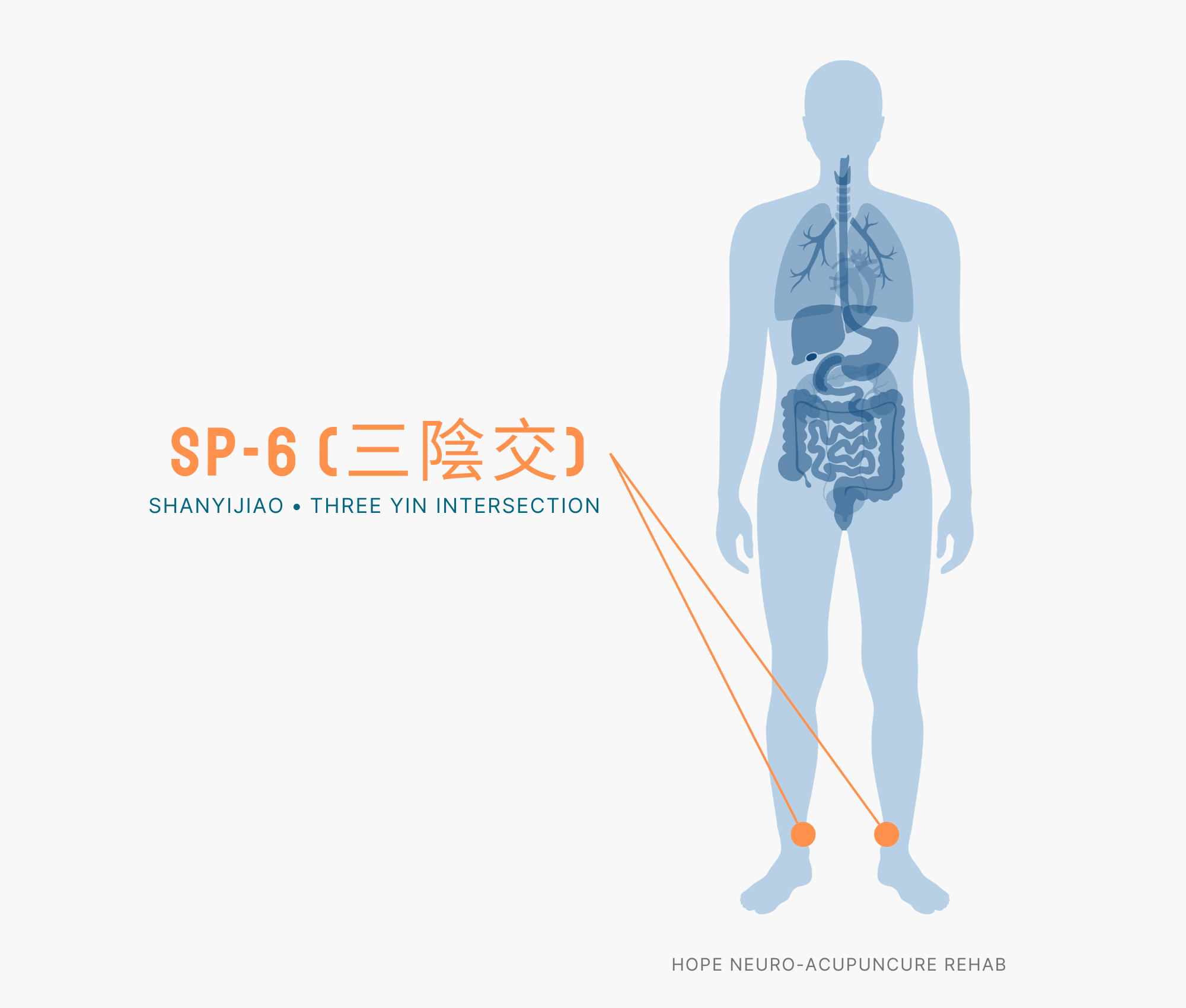
    4. SP6 (Sanyinjiao) — The intersection of digestion, reproduction, and urinary function

    SP6 acupuncture point

    Location: Located four finger-widths (approximately 10cm) above the inner ankle bone, in the center of the inner calf. Find it by following the inner edge of the tibia upward.

    Acupressure technique: Slowly press and release with your thumb for 3-5 seconds at a time, or gently massage in circular motions for 1-2 minutes. If you feel a warm sensation or lightness after acupressure, you’re stimulating the point correctly.

    Effects: This acupoint comprehensively regulates the digestive, urinary, and reproductive systems. Besides relieving abdominal bloating, it also improves uterine contractions, irregular menstruation, and coldness in the pelvic area. It’s particularly effective for bloating caused by hormonal changes in women, such as premenstrual syndrome.

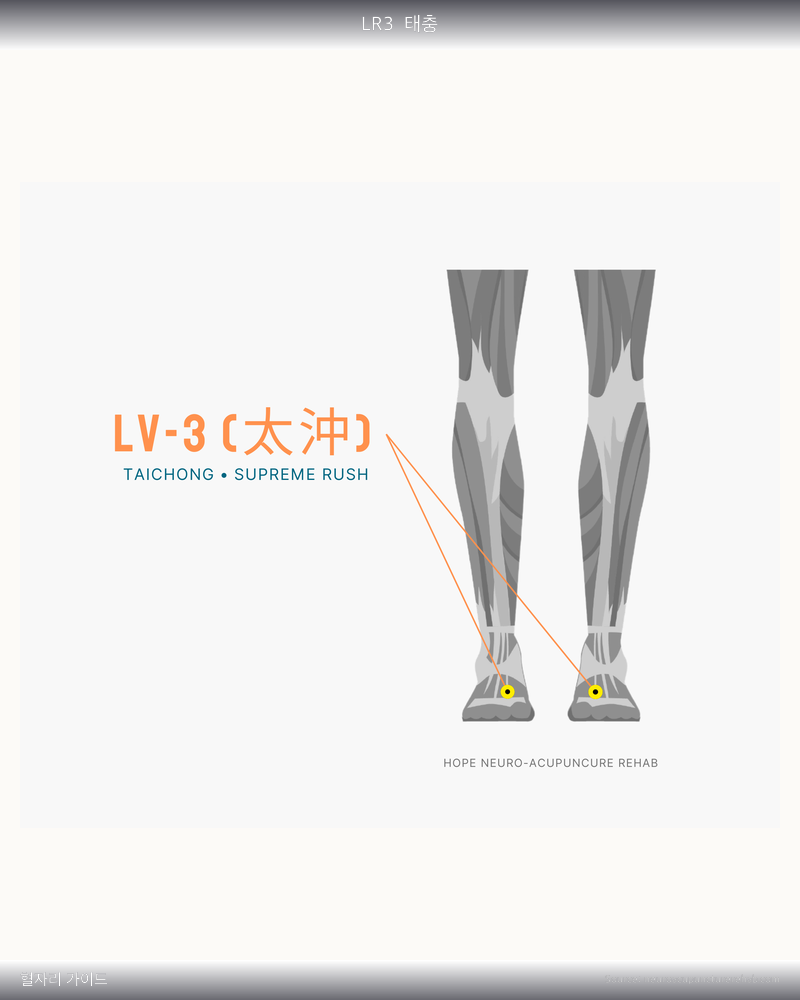
    5. LR3 (Taichong) — The connection between stress and digestion

    Location: Located between the first and second toes on the top of the foot, approximately one-and-a-half finger-widths above the foot’s surface. You’ll feel a slight depression and tenderness when you touch it.

    Acupressure technique: Slowly press and release with your thumb for 3-5 seconds at a time, or massage in circular motions using your finger knuckles. Apply enough pressure to feel a slight ache, but avoid excessive force. 1-2 minutes is sufficient.

    Effects: Promotes qi circulation in the liver and improves intestinal movement impaired by stress. It’s especially effective for abdominal bloating caused by emotional stress and work fatigue, while simultaneously relieving headaches, eye strain, and menstrual cramps. It normalizes nerve regulation of digestive organs and restores balance to the gut-brain axis.

    5-minute self-acupressure routine — Actual sequence and time distribution

    Preparation (1 minute): Sit or lie down in a comfortable position and allow your abdomen to fully relax. Take 3 deep breaths, inhaling and exhaling slowly to prepare your body and mind.

    Acupressure sequence:

    • Step 1 (1 minute): CV12 (Zhongwan) — Place your middle fingers, one on top of the other, on CV12 and press for 5 seconds while exhaling, then release for 5 seconds while inhaling. Repeat this cycle.
    • Step 2 (1 minute): CV6 (Qihai) — Gently massage CV6 below the navel in clockwise circular motions, or press and release repeatedly for 5 seconds at a time.
    • Step 3 (1 minute): ST36 (Zusanli) on both sides — Stimulate the left leg’s ST36 for 30 seconds, then the right leg for 30 seconds. With your knee bent, apply slow pressure using your thumb.
    • Step 4 (1 minute): SP6 (Sanyinjiao) and LR3 (Taichong) on both sides — Alternately stimulate the left SP6 for 30 seconds and the right SP6 for 30 seconds. (LR3 can be included or excluded depending on your situation.)

    Closing (1 minute): Place your hands on your abdomen and slowly massage in clockwise circular motions to activate blood circulation and digestive function. Drink warm water to enhance the effects.

    Frequency: Practice 1-2 times daily, preferably at least 1 hour after eating or before bed. With consistent daily practice, you should notice easier gas expulsion within 1-2 weeks, and significant improvement in chronic bloating after 4 or more weeks of continued practice.

    ⚠️ Medical disclaimer: This article is provided for informational purposes and does not replace professional medical diagnosis or treatment. If you experience severe abdominal bloating, pain, vomiting, constipation or diarrhea, or symptoms lasting more than 2 weeks, please consult a healthcare professional (acupuncturist, gastroenterologist, or doctor). If you have a specific condition such as irritable bowel syndrome, inflammatory bowel disease, or bowel obstruction, please obtain a diagnosis before performing acupressure.
    🤰 Pregnancy warning: Among the acupoints mentioned above, SP6 (Sanyinjiao) and LR3 (Taichong) can trigger uterine contractions and should not be used during pregnancy. CV12 (Zhongwan), CV6 (Qihai), and ST36 (Zusanli) are relatively safe; however, if you are pregnant or may be pregnant, please consult a healthcare professional before practicing acupressure. During pregnancy, it is best to minimize abdominal stimulation.
  • 5 Acupressure Points for Breast Pain — Quick Self-Massage Guide

    5 Acupressure Points for Breast Pain — Quick Self-Massage Guide

    One-line Summary: Breast pain is effectively relieved by stimulating chest acupoints such as Danzhong, Zhuozhong, Yuruan, and improving liver function through Taichong. Start with 5 minutes of self-massage daily.

    Introduction

    Breast pain is a common symptom experienced by one in three women. It occurs when hormonal changes related to the menstrual cycle, stress, uncomfortable clothing, and poor posture combine. Recurring pain significantly diminishes quality of life.

    In traditional Chinese medicine, breast pain is called “breast qi stagnation,” occurring when qi becomes obstructed in the meridians passing through the chest or when liver function declines. Fortunately, stimulating key acupoints in the chest area can improve qi flow and relieve pain. Self-massage acupressure, which can be done anytime and anywhere without medication, has become the preferred choice for many people.

    5 Acupoints for Relieving Breast Pain

    1. Danzhong (REN17) — The “Master Acupoint” for Regulating Emotion and Qi

    Location: The midpoint between the two nipples, equidistant from both sides of the center of the chest. It can be found by descending along the center of the chest from below the collarbone.

    Massage Technique: Overlap the thumbs of both hands and gently press perpendicular to Danzhong, repeating the pressing and releasing motion. Press for about 3-5 seconds each time before slowly releasing. Be careful not to stimulate to the point of causing pain.

    Effects: Danzhong, known as the “heavenly balance,” is an acupoint that regulates emotion and qi. It can simultaneously address stress and qi stagnation that cause breast pain. It also has excellent effects on relieving anxiety and promoting mental and physical calm.

    2. Zhuozhong (ST16) — Direct Treatment Point for Breast Pain

    ST16 acupuncture point

    Location: The upper part of each breast, at the intersection of the collarbone and the first intercostal space (between the first ribs). There is one on each side.

    Massage Technique: Use the middle and ring fingers of both hands together to gently massage Zhuozhong with slow, circular motions. Stimulate each acupoint for about 2-3 minutes. Strong pressure can cause discomfort, so maintaining appropriate pressure intensity is important.

    Effects: This acupoint directly promotes qi and blood circulation in the breast area, showing the most immediate effect on relieving breast pain and hardness. As blood circulation improves, pain and discomfort decrease rapidly.

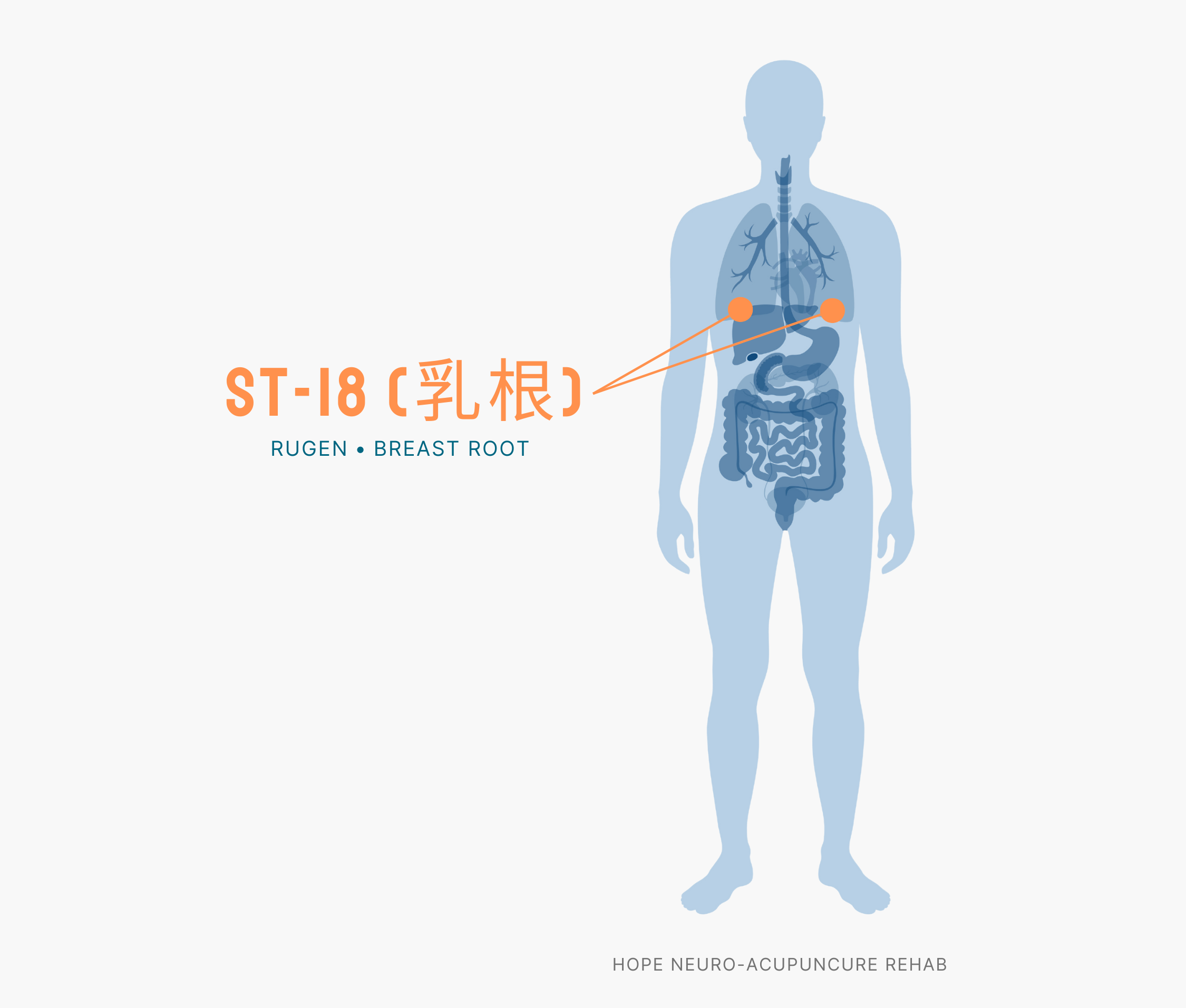
    3. Yuruan (ST18) — Acupoint for Relieving Lower Breast Pain

    ST18 acupuncture point

    Location: Directly below the breast, in the fifth intercostal space (between the fifth and sixth ribs). It is located below the lower boundary line of the breast.

    Massage Technique: Place the thumbs of both sides on Yuruan simultaneously and press slowly. It is recommended to use breathing-guided massage: increase pressure while inhaling and release while exhaling. Repeat 10 times, holding for 3-5 seconds each time.

    Effects: This acupoint effectively relieves breast pain, especially pain in the lower breast or extending to the sides. It is particularly helpful when intercostal neuralgia is involved.

    4. Qimen (GB22) — Specialized Acupoint for Stress-Related Breast Pain

    GB22 acupuncture point

    Location: Below the armpit, directly below the center of the axilla when the arm is raised, between the third rib. There is one on each side under the arms.

    Massage Technique: Lower your arm to your chest and use the middle finger of the opposite hand to locate Qimen and massage with circular motions. To stimulate both sides simultaneously, you can use both middle fingers. Massage each acupoint for 3-5 minutes.

    Effects: As a major acupoint of the gallbladder meridian, it is excellent for relieving breast pain caused by stress and tension. It is particularly effective for pain caused by nervous tension and pre-menstrual breast pain.

    5. Taichong (LR3) — Improving Liver Function to Address Root Causes

    Location: On the top of the foot, slightly above where the bones of the big toe and second toe meet. It can be found by following the raised area of the foot upward.

    Massage Technique: Sit and place one foot on your lap, then slowly press and massage Taichong with your thumb. Repeat by pressing for 5 seconds and resting for 5 seconds while breathing, massaging each foot for 2-3 minutes. Apply to both feet.

    Effects: A key acupoint for regulating liver function, it addresses the root causes of breast pain from hormonal imbalance and stress. It is also often accompanied by improvement in irregular menstruation, emotional fluctuations, and chronic fatigue.

    5-Minute Self-Massage Routine

    Here is a 5-minute routine that can be practiced even during a busy day. Perform once or twice daily, in the morning or evening.

    1. Preparation (30 seconds): Sit or lie comfortably and take 3-4 deep breaths to relax your body and mind.
    2. Danzhong Massage (1 minute): Overlap the thumbs of both hands and press Danzhong 30 times with gentle, rhythmic pressure.
    3. Zhuozhong & Yuruan Massage (2 minutes): Massage both sides of Zhuozhong with circular motions for 1 minute each. (Total: 1 minute) Then massage Yuruan on both sides for 30 seconds each. (Total: 1 minute)
    4. Qimen Massage (1 minute): Simultaneously massage both sides of Qimen with circular motions for 1 minute.
    5. Taichong Massage (30 seconds): As a finish, stimulate Taichong on both feet for 15 seconds each with quick, firm pressure.
    6. Cool Down (30 seconds): Take 3-4 deep breaths to allow energy to spread throughout your body.

    💡 Tip: Consistency is key. You can feel results if you continue for more than 3 weeks. Rather than doing this only when you have pain, practice regularly as a preventive measure.

    ⚠️ Medical Disclaimer: This article is written for informational health purposes and does not replace professional medical diagnosis or treatment. If symptoms persist or are severe, be sure to consult with a healthcare professional.
    🤰 Pregnancy Warning: Among the acupoints above, Taichong (LR3) may cause uterine contractions in pregnant women. If you are pregnant or may be pregnant, be sure to consult with a professional before practicing. The other acupoints—Danzhong, Zhuozhong, Yuruan, and Qimen—are generally safe, but it is recommended to consult with your doctor before trying any new procedures during pregnancy.
  • Atopy Relief: 5 Pressure Points That Actually Work

    Atopy Relief: 5 Pressure Points That Actually Work

    One-line summary: Atopic dermatitis is a skin condition caused by poor qi-blood circulation and weakened immunity. Stimulating 5 key acupoints—Sanyinjiao, Quchi, Xuehai, Hegu, and Feishu—can help relieve itching and improve skin condition.

    Introduction

    Have you ever experienced scratching so much at night that it bleeds, or insomnia due to unbearable itching? Atopic dermatitis is not just a skin condition but a systemic symptom caused by immune system imbalance. In traditional Chinese medicine, atopy is viewed as ‘Spleen Qi Deficiency with Excess Dampness (Pi Xu Shi Sheng)’—a condition where the spleen weakens and moisture accumulates in the body. Acupoint pressure therapy effectively promotes qi-blood circulation, restores immune function, and naturally alleviates atopic symptoms. In particular, self-massage is a great supplementary method to medical treatment since it can be done anytime and anywhere.

    5 Effective Acupoints for Atopy Relief

    1. Sanyinjiao (SP6) — The Center for Hormonal Balance

    SP6 acupuncture point

    Location: Four finger-widths above the highest point on the inner ankle, toward the shin

    WHO Code: SP6

    Benefits: Sanyinjiao is where the Spleen, Liver, and Kidney meridians converge. It excels at balancing female hormones, enhancing immunity, and improving digestion. It strengthens spleen function—the root cause of atopy—and eliminates dampness. It also prevents atopy flare-ups by relieving stress.

    Massage technique: Press with your thumb for 3 seconds, then release for 2 seconds, and repeat. Perform for 3 minutes at a time, twice daily (morning and evening). Start gently and gradually increase pressure.

    2. Quchi (LI11) — The Premier Point for Inflammation and Itching Relief

    LI11 acupuncture point

    Location: The outer end of the elbow crease when the elbow is bent at 90 degrees (thumb side)

    WHO Code: LI11

    Benefits: This point clears heat from the Large Intestine meridian, directly alleviating skin inflammation and suppressing itching. It calms overactive immune responses and reduces irritation by lowering skin temperature.

    Massage technique: Slowly press with your opposite thumb while making small circles. Massage for about 1 minute in the morning and 1 minute in the evening. It’s more effective if done after soaking your arm in warm water in a bathtub.

    3. Xuehai (SP10) — The Fundamental Point for Skin Improvement

    SP10 acupuncture point

    Location: Two to three finger-widths above the inner side of the knee, on the inner thigh

    WHO Code: SP10

    Benefits: Known as ‘The Blood Point,’ Xuehai purifies the blood and nourishes the skin. It restores skin dryness and depletion caused by atopy and repairs the skin barrier damaged by prolonged irritation.

    Massage technique: Sit down, bend your knee slightly for comfort, and repeatedly press with your thumb for 3 seconds each time. Perform for 3 minutes once daily.

    4. Hegu (LI4) — The Versatile Point for Immunity Enhancement

    LI4 acupuncture point

    Location: The hollow between the thumb and index finger (where a crease forms when the fingers are together)

    WHO Code: LI4

    Benefits: One of the most widely used acupoints in traditional medicine, it’s effective at enhancing immunity, relieving stress, and suppressing inflammation. It alleviates excessive stress—a major atopy aggravator—and promotes qi-blood circulation throughout the body.

    Massage technique: Slowly press with your opposite thumb while making circles. Alternate between both hands, pressing for 1 minute each, twice daily. It’s best to do this when you wake up and before bed.

    5. Feishu (BL13) — Improving Lung Function and Skin Respiration

    BL13 acupuncture point

    Location: Between the shoulder blades on the back of the body, two finger-widths lateral to the spine at the level of the 3rd thoracic vertebra

    WHO Code: BL13

    Benefits: This point strengthens lung function and improves skin nourishment. The respiratory system and skin are closely related; enhancing lung function improves skin metabolism and oxygen supply, helping relieve atopic symptoms.

    Massage technique: Since it may be difficult to do alone, seek help from someone else or stimulate by placing a tennis ball against your back and rolling it slowly. Alternatively, receiving regular moxibustion therapy from a professional is also beneficial.

    5-Minute Self-Massage Routine

    Preparation: Sit comfortably and expose your hands and legs. Apply a small amount of lotion or essential oil to reduce friction.

    1. Sanyinjiao (SP6) – 1 minute (30 seconds on each side or 1 minute on one side)
    2. Xuehai (SP10) – 1 minute (30 seconds on each side)
    3. Quchi (LI11) – 1 minute (30 seconds on each side)
    4. Hegu (LI4) – 1 minute (30 seconds on each side)
    5. Feishu (BL13) – 1 minute (use a tennis ball for 1 minute if doing it alone is difficult)

    Frequency: Perform daily, or twice daily (morning and evening) during atopy flare-ups. Practice on an empty stomach or at least 2 hours after meals.

    🤰 Pregnancy Warning: Sanyinjiao (SP6) and Hegu (LI4) can trigger uterine contractions in pregnant women. If you are pregnant or might be pregnant, consult a professional before practicing. Feishu (BL13) also requires careful stimulation, so confirm with a healthcare provider before performing.
    ⚠️ Medical Disclaimer: This article is provided for informational purposes and does not substitute for professional medical diagnosis or treatment. If symptoms persist or are severe, consult a healthcare professional (dermatologist or acupuncturist). Since individual differences are significant, please consider your constitution and health status before practicing.
  • How to Relieve Arthritis Naturally with These 5 Pressure Points

    How to Relieve Arthritis Naturally with These 5 Pressure Points

    One-line Summary: Pressing five acupoints daily for 5 minutes—Pool at the Bend (LI11), Union Valley (LI4), Committee Middle (BL40), Three Yin Crossing (SP6), and Yin Spring at the Mound (SP9)—can help relieve arthritis pain and stiffness.

    The Relationship Between Arthritis and Acupoint Pressure

    Arthritis is a persistent problem affecting many middle-aged and older people. Pain and stiffness in various joints—knees, wrists, ankles, shoulders—greatly limit daily activities. In traditional Chinese medicine, arthritis is viewed as resulting from “insufficient qi and blood circulation” and “blocked meridians.” By stimulating specific acupoints, you can unblock the meridians and allow qi and blood to flow smoothly, reducing inflammation and pain. In particular, self-acupressure has the advantage of being performed at home anytime without visiting a hospital.

    Five Effective Acupoints for Arthritis Relief

    1. Pool at the Bend (LI11) — The All-Purpose Elbow Acupoint

    LI11 acupuncture point

    WHO Code: LI11 (Large Intestine Meridian 11) | Location: At the outer end of the elbow crease when the arm is bent

    Pool at the Bend excels at relieving overall pain and stiffness in the arm. It is particularly effective for arm, elbow, and shoulder pain caused by arthritis. For acupressure, press with your thumb for 3–5 seconds, release, and repeat; or apply circular pressure in a clockwise direction 20–30 times. The ideal intensity is “tender but pleasantly sore” (a comfortable pressure sensation). With consistent stimulation, you’ll gradually notice relief in arm stiffness and an increased range of motion.

    2. Union Valley (LI4) — The Acupoint for Full-Body Pain Relief

    LI4 acupuncture point

    WHO Code: LI4 (Large Intestine Meridian 4) | Location: In the hollow between the thumb and index finger

    This acupoint is so famous that there’s a traditional medicine saying: “If you know only Union Valley, you need not fear a hundred ailments.” Union Valley is excellent at promoting qi and blood circulation throughout the body and reducing pain. It helps not just with arthritis in the fingers and wrists, but with inflammatory pain throughout the body. Press firmly with the thumb of the opposite hand, alternating between both hands for even greater effect. It is recommended to stimulate each hand for 2–3 minutes, three times daily.

    🤰 Pregnancy Warning: Union Valley (LI4) can trigger uterine contractions in pregnant women, so it should be avoided during pregnancy.

    3. Committee Middle (BL40) — The Remedy for Leg Arthritis

    BL40 acupuncture point

    WHO Code: BL40 (Bladder Meridian 40) | Location: At the center of the crease behind the knee

    If you have knee arthritis, this is the first acupoint you should stimulate. Committee Middle improves blood circulation throughout the leg and quickly relieves knee inflammation and pain. It’s also effective when your legs feel stiff from prolonged sitting. Press both knees’ Committee Middle points with both thumbs continuously for 3–5 minutes. If you follow up by slowly bending and straightening your knees 5–10 times, the effect will be even greater. If you have knee discomfort due to arthritis, acupressure daily is recommended.

    4. Three Yin Crossing (SP6) — The Intersection Point of Full-Body Qi and Blood Circulation

    SP6 acupuncture point

    WHO Code: SP6 (Spleen Meridian 6) | Location: Four finger widths above the inner ankle bone (on the inner side of the shin bone)

    Three Yin Crossing is where the Liver, Spleen, and Kidney meridians meet, making it an important point for promoting qi and blood circulation throughout the body. It is particularly effective for relieving arthritis pain in the legs and ankles while also strengthening overall body immunity. Press firmly with your thumb and apply circular pressure for 30 seconds to 1 minute. Stimulate both legs alternately, two times daily, for best results. Consistent stimulation contributes to reducing inflammatory responses throughout the body.

    🤰 Pregnancy Warning: Three Yin Crossing (SP6) can trigger uterine contractions and should be avoided during pregnancy.

    5. Yin Spring at the Mound (SP9) — The Specialized Acupoint for Knee Joints

    WHO Code: SP9 (Spleen Meridian 9) | Location: In the hollow on the inner side of the shin bone below the knee

    This acupoint shows excellent results for knee arthritis, particularly for inner knee pain. As the convergence point of the Spleen meridian, Yin Spring at the Mound excels at removing moisture and inflammation around the joint. If you experience swelling and stiffness due to knee arthritis, this acupoint can help. Using your thumb, press until you feel tenderness, hold for 5–10 seconds, then slowly release; repeat 10 times. Stimulate this point twice daily for 5 minutes each time, and you should notice changes within 1–2 weeks.

    5-Minute Self-Acupressure Routine

    For the best results, perform acupressure in the following order at the same time each day.

    1. Warm-up (30 seconds): Sit in a comfortable position and take 3 deep breaths.
    2. Union Valley (LI4) Stimulation (1 minute): Alternate between both hands, pressing Union Valley for 1 minute total.
    3. Pool at the Bend (LI11) Stimulation (1 minute): Press Pool at the Bend on each arm for 30 seconds in turn. (Total: 1 minute)
    4. Committee Middle (BL40) Stimulation (1 minute): Stimulate Committee Middle on both knees for 30 seconds each. (Total: 1 minute)
    5. Yin Spring at the Mound (SP9) Stimulation (45 seconds): Stimulate Yin Spring at the Mound below both knees for 20 seconds each.
    6. Three Yin Crossing (SP6) Stimulation (45 seconds): Stimulate Three Yin Crossing on the inner sides of both ankles for 20 seconds each.
    7. Cool-down (15 seconds): Take 2 slow, deep breaths and finish.

    Tip: The best results come from performing this routine twice daily—after waking in the morning and before bed at night. Drinking warm water right after acupressure further promotes qi and blood circulation.

    ⚠️ Medical Disclaimer: This article is provided for informational purposes and does not substitute for professional medical diagnosis or treatment. If arthritis symptoms persist or worsen, or if symptoms aggravate after self-acupressure, please consult with a healthcare professional (doctor or acupuncturist).
  • Acid Reflux? Press These 5 Points for Natural Relief

    Acid Reflux? Press These 5 Points for Natural Relief

    One-Line Summary: Acid reflux symptoms can be relieved through self-acupressure on five acupoints—Zhongwan, Zusanli, Neiguan, Sanyinjiao, and Taichong—and regular practice can improve digestive function.

    Introduction

    Have you ever experienced acid reflux at night or a burning sensation in your chest area? Acid reflux is a common digestive issue in modern life, increasing due to stress, irregular eating habits, and consumption of irritating foods. While medication is important, acupoint acupressure in traditional medicine activates the body’s natural healing abilities to fundamentally relieve acid reflux symptoms. Self-acupressure is particularly popular because it can be performed anytime, anywhere, and without cost. This article explains in detail the five most effective acupoints for acid reflux relief and the correct acupressure techniques.

    Five Effective Acupoints for Acid Reflux

    1. Zhongwan (中脘) — CV12

    Location: Approximately 4 cun (about 12 cm or the width of four fingers) directly above the umbilicus. It is located at the midpoint between the end of the sternum and the umbilicus.

    Benefit: Zhongwan is the central acupoint for digestive function, normalizing gastric acid secretion and promoting gastric peristalsis. It immediately relieves acid reflux, indigestion, and abdominal bloating, and consistent acupressure improves long-term gastric health.

    Technique: Sit or lie in a comfortable position, then place the tip of your thumb vertically on Zhongwan. Slowly press for 5 seconds and release for 5 seconds, repeating about 10-15 times per session. Start gently and gradually increase pressure.

    2. Zusanli (足三里) — ST36

    ST36 acupuncture point

    Location: About 4 cun (approximately 12 cm) below the outer side of the knee. It is located at the point where the muscle beside the tibia begins when moving downward from the depression below the knee toward the toes.

    Benefit: Zusanli is known as the “immunity acupoint” and strengthens overall immune function as well as improves digestive function. It restores digestive function weakened by acid reflux and addresses the root cause of digestive symptoms by enhancing bodily energy.

    Technique: Sit comfortably with your legs extended and slowly apply pressure to Zusanli with your thumb. Repeat pressing for 3-5 seconds and releasing 15-20 times, performing on both legs for the same duration.

    3. Neiguan (內關) — PC6

    PC6 acupuncture point

    Location: On the inner side of the wrist, approximately 3 cun (about 6-7 cm) from the fingers toward the elbow. It is located between the two tendons visible when the wrist is flexed (in the depression between the tendons).

    Benefit: Neiguan rapidly relieves nausea and vomiting by stabilizing the nervous system and improving stress-related gastric symptoms. It normalizes digestive function by alleviating discomfort from acid reflux and regulating autonomic nervous system imbalance.

    Technique: Extend one arm, locate Neiguan using the thumb of the opposite hand, and press slowly to feel slight tenderness. Repeat pressing for 3-5 seconds 10-15 times and perform on both arms. It is effective to stimulate this point frequently before going to work or when stressed.

    4. Sanyinjiao (三陰交) — SP6

    SP6 acupuncture point

    Location: About 4 cun (approximately 12 cm) above the inner ankle bone. It is located at the point where you meet when moving upward along the inner edge of the tibia.

    Benefit: Sanyinjiao is an important acupoint that regulates the spleen and digestive function, strengthening gastric function and improving digestive absorption. It shows excellent effects in relieving not only acid reflux but also chronic indigestion and abdominal discomfort.

    Technique: From a seated position, bend one leg and place it on the opposite knee, then locate Sanyinjiao with your thumb. Repeat pressing for 5 seconds 15-20 times, performing on both legs with the same pressure.

    5. Taichong (太衝) — LR3

    Location: Between the big toe and the second toe on the top of the foot, above the joint at the base of the toes. It is located approximately one bone length above where the two bones meet.

    Benefit: Taichong regulates the liver’s qi and fundamentally resolves stress-induced acid reflux. It calms digestive symptoms worsened by nervous instability and normalizes gastric function by improving the body’s qi circulation.

    Technique: Sit comfortably with one leg placed on the opposite knee, then locate Taichong with your thumb. Repeat pressing deeply for 3-5 seconds 10-15 times, performing on both feet with the same pressure.

    5-Minute Self-Acupressure Routine

    Here is a 5-minute acid reflux relief acupressure routine that can be easily performed even in a busy schedule.

    Total Time Required: About 5 minutes

    • Step 1 (1 minute): Zhongwan acupressure — Slowly press 10-15 times with your thumb in a comfortable position
    • Step 2 (1 minute): Neiguan acupressure (both arms) — Press 10-15 times for 30 seconds on each arm
    • Step 3 (1.5 minutes): Zusanli acupressure (both legs) — Press 15-20 times for 45 seconds on each leg
    • Step 4 (1 minute): Taichong acupressure (both feet) — Press 10-15 times for 30 seconds on each foot
    • Step 5 (0.5 minutes): Sanyinjiao acupressure (both legs) — Press 5-10 times for 15 seconds on each leg

    Recommended Timing: Perform 1-2 times daily in the morning on an empty stomach, before bed, or when acid reflux symptoms appear. You can experience noticeable results with consistent practice for at least 2-4 weeks.

    🤰 Pregnancy Warning: Some of the above acupoints, including Sanyinjiao (SP6), Taichong (LR3), and Hegu (LI4), may trigger uterine contractions in pregnant women. If you are pregnant or may be pregnant, please consult with a traditional medicine practitioner or healthcare professional before performing acupressure.
    ⚠️ Medical Disclaimer: This article is provided for informational purposes only and does not replace professional medical diagnosis or treatment. If symptoms persist or are severe, or if a digestive tract condition is suspected, please consult a healthcare professional. Acupoint stimulation may not be appropriate depending on your individual health condition, so guidance from a healthcare professional is recommended.
  • The 5 Best Acupressure Points for Acne (With Exact Locations)

    The 5 Best Acupressure Points for Acne (With Exact Locations)

    One-line summary: Acne is primarily caused by internal heat in the body and hormonal imbalance. By applying acupressure to five acupoints—Hegu (LI4), Sanyinjiao (SP6), Taichong (LR3), Quchi (LI11), and Zusanli (ST36)—for 2 minutes daily, you can expect improved skin and enhanced immunity.

    Introduction

    Are you troubled by acne that keeps appearing on your face? Acne is not simply a skin surface problem but a signal of internal imbalance. In traditional Chinese medicine, acne is viewed as resulting from excessive internal heat, hormonal imbalance, weakened digestive function, and poor qi and blood circulation caused by stress.

    In particular, acne that repeatedly appears on the chin, forehead, and temples is not simply inflammation but is deeply related to hormones and liver function. The five acupoints introduced here have been used for thousands of years in Eastern medicine to improve skin and enhance internal organ function. Without antibiotics or strong chemical substances, just 5 minutes of self-administered acupressure daily can help detoxify your body and balance hormones.

    Five Acupoints for Acne Improvement

    1. Hegu (LI4) — Large Intestine Meridian

    LI4 acupuncture point

    Location: The point slightly inward from where the thumb and index finger meet (the commonly shown location you see online)

    Acupressure technique: Using the thumb of the opposite hand, apply gentle circular pressure at a level that feels “good but slightly tender” for about 1 minute

    Benefits: It lowers the heat in the large intestine and promotes toxin elimination. The facial skin and large intestine are directly connected through meridians, so stimulating Hegu quickly calms facial inflammation and strengthens immunity. It also improves not only acne but also constipation and skin deterioration caused by poor digestion.

    2. Sanyinjiao (SP6) — Spleen Meridian

    SP6 acupuncture point

    Location: The point 4 finger-widths above the inner ankle bone (on the inner side of the shin bone)

    Acupressure technique: Apply slow pressure with your thumb, pressing for 5 seconds and resting for 5 seconds repeatedly. 1-2 minutes on each leg

    Benefits: This is an important acupoint that regulates female hormones and reproductive function. It prevents worsening of acne caused by irregular menstrual cycles or hormonal imbalance. It enhances spleen and kidney function, improves digestion and elimination, and normalizes water metabolism in the body.

    3. Taichong (LR3) — Liver Meridian

    Location: The point in the depression between the big toe and second toe on the top of the foot

    Acupressure technique: Apply slow pressure with your thumb, stimulating with a gentle downward-pulling sensation toward the toes. 1 minute on each foot

    Benefits: The liver is the central organ for hormone metabolism and emotional regulation. Taichong promotes qi circulation in the liver and improves hormonal imbalance caused by stress. It also improves facial complexion, adds luster to the skin, and addresses the fatigue that accompanies chronic acne.

    4. Quchi (LI11) — Large Intestine Meridian

    LI11 acupuncture point

    Location: The end of the crease that forms when you bend your elbow (on the outer side of the arm)

    Acupressure technique: Apply vertical pressure with the thumb of the opposite hand at a level that feels “good but slightly tender”. 1 minute on each arm

    Benefits: This acupoint directly lowers large intestine heat. When excessive internal heat rises to the skin, it creates inflammatory acne, which this point quickly calms. It is especially effective for infected acne or acne with pus, and continuous stimulation improves inflamed skin constitution.

    5. Zusanli (ST36) — Stomach Meridian

    ST36 acupuncture point

    Location: The point 4 finger-widths below the depression on the outside below the knee (on the front of the shin bone)

    Acupressure technique: Apply slow pressure with your thumb, pressing for 3 seconds and resting for 3 seconds repeatedly. 1-2 minutes on each leg

    Benefits: This is a “universal acupoint” that strengthens the immune system and promotes digestive function. It improves poor digestion and insufficient nutrient absorption, which are among the causes of acne, and increases overall stamina and body resistance. It also brightens skin tone and improves oozing eczematous acne.

    5-Minute Self-Acupressure Routine

    Optimal timing: Choose either morning (after waking) or evening (before bed)

    Order and time allocation:

    1. Hegu (LI4) — 1 minute both sides (2 minutes total)
    2. Quchi (LI11) — 1 minute both sides (2 minutes total)
    3. Sanyinjiao (SP6) — 1-2 minutes both sides (1 minute total)
    4. Taichong (LR3) — 1 minute both sides (1 minute total)
    5. Zusanli (ST36) — 1-2 minutes both sides (1-2 minutes total)

    Additional tip: Drinking a glass of warm water after acupressure further activates qi circulation in the body. Doing it at the same time each day allows your body to remember the rhythm, enhancing the effects.

    ⚠️ Medical Disclaimer: This article is written for informational health purposes and does not replace professional medical diagnosis or treatment. If symptoms persist or are severe, please consult a healthcare professional.
    🤰 Pregnancy Warning: Among the above acupoints, Hegu (LI4), Sanyinjiao (SP6), and Taichong (LR3) may trigger uterine contractions in pregnant women. If you are pregnant or may be pregnant, consult a professional before practicing.
  • The 5 Best Acupressure Points for Ankle Pain (With Exact Locations)

    The 5 Best Acupressure Points for Ankle Pain (With Exact Locations)

    One-line summary: Ankle pain relief can be accelerated through acupressure on five key points—Kunlun (BL60), Sanyinjiao (SP6), Taichong (LR3), Taixi (KI3), and Zusanli (ST36)—which improve blood circulation and relieve muscle tension.

    Why Does Ankle Pain Occur and How Can Acupressure Points Help?

    Ankle pain in daily life is more common than you might think. Whether from prolonged standing, wearing high heels, or twisting your ankle during sports, pain can strike suddenly. While modern medicine attributes it to muscle damage or inflammation, traditional medicine offers a different perspective.

    Traditional medicine views ankle pain as resulting from blocked meridians or insufficient circulation of qi and blood, leading to pain and stiffness. Since the ankle is a junction where multiple meridians—including the Bladder, Liver, and Kidney meridians—converge, stimulating the appropriate acupoints is highly effective. Acupressure works without medication, using finger pressure to immediately improve local blood circulation and release tension in nerve endings, reducing pain and accelerating recovery.

    Five Key Acupressure Points for Ankle Pain

    1. Kunlun (BL60, 崑崙) — A Master Point for the Outer Ankle

    BL60 acupuncture point

    Location: Located on the outer side of the ankle, in the hollow between the lateral malleolus and the Achilles tendon. Turn your ankle slightly inward and you’ll find it easily with your fingers.

    Technique: Using your thumb, apply pressure in slow circular motions, pressing and releasing for 5-10 seconds at a time. Stimulate about 10-15 repetitions per session, aiming for a tender but manageable pressure sensation. Avoid pressing too hard, as this can damage tissue.

    Effects: Kunlun is a ‘master point’ for alleviating ankle inflammation and pain. It’s effective for lateral ankle pain, ankle sprain complications, and even calf cramps. It also promotes qi and blood circulation throughout the lower body, helping reduce leg fatigue. As a key point on the Bladder meridian, it connects to the spine and contributes to overall tension relief.

    2. Sanyinjiao (SP6, 三陰交) — The Center of Lower Body Circulation

    SP6 acupuncture point

    Location: Located four finger-widths (approximately 10cm) above the inner ankle bone, directly behind the inner edge of the tibia. Tracing up along the shinbone, you’ll find a tender point.

    Technique: Using your thumb, stimulate by slowly pushing upward. Press for 5-10 seconds at a time, repeating 15-20 times per session. It’s especially effective when the calf muscles are tight. Caution is advised for pregnant women.

    Effects: Excellent for relieving inner ankle pain, knee pain, and general leg swelling and fatigue. As the intersection of the Liver, Kidney, and Spleen meridians, it’s central to lower body qi and blood circulation. It significantly enhances recovery after ankle sprains and is a multipurpose point that even improves body temperature regulation and hormonal balance.

    3. Taichong (LR3, 太衝) — The Master Point for Pain Relief

    Location: Located on the top of the foot, in the hollow between the first and second metatarsal bones, about 3-4cm from the heel toward the toes. Pressing with your finger will reveal a distinct tender point.

    Technique: Using your thumb, stimulate by pushing upward from below. Press for 5 seconds, release, and repeat 15-20 times. Even if pain is only in one foot, stimulating both feet enhances the effect.

    Effects: As the primary point on the Liver meridian, it’s a true ‘master point for pain relief.’ It alleviates not only ankle pain but also stress-related pain, headaches, and menstrual cramps. It rapidly improves blood circulation in the foot, reducing swelling and remarkably calming nerve pain. Caution is advised for pregnant women.

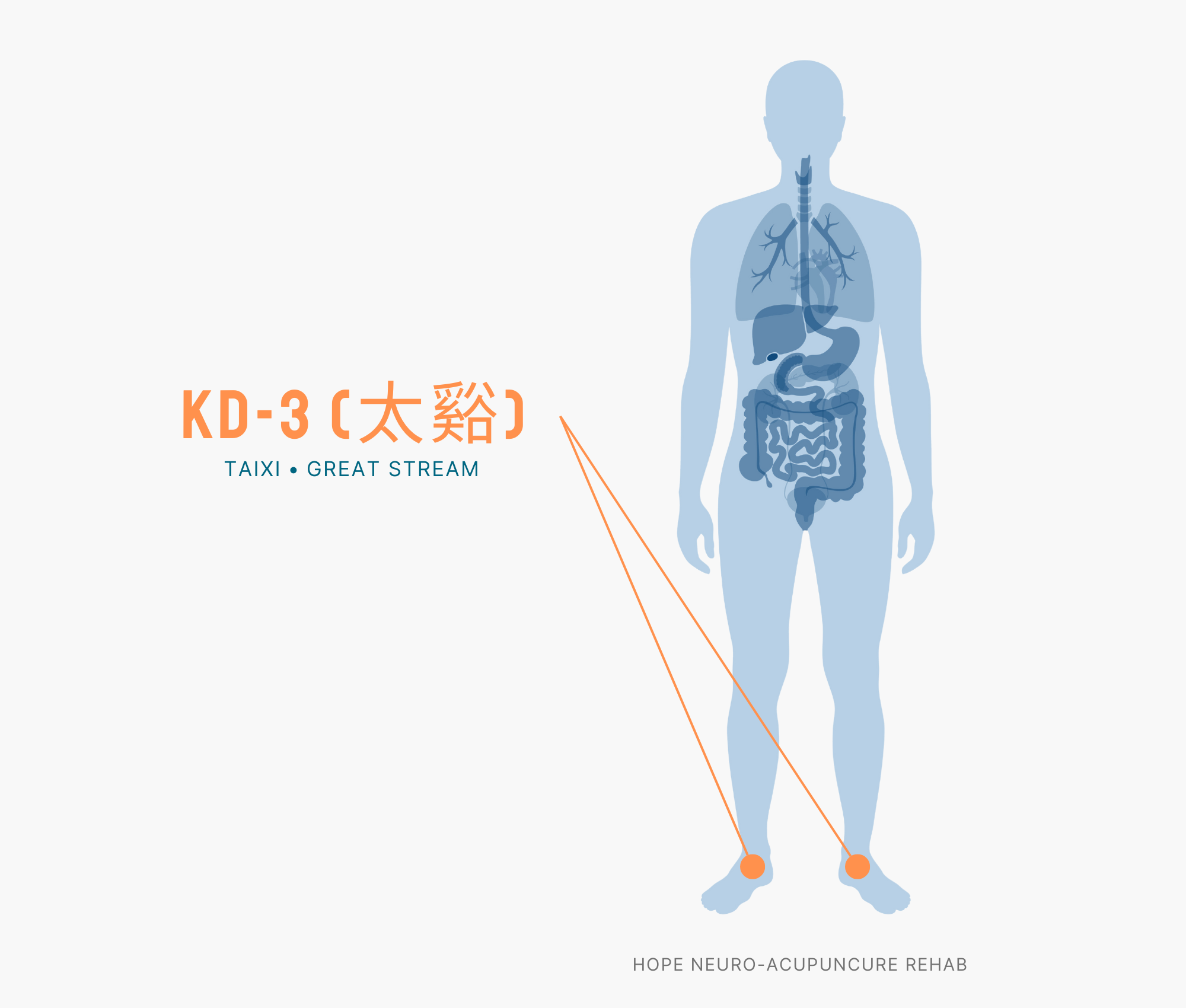
    4. Taixi (KI3, 太溪) — The Source of Body’s Recovery Power

    KI3 acupuncture point

    Location: Located on the inner side of the ankle, in the hollow between the medial malleolus and the Achilles tendon. It’s positioned on the opposite side of the ankle from Kunlun (on the inner side).

    Technique: Using your thumb, apply pressure in slow circular motions. Press for 5-10 seconds, release, and repeat 10-15 times. Since this point is where the body’s vital energy converges, it’s effective even with gentle pressure.

    Effects: As the primary point on the Kidney meridian, it’s the source of the body’s recovery and immune capacity. It helps relieve inner ankle pain, cold feet, and fatigue. It’s especially effective for fundamental recovery after ankle sprains, and regular stimulation can even prevent recurrence. It also improves sleep disturbances and pain exacerbation caused by stress.

    5. Zusanli (ST36, 足三里) — The Universal Remedy for Whole-Body Fatigue

    ST36 acupuncture point

    Location: Located four finger-widths below the knee on the outer side of the shinbone. Starting from the hollow below the knee and moving downward, you’ll find it. The precise location is between the outer muscle and bone of the tibia.

    Technique: Press vertically using your thumb or knuckle. Press for 5-10 seconds, release, and repeat 15-20 times. If you want the strongest effect from acupressure, it’s fine to apply firmer pressure.

    Effects: Zusanli, whose name means ‘the third mile of the leg,’ is a universal point governing digestion, immunity, and fatigue recovery. It’s effective when reduced mobility from ankle pain has accumulated whole-body fatigue. It relieves calf muscle tension and improves lower body circulation, accelerating ankle recovery. It’s especially beneficial for ankle pain accompanied by reduced vitality or chronic fatigue.

    5-Minute Self-Acupressure Routine — Effective Time Management

    Preparation Stage (1 minute): Sit comfortably and apply warm compress around the ankle for 5 seconds using a warm towel. This dilates blood vessels and opens the meridians.

    Step 1 – Kunlun (BL60) Stimulation (1 minute): Stimulate the Kunlun point on the outer ankle using your thumb in circular motions, pressing and releasing 15 times. Even if pain is only in one foot, stimulate both feet.

    Step 2 – Sanyinjiao (SP6) Stimulation (1 minute): Stimulate the location four finger-widths above the inner ankle, pushing upward slowly. Alternate between both legs, repeating about 20 times.

    Step 3 – Taichong (LR3) + Taixi (KI3) Stimulation (1.5 minutes): Alternate between stimulating Taichong on the top of the foot and Taixi on the inner ankle. Press each point for 10 seconds, repeating 10-15 times on both feet.

    Step 4 – Zusanli (ST36) Finish (0.5 minutes): Press the Zusanli point below the knee vertically, pressing and releasing 10 times. This improves whole-body circulation and enhances the acupressure effect.

    💡 Tip: Practicing just 5 minutes twice daily, morning and evening, can improve pain within a week. On days with severe pain, a brief additional stimulation during lunch is also beneficial.

    ⚠️ Medical Disclaimer: This article is provided for informational purposes and does not substitute for professional medical diagnosis or treatment. If ankle pain persists or is severe, especially with significant swelling, bruising, or limited mobility, be sure to seek professional evaluation from an orthopedist or traditional medicine practitioner.
    🤰 Pregnancy Caution: Among the acupoints above, Sanyinjiao (SP6) and Taichong (LR3) may induce uterine contractions in pregnant women. If you are pregnant or may be pregnant, consult your healthcare provider before practice. For pregnant women, it’s recommended to focus on Kunlun (BL60), Taixi (KI3), and Zusanli (ST36).
  • How to Calm Presentation Nerves — 30-Second Technique

    How to Calm Presentation Nerves — 30-Second Technique

    Summary: When your hands are trembling and your heart is racing before a presentation, interview, or important meeting. Here’s a 30-second wrist acupressure secret to control your nerves.

    LR3 혈자리 위치 그림

    Heart Pounding… Hands Trembling

    5 minutes before the presentation. Your heart is racing, your palms are clammy with sweat, and it feels like your voice is going to shake. No matter how much you prepared, the moment arrives and your mind goes blank.

    “Don’t be nervous” — you know telling yourself that doesn’t work. Because nervousness isn’t controlled by the mind. The body reacts first.

    That’s why the solution is also in the body. Just 30 seconds. A method you can do without anyone noticing.

    The 30-Second Tension Buster: Shenmen (HT7) + Neiguan (PC6) Double Acupressure

    Both points are near the wrist, so you can naturally do this even while waiting to present.

    Step 1: Find Shenmen (HT7) (10 seconds)

    HT7 acupuncture point

    On the inner wrist crease, right next to the tendon on the pinky finger side — in the hollow spot. Place the opposite thumb there and you should feel your pulse.

    • Press firmly for 5 seconds
    • Feel the racing heartbeat gently subsiding

    Step 2: Find Neiguan (PC6) (10 seconds)

    PC6 acupuncture point

    On the same arm, three finger-widths above the wrist crease toward the elbow. Press between the two tendons.

    • Press rhythmically for 5 seconds
    • Nausea and chest tightness release simultaneously

    Step 3: One Deep Breath (10 seconds)

    After stimulating both wrists, inhale deeply through your nose and exhale long and slow through your mouth. This single breath flips the switch from sympathetic to parasympathetic nervous system.

    Pre-Presentation Routine Summary

    Timing What to Do Duration
    10 min before Press Hegu (LI4) 10 times per hand in the restroom 2 min
    5 min before Shenmen + Neiguan 30-second acupressure 30 sec
    Right before 4-7-8 breathing, 1 cycle 20 sec

    If You Present Frequently

    Try building a habit of pressing Shenmen (HT7) 10 times every morning. It lowers your baseline anxiety level so that presentation-day tension is significantly reduced. Give it 2 weeks and you’ll notice the difference.

    Frequently Asked Questions

    Can I do acupressure during the presentation too?

    Yes! When one hand is free, lightly press Shenmen (HT7) on the opposite wrist. Do it on the hand opposite to the one holding the pointer or remote for a natural look.

    How do I stop my voice from shaking?

    Stimulating Neiguan (PC6) releases diaphragm tension, which reduces voice trembling. Taking a sip of warm water before the presentation also helps.

    My hands sweat too much.

    Pressing Hegu (LI4) stabilizes the sympathetic nervous system, which reduces hand sweating. Try 10 presses per hand 10 minutes before the presentation.

    Can I use these methods for job interviews too?

    Absolutely. Do it in advance in the waiting room, and during the interview you can discreetly press your wrist while your hands rest on your knees.

    What about anxiety that starts days before?

    Starting days before the presentation, press Shenmen + Neiguan + Baihui (GV20) for 5 minutes each before bed every night. This reduces accumulated tension.

    Pregnancy Warning: Hegu (LI4) mentioned in this article may cause stimulation in pregnant women. If you are pregnant or may be pregnant, please consult a professional before use.
    ⚠️ Medical Disclaimer: This article is for informational purposes only and does not replace professional medical diagnosis or treatment. If symptoms persist or worsen, please consult a healthcare professional.
  • Getting to the Root of Chronic Stress

    Getting to the Root of Chronic Stress

    Summary: Chronic stress won’t go away from a day or two of rest. Here’s a 4-week self-acupressure program to systematically release the tension deeply embedded in your body.

    LR3 혈자리 위치 그림

    Exhaustion That Won’t Go Away No Matter How Much You Rest

    You rested all weekend, but by Monday morning you’re already drained. No matter how much you sleep, you never feel refreshed. Everything you eat sits heavy in your stomach. Irritability is constant, and the slightest thing can bring you to tears.

    This isn’t just being tired. This is chronic stress. Not a one-time stress event, but months or even years of accumulated tension that has trapped your entire body in “emergency mode.” Chronically elevated cortisol leads to lowered immunity, digestive issues, sleep disorders, and chronic pain — one after another.

    Can a simple “hang in there!” fix this? Of course not. You need to systematically release the tension embedded in your body.

    The Marks Chronic Stress Leaves on Your Body

    • Shoulders/Neck: Hard as rocks, stiff as stone
    • Jaw: Unconsciously clenching tight (teeth grinding, TMJ pain)
    • Digestion: Bloated stomach, alternating constipation and diarrhea
    • Sleep: Hard to fall asleep, waking up suddenly in the middle of the night
    • Emotions: Lethargic, irritability exploding over the smallest things

    4-Week Chronic Stress Relief Program

    Week 1: Foundation Relaxation — Shenmen (HT7) + Neiguan (PC6)

    PC6 acupuncture point

    First, you need to soothe the overactivated sympathetic nervous system.

    • 5 minutes morning and evening, alternating Shenmen and Neiguan acupressure
    • Press each point 5 seconds, rest 3 seconds, 10 times per side
    • Goal: Sleep quality starts to gradually improve

    Week 2: Activate Circulation — Hegu (LI4) + Taichong (LR3)

    Open up the blocked qi and blood circulation.

    • Add Four Gates (Hegu + Taichong) simultaneous stimulation to Week 1 routine
    • Add 5 minutes during lunch break
    • Goal: Shoulder knots decrease, digestion starts improving

    Week 3: Mental Clarity — Baihui (GV20) + Sishencong

    Clear the foggy energy from the head.

    • Add Baihui tapping + Sishencong (four points around the crown) massage to Week 2 routine
    • Tap the crown for 1 minute each morning
    • Goal: Head clears and concentration improves

    Week 4: Integrated Routine Establishment

    Combine all the points learned over 3 weeks into one unified routine.

    • Morning 5 min: Baihui, Hegu, Taichong
    • Evening 5 min: Shenmen, Neiguan, Baihui
    • Goal: Overall stress levels noticeably decrease

    Fundamental Changes That Need to Happen

    Acupressure alone has its limits. Things to practice alongside it:

    • Sleep environment: Put your smartphone away 30 minutes before bed, keep room temperature at 18-20 degrees C
    • Exercise: At least 30 minutes of aerobic exercise 3 times per week (walking is great)
    • Social connection: Have a conversation with someone you trust at least once a week
    • Professional counseling: If chronic stress has lasted 3+ months, I strongly recommend psychological counseling

    Frequently Asked Questions

    Are chronic stress and burnout the same thing?

    Similar but different. Burnout is chronic stress pushed to its extreme, characterized by helplessness and cynicism. If you’re at the burnout stage, professional counseling is absolutely necessary.

    Do I only need to do the 4-week program once?

    It’s best to maintain 5 minutes morning and evening even after the 4 weeks. Once it becomes a habit, you’ll actually feel uncomfortable on days you skip it.

    I gained weight from chronic stress. Can acupressure help?

    When stress hormones (cortisol) are chronically high, belly fat increases. Reducing stress through acupressure can indirectly help with weight management.

    Is it okay if acupressure is quite painful?

    A dull ache is the right level. If you feel sharp pain, reduce the pressure. In a chronic stress state, your body is more sensitive, so starting gently is important.

    I’m on medication. Can I still do acupressure?

    Acupressure has almost no drug interactions. However, if you’re taking mental health medications, let your doctor know beforehand.

    Pregnancy Warning: Hegu (LI4) mentioned in this article may cause stimulation in pregnant women. If you are pregnant or may be pregnant, please consult a professional before use.
    ⚠️ Medical Disclaimer: This article is for informational purposes only and does not replace professional medical diagnosis or treatment. If symptoms persist or worsen, please consult a healthcare professional.