Author: Acupoint Guide Editorial Team

  • 咳を和らげるツボ5選 — 自宅でできるセルフ指圧

    咳を和らげるツボ5選 — 自宅でできるセルフ指圧

    One-Minute Summary: Applying acupressure to Feishu, Tianduo, Zhongfu, Lieque, and Taiyuan—five acupoints—twice daily for five minutes each improves respiratory function and helps relieve cough.

    Introduction

    When a sudden cough comes on, daily life becomes inconvenient, and if nighttime coughing disrupts your sleep, it’s truly frustrating. In particular, lingering cough from an unresolved cold or respiratory discomfort from seasonal changes are symptoms many people experience.

    In traditional Chinese medicine, cough is understood as a result of reduced lung function and insufficient respiratory circulation. Our bodies have specific acupoints that promote lung function and strengthen the respiratory system. By consistently stimulating these acupoints, you can activate the secretion of lung fluids and relieve airway tension, naturally improving cough symptoms. Since you can simply stimulate them with your fingers without taking medication, you can practice this anytime and anywhere.

    5 Effective Acupoints for Cough Relief

    1. Feishu (BL13) — The Center of Lung Function

    BL13 acupuncture point

    Location: Upper back, approximately 2cm lateral to the third thoracic vertebra. If it’s difficult to locate precisely, it is at the level of the inner edge of the shoulder blade, approximately one index finger width away from both sides of the spine.

    Acupressure Method: While lying down or in a comfortable position, slowly press and release with your thumb 10-15 times. Continue until you feel a refreshing sensation rather than pain.

    Benefits: As the most important acupoint of the lung meridian, it strengthens lung function and is effective for respiratory conditions in general. It is particularly useful for relieving chronic cough, asthma, and cough caused by bronchitis.

    2. Tianduo (BL11) — Respiratory Strengthening

    BL11 acupuncture point

    Location: Upper back, near the boundary between the neck and shoulder, approximately 2cm lateral to the first thoracic vertebra. You can find it by placing your finger behind the neck and moving it down along both sides of the spine.

    Acupressure Method: Gently press with both thumbs simultaneously about 10 times. If it’s difficult to do alone, you can also use a mini massage stick.

    Benefits: It calms upper respiratory inflammation and strengthens overall respiratory function. It quickly relieves lingering cough from cold aftereffects or throat itchiness.

    3. Zhongfu (REN17) — The Center of Lung and Chest

    Location: The center of the chest, at the height where your finger touches when your arm hangs down from the centerline between both breasts. More precisely, it is at the apex between the ribs at the center of the breastbone.

    Acupressure Method: Standing upright, gently press the center of the chest with your thumb or middle finger 10-15 times. Be careful not to press too hard.

    Benefits: It directly stimulates lung function to make breathing deeper and easier. It improves oppressive cough, chest tightness, and shortness of breath.

    4. Lieque (LU7) — The Special Point of the Lung Meridian

    LU7 acupuncture point

    Location: Approximately 1.5cm from the inner wrist crease in the direction of the thumb. When you bend your wrist, two tendons become visible, and it is in the hollow space between them.

    Acupressure Method: Extend one arm and press slowly with the opposite thumb for about 1 minute or stimulate it in a circular motion. Alternate between both sides.

    Benefits: As a key acupoint that regulates the entire lung meridian, it broadly improves not only cough but also sneezing, nasal symptoms, and skin conditions. It shows rapid effects especially for acute cough.

    5. Taiyuan (LU11) — The Final Acupoint for Clearing Lung Heat

    Location: The outer edge of the thumb nail, at the point where the nail meets the finger skin. More precisely, it is at the edge of the thumb tip toward the index finger.

    Acupressure Method: Stimulate the Taiyuan area with the thumb and index finger of the opposite hand by gently pinching. Repeat 10-15 times, but do not press too hard.

    Benefits: It drains heat from the lungs and removes toxins from the body. It is particularly effective for cough accompanied by throat soreness and cough with a burning sensation.

    5-Minute Self-Acupressure Routine

    Time Allocation and Order:

    1. Feishu (BL13) — 1 minute (30 seconds each side)
    2. Tianduo (BL11) — 1 minute (30 seconds each side)
    3. Lieque (LU7) — 1 minute (30 seconds each side)
    4. Zhongfu (REN17) — 1 minute (1 minute at the center point)
    5. Taiyuan (LU11) — 1 minute (30 seconds each side)

    Recommended Time: After waking in the morning or before bed at night. It is more effective if done twice a day.

    Additional Tips: If you wash your hands with warm water to warm your fingers before starting, blood circulation becomes more active and the effectiveness increases.
    ⚠️ Medical Disclaimer: This article is written for informational purposes and does not replace professional medical diagnosis or treatment. If symptoms are severe, such as cough persisting for more than 2 weeks, spitting up blood-tinged sputum, or high fever, please consult a healthcare professional (hospital or traditional medicine clinic).
    🤰 Pregnancy Warning: The acupoints presented in this article are generally safe, but their effects may vary depending on individual constitution and pregnancy stage. If you are pregnant or might be pregnant, please consult with a healthcare professional (doctor or traditional medicine practitioner) before practicing.
  • 冷え性に効果的なツボTOP5 — 位置と指圧法ガイド

    冷え性に効果的なツボTOP5 — 位置と指圧法ガイド

    One-line summary: Cold hands and feet syndrome occurs due to insufficient peripheral blood circulation, and can be improved by stimulating acupressure points at five locations – Sanyinjiao, Taichong, Hegu, Guanyuan, and Zusanli – to promote qi and blood circulation.

    Introduction

    Many people experience cold and tingling symptoms in their hands and feet not just in winter, but year-round. This is known as cold hands and feet syndrome. For those who feel discomfort with cold fingertips and toes no matter how much clothing they wear, Traditional Chinese Medicine recommends acupressure at points that improve qi and blood circulation. Cold hands and feet syndrome fundamentally occurs due to insufficient peripheral blood circulation and reduced qi (氣) circulation. Acupressure is effective in stimulating acupoints to promote qi and blood flow and normalize body temperature. This article explains in detail five acupoints that directly help improve cold hands and feet syndrome and their acupressure techniques.

    The Five Acupoints in Detail

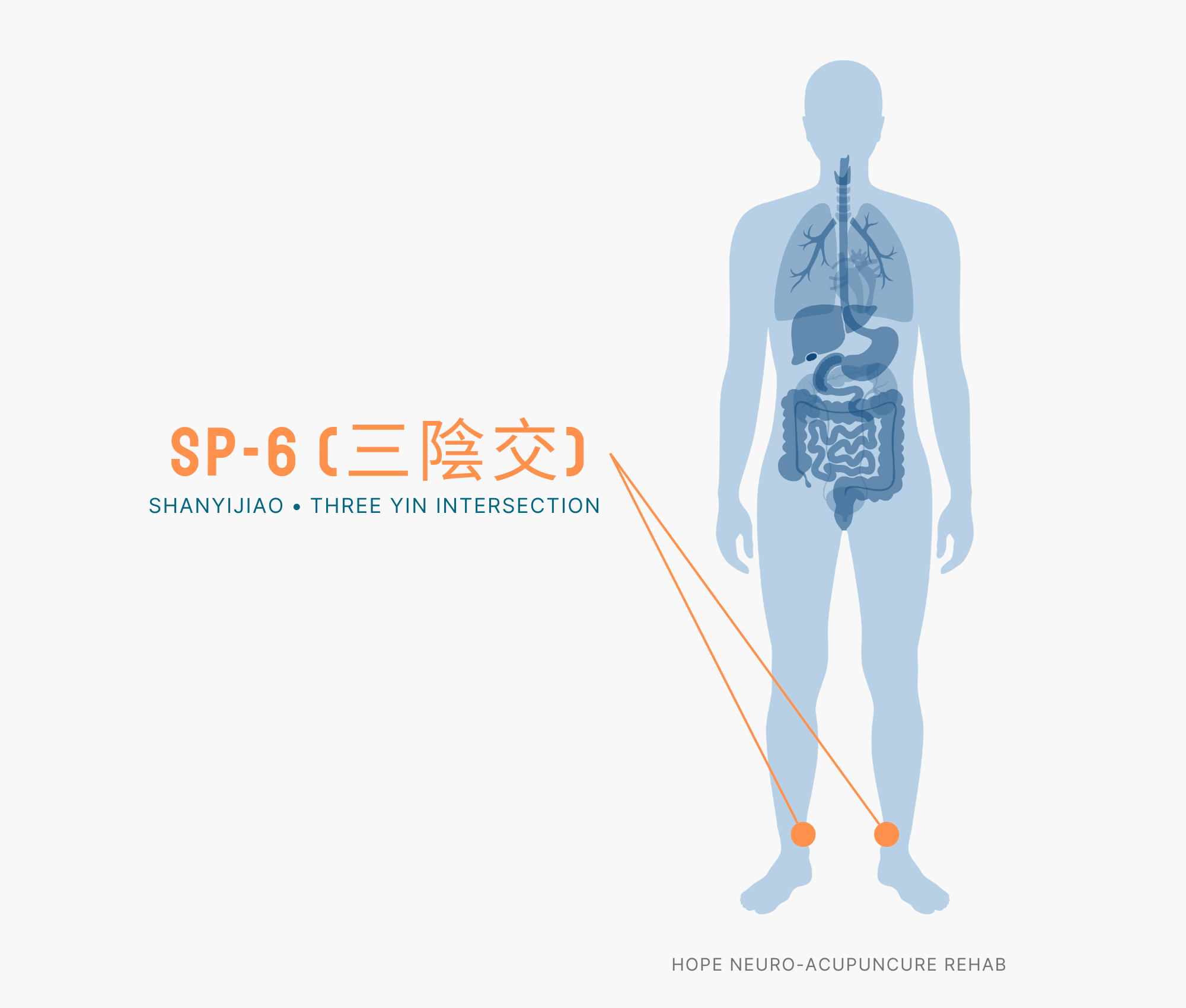
    1. Sanyinjiao (SP6, Sanyinjiao)

    SP6 acupuncture point

    Location: On the inner side of the lower leg, approximately 10cm (four finger widths) above the inner ankle bone, at the inner edge of the tibia
    WHO Code: SP6
    Acupressure Technique: Use your thumb to repeatedly press and release slowly. Apply pressure for 30 seconds until you feel a mild soreness, then rest for 10 seconds and repeat. Perform on both legs.
    Benefits: Sanyinjiao is where the spleen, liver, and kidney meridians meet, making it the most effective point for promoting qi and blood circulation. It excels not only at treating cold hands and feet but also at promoting fatigue recovery and enhancing immunity. Regular acupressure can improve chronic cold symptoms.

    2. Taichong (LR3, Taichong)

    Location: Between the bones of the big toe and second toe on the top of the foot, approximately 3cm above the ankle
    WHO Code: LR3
    Acupressure Technique: Press firmly using the fingertip of your thumb. The most effective pressure is when you feel a mild soreness (痛快感). Apply pressure 10 times for 1 minute on each side, and perform on both feet.
    Benefits: Taichong promotes the flow of liver qi (肝氣), directly improving blood circulation. It effectively treats not only cold sensations in the hands and feet but also poor blood circulation caused by stress. It is one of the acupoints where cold hands and feet syndrome patients feel the quickest improvement.

    3. Hegu (LI4, Hegu)

    LI4 acupuncture point

    Location: Between the bones of the thumb and index finger, at the highest point of the muscle visible on the back of the hand
    WHO Code: LI4
    Acupressure Technique: Use the thumb of your other hand to slowly press in circular motions. Apply pressure for 30 seconds until you feel a mild soreness, then rest for 10 seconds and repeat. Perform on both hands.
    Benefits: Hegu is an important acupoint of the large intestine meridian, known as “the cure-all point.” It promotes qi and blood circulation throughout the body, and excels particularly at improving blood circulation in the upper body and hands. It simultaneously alleviates not only cold hands and feet but also various other symptoms such as headaches and facial flushing.

    4. Guanyuan (CV4, Guanyuan)

    Location: Approximately 10cm below the navel, on the midline of the body
    WHO Code: CV4
    Acupressure Technique: In a lying position, gently massage in circular motions using 3-4 fingers. Do not press hard; massage for 2-3 minutes until you feel warmth.
    Benefits: Guanyuan is an important acupoint called the “lower dantian,” which tonifies kidney yang and strengthens foundational energy throughout the body. Chronic cold hands and feet syndrome often occurs due to kidney yang deficiency, and stimulating Guanyuan fundamentally improves this condition.

    5. Zusanli (ST36, Zusanli)

    ST36 acupuncture point

    Location: Approximately 10cm (four finger widths) below the outer side of the knee, on the front of the shin
    WHO Code: ST36
    Acupressure Technique: Use your thumb to repeatedly press and release slowly. Apply pressure for 30 seconds until you feel a mild soreness, then rest for 10 seconds and repeat 3-4 times. Perform on both legs.
    Benefits: Zusanli is a well-known acupoint for enhancing immunity and improving overall circulation. It promotes stomach function to improve digestion and absorption, thereby promoting qi and blood production. Regular stimulation simultaneously improves chronic cold symptoms and fatigue.

    5-Minute Self-Acupressure Routine

    Optimal time allocation for best results:

    1. Preparation (30 seconds): Wash your hands and feet with warm water and take a comfortable position (sitting or lying down).
    2. Hegu (LI4) acupressure (50 seconds): 25 seconds on each hand, pressing gently in circular motions
    3. Sanyinjiao (SP6) acupressure (60 seconds): 30 seconds on each leg, pressing and releasing slowly
    4. Taichong (LR3) acupressure (60 seconds): 30 seconds on each foot, applying pressure until you feel slight soreness
    5. Zusanli (ST36) acupressure (60 seconds): 30 seconds on each leg, until you feel soreness
    6. Guanyuan (CV4) massage (50 seconds): In a lying position, massage gently in circular motions
    7. Cool down (20 seconds): Drink warm water or put on warm clothing to maintain body temperature.

    Recommended timing: Perform this routine 1-2 times daily, either in the morning after waking or in the evening before bed. You will notice significant improvement if you consistently perform this routine for at least 3 weeks.

    ⚠️ Medical Disclaimer: This article is provided for informational purposes only and does not replace professional medical diagnosis or treatment. Cold hands and feet syndrome can result from various underlying conditions including thyroid disease, circulatory disorders, and Raynaud’s syndrome. If symptoms persist or are severe, or if ulcers or color changes appear on your hands or feet, please consult a healthcare professional (physician or Traditional Chinese Medicine practitioner).
    🤰 Pregnancy Warning: Among the above acupoints, Sanyinjiao (SP6), Taichong (LR3), and Hegu (LI4) may trigger uterine contractions in pregnant women. If you are pregnant or may be pregnant, please consult a healthcare professional before practicing acupressure. For pregnant women, it is safe to focus acupressure on Guanyuan (CV4) and Zusanli (ST36) only.