Introduction
Sudden hiccups are truly frustrating. Hiccups that suddenly appear while eating, during important meetings, or in a quiet library disrupt daily life. Even when trying various methods like drinking water upside down or holding your breath, they often don’t stop easily.
In traditional medicine, hiccups are viewed as “a state where the stomach’s qi flows backward.” This condition, caused by involuntary contractions of the diaphragm, can be regulated through the nervous system. In particular, by stimulating specific acupoints, you can calm the vagus nerve and diaphragmatic nerve to quickly relieve the symptoms. I’ll now show you how to stop hiccups in just 3-5 minutes using only your fingertips, without medication.
5 Effective Acupoints for Hiccups
1. Tiantu (CV22, Tiantu) — Fastest Results
Location: At the center of the neck, in the hollow area above the collarbone (sternum). It’s the indented area above the clavicle.
Acupressure Method: Place both thumbs on the Tiantu acupoint and slowly press down 1-2mm while inhaling. Hold for 5 seconds, then slowly release. Repeat 3 times. Avoid pressing too hard as it may compress the trachea; apply gentle pressure.
Effects: Tiantu is an important acupoint connected to the respiratory system and esophagus. It directly stimulates the vagus nerve to quickly block the nerve response of hiccups. Most people feel results within 1-2 minutes, making it the fastest emergency acupressure point.
2. Neiguan (PC6, Neiguan) — Best for Stress-Related Hiccups

Location: On the inner side of the arm, about 2-3cm (two finger widths) above the wrist crease toward the elbow. It’s at the center between two tendons.
Acupressure Method: Find Neiguan with the opposite thumb and apply “comfortably firm” pressure (tender but pleasant sensation) for 3 seconds, then rest for 5 seconds. Repeat. Apply acupressure to each arm for 1-2 minutes, totaling 3-4 minutes for both sides.
Effects: Neiguan is an acupoint that regulates heart rate and digestive function. It’s particularly effective for hiccups caused by stress or tension. It calms both mind and body while simultaneously relieving diaphragmatic spasms.
3. Zhongwan (CV12, Zhongwan) — Solution for Digestion-Related Hiccups
Location: On the midline of the abdomen, approximately 4 fingers (about 6-8cm) above the navel. It’s the midpoint between the xiphoid process (the lowest part of the breastbone) and the navel.
Acupressure Method: Gather three fingers (index, middle, and ring finger) and press vertically. Press slowly while exhaling, then release while inhaling. Repeat rhythmically for 2-3 minutes. It’s safe to apply acupressure at least 2 hours after eating.
Effects: Zhongwan is a central acupoint for the stomach and digestive system. It’s very effective for hiccups that occur after eating and those caused by indigestion. It regulates stomach peristalsis and prevents the reversal of qi.
4. Hegu (LI4, Hegu) — Master Point for Stabilizing the Entire Nervous System

Location: On the back of the hand, in the hollow area near where the thumb and index finger meet when the hand is open.
Acupressure Method: Press Hegu with the opposite thumb at a “slightly tender” intensity and hold for 5 seconds. Rest for 10 seconds and repeat, applying pressure to each hand for 2 minutes. You can also apply acupressure with a circular massage motion.
Effects: Hegu is called the “universal acupoint” and stabilizes the nervous system overall. It’s used not only for hiccups but also for various symptoms like migraines, facial pain, and stress. It blocks nerve signals to interrupt the reflex circuit of hiccups.
5. Sanyinjiao (SP6, Sanyinjiao) — Restoring Autonomic Nervous System Balance
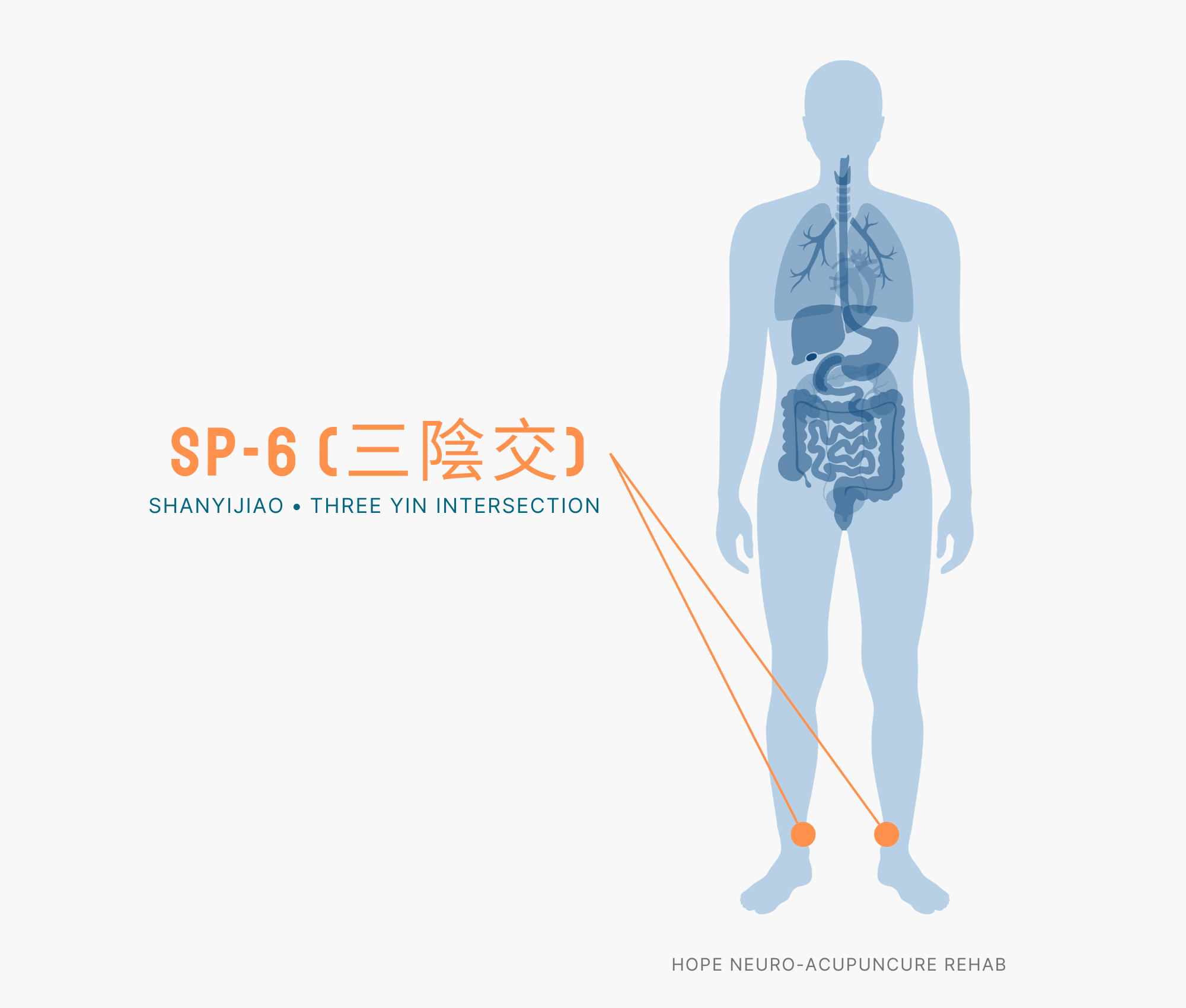
Location: On the inner side of the leg, approximately 3 finger widths (about 4cm) above the prominent inner ankle bone (medial malleolus). You can find it by following the inner edge of the tibia upward.
Acupressure Method: Press with your thumb at “comfortably firm” intensity (tender but pleasant) and hold for 3 seconds. Rest for 5 seconds and repeat, applying pressure to each leg for 2 minutes. It’s important to breathe slowly with each press.
Effects: Sanyinjiao is where three meridians—the liver, kidney, and spleen—converge. It activates the parasympathetic nervous system to switch the entire body into relaxation mode. It’s particularly effective for chronic or recurrent hiccups.
5-Minute Self-Acupressure Routine — Emergency Hiccup Relief
Recommended Routine by Situation:
- Emergency Situation (must stop within 1-2 minutes): Tiantu + Hegu → Tiantu 1 minute + Hegu 1 minute
- Stress-Related (during meetings, tense situations): Neiguan → 2-3 minutes of acupressure
- Post-Meal Hiccups (right after eating): Zhongwan + Neiguan → 1-2 minutes each
- Prevention and Long-term Treatment: Tiantu (1 minute) → Neiguan (1 minute) → Zhongwan (1 minute) → Hegu (1 minute) → Sanyinjiao (1 minute) = 5 minutes total
Precautions When Applying Acupressure:
- Don’t press too hard. The standard is “tender but pleasant” pressure.
- If your hands are cold, effectiveness decreases, so apply acupressure with warm hands.
- If you practice slow diaphragmatic breathing while applying acupressure, the effect doubles.
- Avoid pressing Zhongwan immediately after eating (within 30 minutes).
- If one acupressure session doesn’t work, try again after 1 hour.
Leave a Reply