Summary: Rock-hard stiff shoulders? Release them fast with 5 self-massage techniques. Jianjing (GB21), Fengchi (GB20), Tianzong (SI11), Quchi (LI11), and Hegu (LI4) acupressure is all you need.
When Your Shoulders Feel Like Rocks
After sitting in front of a computer all day, stiffness creeps up your shoulders. When you turn your neck, it cracks and pops. Raise your arm and you feel that throbbing ache. “I wish someone would just rub my shoulders…” — you’ve thought that, right?
Rock-hard shoulders happen when blood circulation is poor and muscles knot up. Maintaining the same posture for hours causes the trapezius and levator scapulae to stiffen, triggering pain. It often comes with pounding headaches too.
Fortunately, there are ways to release them quickly at home by yourself. Pressing 5 key acupressure points around the shoulders loosens knotted muscles and improves circulation. Let me walk you through them one by one.
1. Jianjing (GB21) — The Direct Hit on Shoulder-Top Knots
Location
The midpoint on the line connecting the center of the back of your neck to the tip of your shoulder — the highest point on top of the shoulder. When you press and feel a dull ache, that’s Jianjing.
Massage Method
- Place the middle and index fingers of the opposite hand on Jianjing
- Press firmly for 3 seconds, rest 3 seconds — repeat 10 times
- Slowly turning your head side to side while pressing doubles the effect
Effect: A direct hit on shoulder knots. Immediately releases trapezius tension.
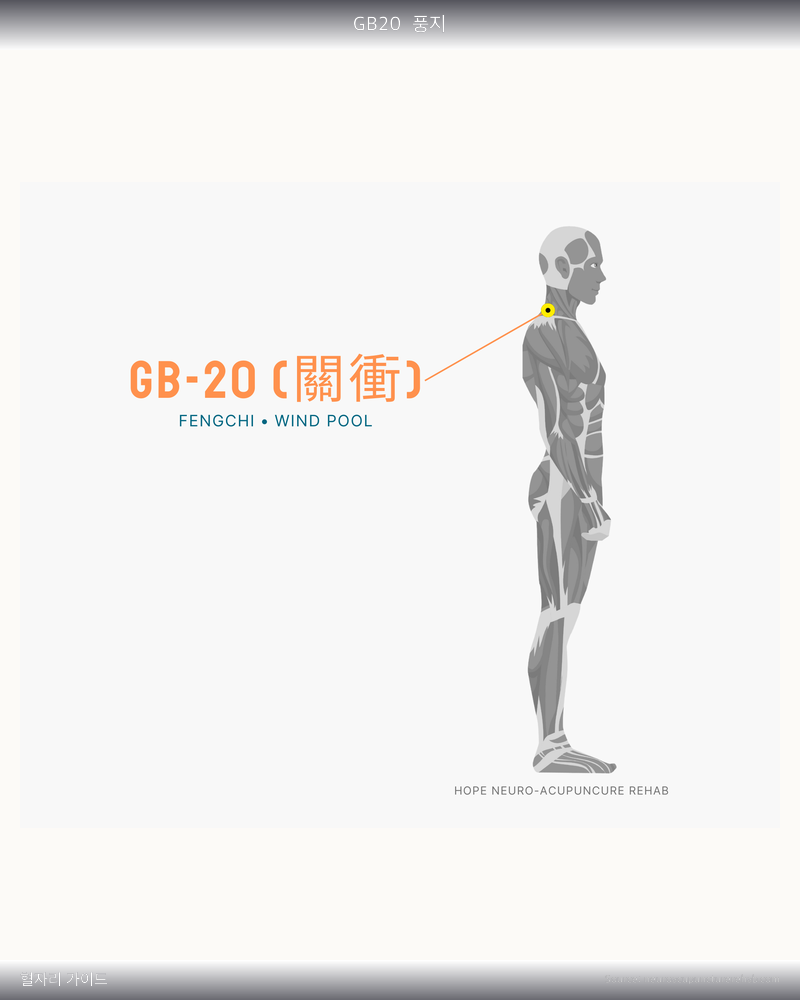
2. Fengchi (GB20) — Refreshing the Neck-Shoulder Connection
Location
The hollows on both sides below the base of your skull. Find the border where the head meets the neck, then move about two finger-widths to each side.
Massage Method
- Place both thumbs on Fengchi and wrap the remaining fingers around your head
- Press upward firmly for 5 seconds at a time
- Roll in circular motions — repeat 10 times
Effect: Relieves both the stiffness that spreads from the back of the neck to the shoulders and headaches simultaneously.
3. Tianzong (SI11) — Dissolving the Hard Knots Inside the Shoulder Blade
Location
The concave center of the scapula (shoulder blade). Reach the opposite hand over your shoulder and feel for an especially tender spot in the middle of the shoulder blade.
Massage Method
- Press the Tianzong area firmly with the opposite hand’s middle finger
- Hold 5 seconds then release — repeat 8 times
- Placing a tennis ball between the wall and your back to roll over the spot reaches even deeper
Effect: The key point for releasing deep knots between the back and shoulders.
4. Quchi (LI11) — Promoting Circulation from Elbow to Shoulder
Location
The outer end of the crease that forms when you bend your elbow to 90 degrees.
Massage Method
- Press Quchi firmly with the opposite thumb for 3 seconds
- Rotating your wrist while pressing enhances the relief
- Repeat 10 times on each arm
Effect: Promotes circulation along the meridian connecting the arm to the shoulder, relieving both arm numbness and shoulder stiffness.
5. Hegu (LI4) — The All-Purpose Point for Remote Shoulder Pain Relief
Location
The webbing between the thumb and index finger, at the highest point of the bulging muscle.
Massage Method
- Grip Hegu firmly between the opposite thumb and index finger
- Press firmly for 3-5 seconds, rest 3 seconds — repeat 10 times
- Slowly rotating the affected shoulder while pressing accelerates pain reduction
Effect: Hegu is the master key for upper body pain. Used not only for shoulders but also for headaches and toothaches.
5-Point Comparison Chart
| Acupoint | Location Summary | Primary Effect | Difficulty |
|---|---|---|---|
| Jianjing GB21 | Center of shoulder top | Trapezius knot release | Easy |
| Fengchi GB20 | Both sides below skull base | Neck-shoulder headache relief | Easy |
| Tianzong SI11 | Center of shoulder blade | Deep back-shoulder knots | Medium |
| Quchi LI11 | Outer end of elbow crease | Arm-shoulder circulation | Easy |
| Hegu LI4 | Hand webbing | Upper body pain master key | Easy |
Follow This Order — 5-Minute Routine
- Fengchi first — open up neck and head circulation (1 min)
- Jianjing alternating sides — release shoulder-top knots (1 min)
- Tianzong with a tennis ball — reach deep knots (1 min)
- Quchi on both arms — promote arm-to-shoulder circulation (1 min)
- Hegu to finish — sweep away remaining pain (1 min)
Frequently Asked Questions
How many times a day can I do shoulder self-massage?
2-3 times a day is ideal. Doing it for 5 minutes each in the morning, at lunch, and before bed significantly reduces tension.
What should I do if it’s too painful during massage?
A dull ache with a satisfying release is the right level. If you feel sharp pain, reduce the pressure. Never press hard enough to cause bruising.
How quickly will I feel results from shoulder massage?
Light tension can feel better immediately after massage. For chronic stiffness, keep at it consistently for at least 2 weeks.
Why does Jianjing (GB21) hurt so much when pressed?
Jianjing sits right on the trapezius, so the more knotted your shoulders are, the more painful it feels. Start gently and gradually increase the intensity.
Can I apply a hot towel after shoulder self-massage?
Yes, applying heat after massage enhances the effect. The improved blood circulation helps release knotted muscles even more.
Leave a Reply