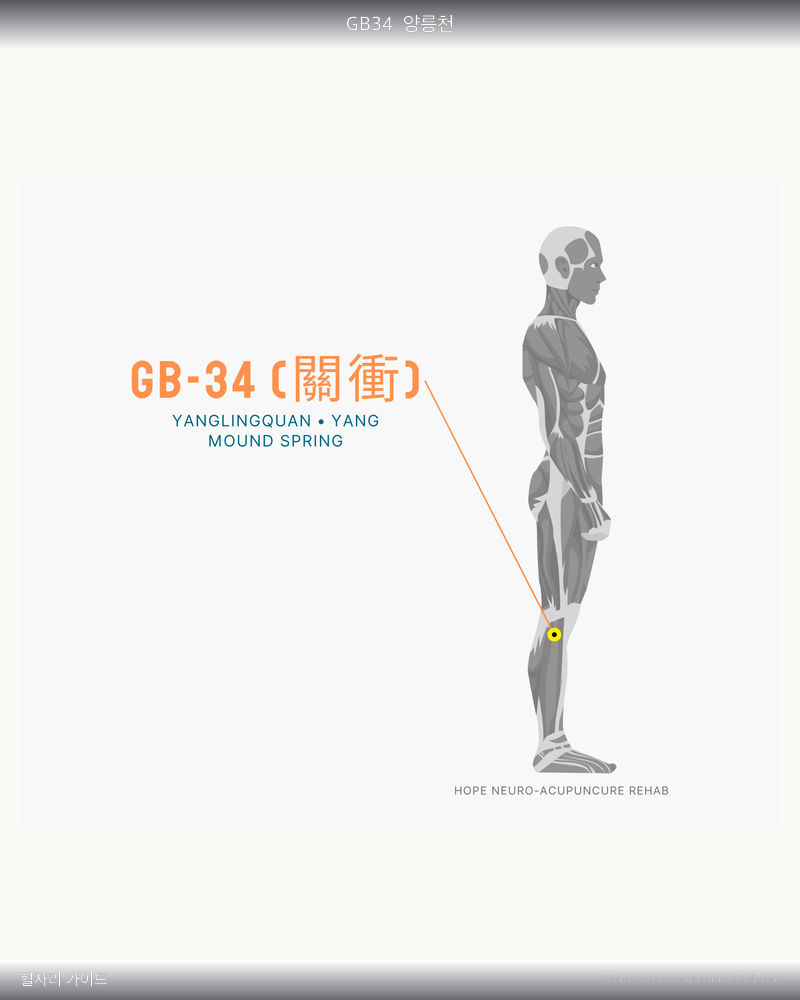
What Is Yanglingquan?
Yanglingquan means ‘spring at the yang mound’!
Located below the outer knee bone (fibular head), it belongs to the Gallbladder meridian. In traditional Chinese medicine, it’s called the Influential Point of Sinews (Jin Hui Xue).
This means it’s the representative acupoint for all the body’s muscles, tendons, and ligaments! Like a commander-in-chief of muscles, it influences the entire musculoskeletal system.
When your knee hurts, your legs feel stiff, or you have post-workout soreness — Yanglingquan will be your go-to solution.
How to Find Yanglingquan
It’s next to the knee, so it’s easy to find!
- Sit in a chair and feel the outer side of your knee.
- Below and to the outside of the knee, you’ll feel a round bone protruding. This is the ‘fibular head.’
- Press just below and slightly in front of that bone.
- The hollow depression is Yanglingquan!
- If you feel a dull ache or refreshing sensation when pressing with your thumb, you’ve found it.
Tip: Bend your knee and trace down the outer side of the leg — the first round bone you meet, Yanglingquan is just below it!
Key Benefits of Yanglingquan
- Relieves knee pain — Directly addresses pain around the knee joint
- Eases leg pain — Relieves calf and thigh pain
- Aids digestion — Supports gallbladder function to help digest greasy foods
- Good for shoulder pain — Though distant, the Gallbladder meridian passes through the shoulder
- Releases muscle tension — Relaxes muscles and tendons throughout the body
- Reduces flank pain — The Gallbladder meridian passes through the flanks
Self-Acupressure Technique for Yanglingquan
Preparation
Sit comfortably in a chair with knees naturally bent.
Step 1: Locate the Point
Find the hollow spot below the fibular head with your thumb.
Step 2: Press Firmly
- Press with your thumb for 5 seconds
- Release for 3 seconds
- Repeat 10-15 times
Step 3: Circular Motion
- Make small circles with your thumb
- Continue gently for 1-2 minutes
Step 4: Both Legs
Do both legs. 2-3 times daily is ideal.
Before and after exercise: Light pressure before exercise, more thorough pressure after exercise helps prevent muscle soreness!
Great Acupoint Combinations
| Combination | Effect | Best For |
|---|---|---|
| Yanglingquan + Zusanli (ST36) | Inner + outer knee care | Overall knee pain |
| Yanglingquan + Hegu (LI4) | Muscle pain + whole body relaxation | Post-workout whole body soreness |
| Yanglingquan + Taichong (LR3) | Gallbladder + Liver meridian harmony | Flank stiffness and irritability |
Precautions
- If you have severe knee injury or inflammation, consult a doctor first!
- After joint replacement surgery, confirm with a specialist first
- Pressing too hard may cause bruising
- If blood clots in the leg are suspected, do not do acupressure
- Stop immediately if pain worsens
Frequently Asked Questions
Is Yanglingquan really good for knee pain?
Yes! As the Influential Point of Sinews, it’s especially effective for musculoskeletal pain including the knees.
Can I press it before exercise?
Absolutely! Lightly pressing for 1-2 minutes before exercise helps prevent muscle injuries.
What’s the difference between Zusanli and Yanglingquan?
Zusanli specializes in digestion and fatigue, while Yanglingquan specializes in muscles and joints. Both are near the knee but have different roles!
Why press near the knee for shoulder pain?
The Gallbladder meridian connects from the shoulder to the leg, so pressing Yanglingquan at the knee can affect the shoulder too. Amazing, right?
Is it okay to do this every day?
Yes, daily is fine! Especially if you have weak knees or exercise frequently, daily maintenance is recommended.
Leave a Reply