
“`html
Introduction: Understanding Tinnitus Symptoms and the Principles of Acupoint Treatment
Are you bothered by unwanted sounds constantly ringing in your ears, disrupting your daily life? That’s tinnitus. It’s characterized by hearing ringing, buzzing, or hissing sounds in your ears even when there’s no external sound, and it can be accompanied by stress and anxiety.
While modern medicine often finds it difficult to identify a clear cause of tinnitus, Traditional Chinese Medicine takes a different approach. It views tinnitus as resulting from insufficient qi and blood circulation, nervous sensitivity, and nerve fatigue caused by sleep deprivation, and believes it can be improved through stimulation of specific acupoints. In particular, stimulating the meridians (acupuncture channels) around the ear and those leading to the brain can calm the auditory nerve and improve blood circulation.
The 5 Best Acupoints for Tinnitus Relief
1. Tinghui (聽宮) – SI19 / Tinghui

Location: In front of the ear, at the depression that appears when the mouth is closed (below the front of the earlobe).
How to find it: Place your index fingers in front of your mouth, and when you open your mouth, the depressed point is Tinghui. It returns to prominence when you close your mouth.
Acupressure technique: Using the tip of your thumb, apply gentle circular pressure for 30 seconds. Perform on both sides, 2-3 times per day.
Benefits: Tinghui is a specific acupoint for ear disorders. It’s an essential point that directly alleviates tinnitus, hearing loss, and ear fullness, and is emphasized in classical Chinese acupoint texts.
2. Yifeng (翳風) – TE17 / Yifeng

Location: Below the ear, at the depression behind the earlobe (in the space between the mastoid bone and the jaw).
How to find it: Press the earlobe with your finger and fold it backward; a deep groove will appear behind the ear. That’s where Yifeng is located.
Acupressure technique: Apply gentle pressure with your thumb, using circular motions for 30 seconds, keeping the pressure within a range that doesn’t cause pain.
Benefits: Yifeng is an essential point on the Triple Burner meridian (the channel that goes to the ear and face), relieving ear fatigue and stabilizing the auditory nerve. It’s effective for tinnitus, ear pain, and facial nerve paralysis.
3. Fengchi (風池) – GB20 / Fengchi
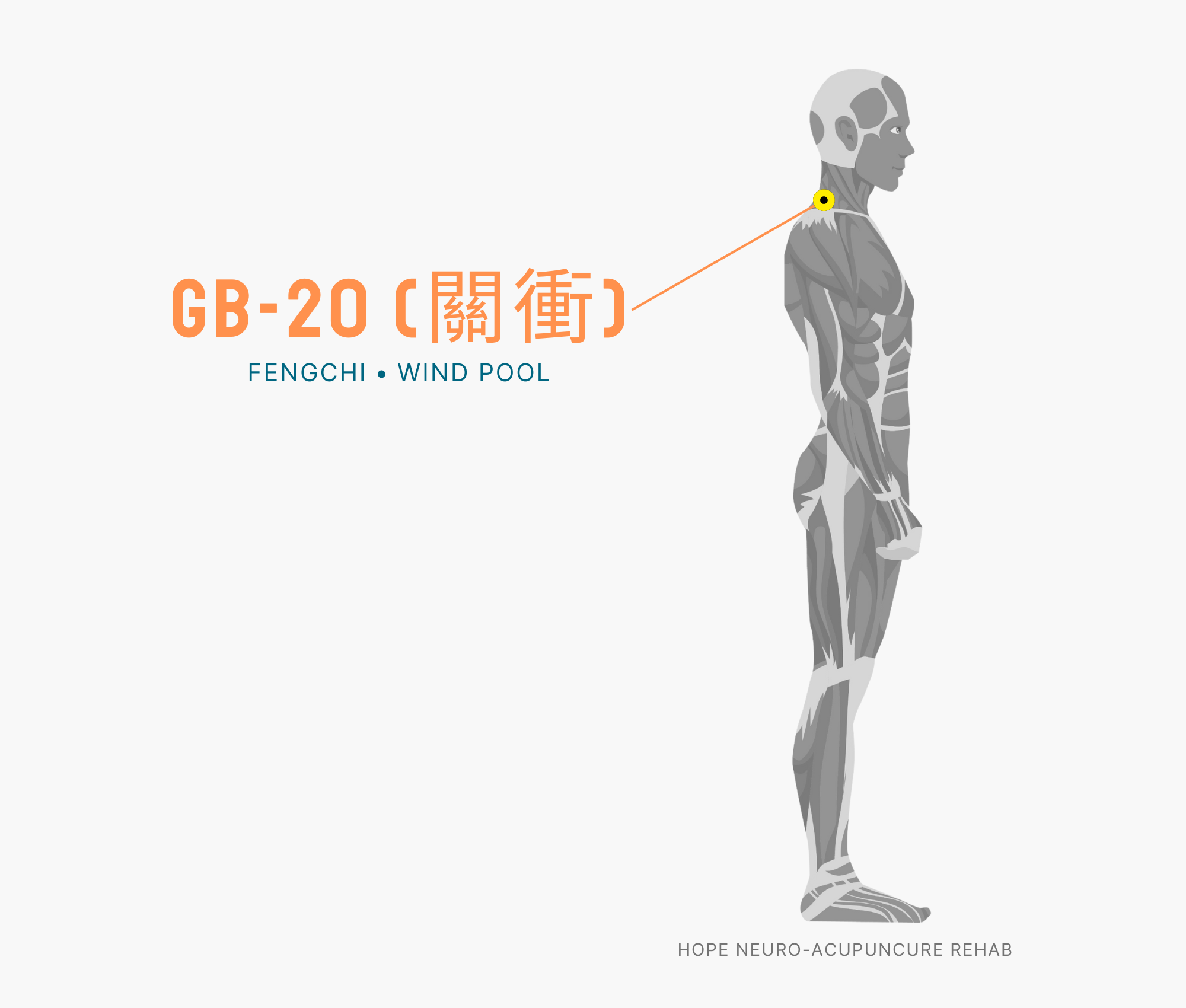
Location: At the back of the neck, below the base of the skull (at the depression between the neck muscles on both sides).
How to find it: Tilt your head back to find the groove between two muscles; specifically, it’s at the movable bone beneath the skull.
Acupressure technique: Using both thumbs, apply pressure toward the inside of the neck at a slight upward angle. Apply pressure for 30 seconds at each point, 3 times per day.
Benefits: It promotes blood circulation to the brain and relieves nerve tension. It can simultaneously alleviate headaches, dizziness, and neck stiffness that often accompany tinnitus.
4. Baihui (百會) – GV20 / Baihui
Location: At the top of the head, at the point where the line connecting the highest points of both ears intersects with the midline.
How to find it: Imagine a line connecting the highest points of both ears; where this line intersects the midline of the head is Baihui. When you press it with your finger, it feels slightly depressed.
Acupressure technique: Using your thumb or middle finger, apply gentle pressure vertically, massaging in small circles for 20-30 seconds. Avoid excessive stimulation.
Benefits: It calms brain nerves and clarifies the mind. It improves tinnitus, insomnia, and anxiety together, and is excellent for recovering from mental fatigue.
5. Kunlun (崑崙) – BL60 / Kunlun

Location: On the outer ankle, at the depression behind the outer ankle bone.
How to find it: Kunlun is located in the groove between the outer ankle bone (lateral malleolus) and the Achilles tendon.
Acupressure technique: Using your thumb, repeatedly press vertically toward the ankle and release for 1 minute. Apply enough stimulation to feel mild tenderness. Perform 1-2 times per day.
Benefits: It relieves nerve tension and improves qi and blood circulation throughout the body. In particular, it relieves nerve fatigue in the ear and prevents tinnitus from worsening due to sleep deprivation.
5-Minute Self-Acupressure Routine: Optimal Sequence and Time Distribution
Perform the following sequence every morning after waking up or every evening before sleep:
- Tinghui (1 minute) — 30 seconds on each side, gentle circular pressure
- Yifeng (1 minute) — 30 seconds on each side, light to moderate pressure
- Fengchi (1 minute) — 30 seconds on each side, pressing toward the brain
- Baihui (1 minute) — 30 seconds centered on the midline
- Kunlun (1 minute) — 30 seconds on each side, stimulate to mild tenderness
Tip: Perform this routine consistently 5-6 days per week, and do it twice daily (morning and evening) on days when symptoms are severe. You should continue for at least 3 months to notice the effects.
“`
Leave a Reply