Introduction
Have you ever experienced scratching so much at night that it bleeds, or insomnia due to unbearable itching? Atopic dermatitis is not just a skin condition but a systemic symptom caused by immune system imbalance. In traditional Chinese medicine, atopy is viewed as ‘Spleen Qi Deficiency with Excess Dampness (Pi Xu Shi Sheng)’—a condition where the spleen weakens and moisture accumulates in the body. Acupoint pressure therapy effectively promotes qi-blood circulation, restores immune function, and naturally alleviates atopic symptoms. In particular, self-massage is a great supplementary method to medical treatment since it can be done anytime and anywhere.
5 Effective Acupoints for Atopy Relief
1. Sanyinjiao (SP6) — The Center for Hormonal Balance
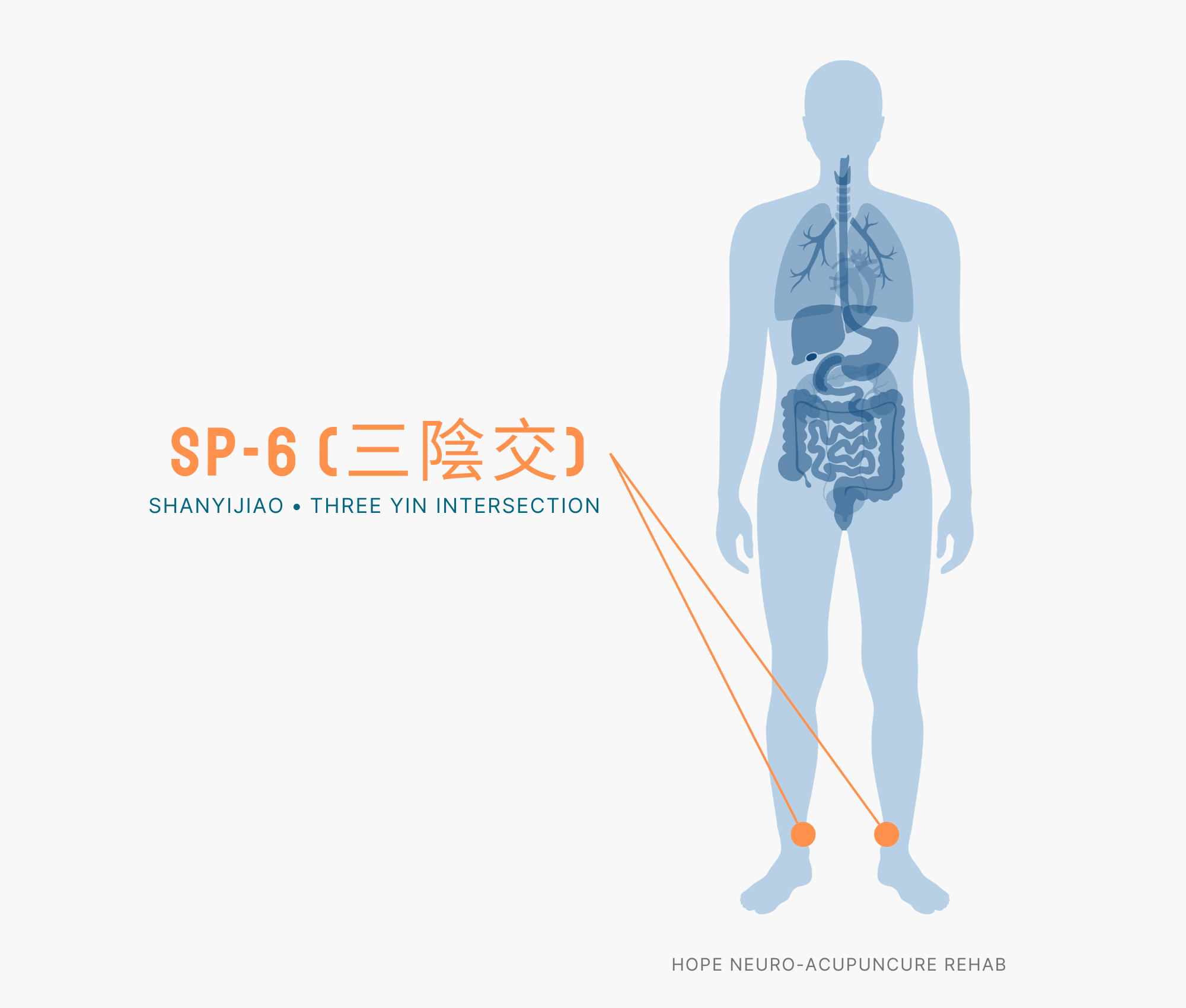
Location: Four finger-widths above the highest point on the inner ankle, toward the shin
WHO Code: SP6
Benefits: Sanyinjiao is where the Spleen, Liver, and Kidney meridians converge. It excels at balancing female hormones, enhancing immunity, and improving digestion. It strengthens spleen function—the root cause of atopy—and eliminates dampness. It also prevents atopy flare-ups by relieving stress.
Massage technique: Press with your thumb for 3 seconds, then release for 2 seconds, and repeat. Perform for 3 minutes at a time, twice daily (morning and evening). Start gently and gradually increase pressure.
2. Quchi (LI11) — The Premier Point for Inflammation and Itching Relief

Location: The outer end of the elbow crease when the elbow is bent at 90 degrees (thumb side)
WHO Code: LI11
Benefits: This point clears heat from the Large Intestine meridian, directly alleviating skin inflammation and suppressing itching. It calms overactive immune responses and reduces irritation by lowering skin temperature.
Massage technique: Slowly press with your opposite thumb while making small circles. Massage for about 1 minute in the morning and 1 minute in the evening. It’s more effective if done after soaking your arm in warm water in a bathtub.
3. Xuehai (SP10) — The Fundamental Point for Skin Improvement

Location: Two to three finger-widths above the inner side of the knee, on the inner thigh
WHO Code: SP10
Benefits: Known as ‘The Blood Point,’ Xuehai purifies the blood and nourishes the skin. It restores skin dryness and depletion caused by atopy and repairs the skin barrier damaged by prolonged irritation.
Massage technique: Sit down, bend your knee slightly for comfort, and repeatedly press with your thumb for 3 seconds each time. Perform for 3 minutes once daily.
4. Hegu (LI4) — The Versatile Point for Immunity Enhancement

Location: The hollow between the thumb and index finger (where a crease forms when the fingers are together)
WHO Code: LI4
Benefits: One of the most widely used acupoints in traditional medicine, it’s effective at enhancing immunity, relieving stress, and suppressing inflammation. It alleviates excessive stress—a major atopy aggravator—and promotes qi-blood circulation throughout the body.
Massage technique: Slowly press with your opposite thumb while making circles. Alternate between both hands, pressing for 1 minute each, twice daily. It’s best to do this when you wake up and before bed.
5. Feishu (BL13) — Improving Lung Function and Skin Respiration

Location: Between the shoulder blades on the back of the body, two finger-widths lateral to the spine at the level of the 3rd thoracic vertebra
WHO Code: BL13
Benefits: This point strengthens lung function and improves skin nourishment. The respiratory system and skin are closely related; enhancing lung function improves skin metabolism and oxygen supply, helping relieve atopic symptoms.
Massage technique: Since it may be difficult to do alone, seek help from someone else or stimulate by placing a tennis ball against your back and rolling it slowly. Alternatively, receiving regular moxibustion therapy from a professional is also beneficial.
5-Minute Self-Massage Routine
Preparation: Sit comfortably and expose your hands and legs. Apply a small amount of lotion or essential oil to reduce friction.
- Sanyinjiao (SP6) – 1 minute (30 seconds on each side or 1 minute on one side)
- Xuehai (SP10) – 1 minute (30 seconds on each side)
- Quchi (LI11) – 1 minute (30 seconds on each side)
- Hegu (LI4) – 1 minute (30 seconds on each side)
- Feishu (BL13) – 1 minute (use a tennis ball for 1 minute if doing it alone is difficult)
Frequency: Perform daily, or twice daily (morning and evening) during atopy flare-ups. Practice on an empty stomach or at least 2 hours after meals.