Why Does Lethargy Occur?
Even after sleeping enough, waking up in the morning feels difficult, and a heavy, dragging feeling persists throughout the day—this is lethargy. While simple fatigue recovers with rest, lethargy is a state where the body’s entire energy system has weakened.
In traditional Chinese medicine, this is viewed as a “deficiency of Qi (氣),” or a state of Qi deficiency (氣虛). Modern people often experience lethargy as Qi is continuously depleted due to excessive stress, irregular lifestyles, overwork, and chronic digestive dysfunction. To restore the body’s vitality and activate metabolism, it’s necessary to improve Qi and blood circulation through acupoint stimulation.
Five Acupoints to Improve Lethargy
① Zusanli (足三里, ST36) — Key Acupoint for Restoring Vitality

Location: On the outer side below the knee, approximately 3cm outward from the center of the front of the shinbone, around 10cm above the ankle
How to Find It: From the depression below the knee (popliteal fossa), move downward in the direction of the foot by the width of four fingers, then locate it approximately 1cm outward from the shinbone.
Acupressure Method: Apply pressure slowly with your thumb, making circular motions for 1 minute. Adjust the pressure intensity until you feel a “subtle ache combined with a sore, relieving sensation.”
Benefits: Zusanli is known as “the tonic for the legs” and restores overall body vitality while strengthening immunity. By improving digestive function and promoting nutrient absorption, it addresses the root cause of lethargy. Stimulating it in the morning helps maintain an energetic mood throughout the day.
② Hegu (合谷, LI4) — Solving Stress and Fatigue Simultaneously

Location: Between the thumb and index finger, at the highest point where the metacarpal bones meet on the back of the hand
How to Find It: When the thumb and index finger are spread apart, locate it just below the highest point, slightly toward the wrist side.
Acupressure Method: Apply vertical pressure with your opposite thumb and slowly rotate in circular motions. Maintain for 30 seconds to 1 minute, with a slight achy sensation being appropriate.
Benefits: Hegu relieves nervous tension and activates brain function. It simultaneously improves stress-related lethargy, concentration problems, and headaches, while promoting blood circulation to the face for improved complexion. Since it’s located on the hand, you can stimulate it anytime, anywhere.
③ Sanyinjiao (三陰交, SP6) — Improving Fatigue and Hormonal Imbalances in Women
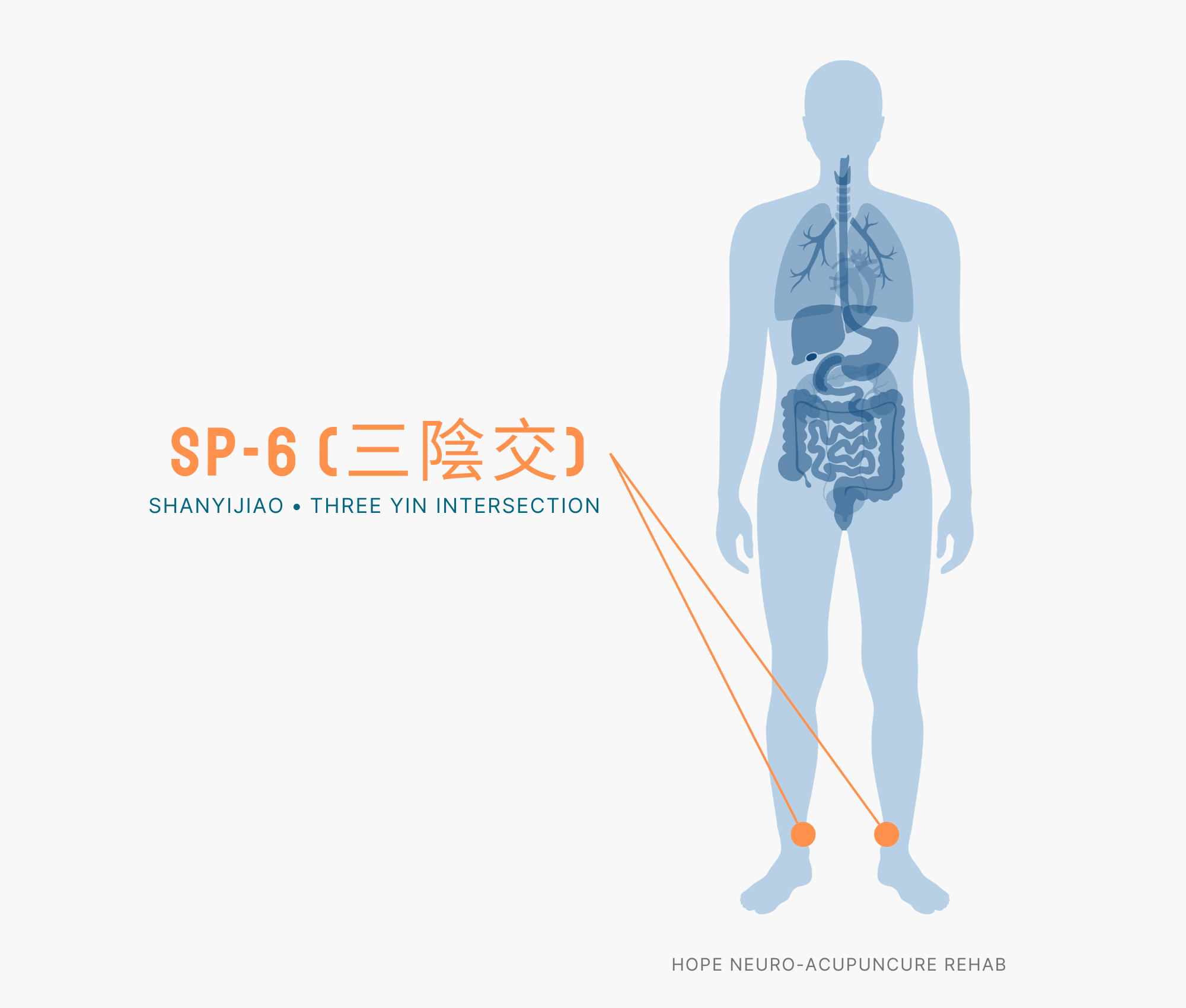
Location: Four finger-widths (approximately 10cm) above the inner ankle bone, on the inner edge of the shinbone
How to Find It: Using the most prominent bone on the inner side of the ankle as a reference point, locate it 3-4 finger-widths toward the toes, between the shinbone and the muscle behind it.
Acupressure Method: Apply vertical pressure with your thumb tip and slowly make circular motions for 1 minute. If there is pain, reduce the pressure intensity and repeat.
Benefits: Sanyinjiao harmonizes the Yin (陰) energy of the liver, spleen, and kidneys. It particularly improves lethargy caused by hormonal imbalances in women, pre-menstrual fatigue, and lack of sleep. It promotes digestive function and enhances the body’s energy production.
④ Taichong (太衝, LR3) — Restoring Liver Function and Improving Emotional Lethargy
Location: On the top of the foot, between the big toe and second toe, approximately 3cm above where the bones meet
How to Find It: Spread the toes apart and follow the crease line between the big toe and second toe as you move toward the top of the foot; locate it in the area of the shallow groove you feel.
Acupressure Method: Apply pressure slowly with your thumb and massage in circular motions for 1 minute. It’s effective when you feel a slight ache followed by a warming sensation.
Benefits: Taichong is called “the gate of the liver” and activates liver function to improve detoxification and metabolism. It simultaneously alleviates emotional stress-related lethargy, depression, and irritability, while promoting sound sleep to accelerate vitality recovery.
⑤ Zhongwan (中脘, CV12) — The Center of Digestion and Vitality Recovery
Location: The center of the abdomen, exactly midway between the navel and the bottom of the breastbone
How to Find It: Starting from the navel, count upward six finger-widths (approximately 15cm) along the center line of the abdomen.
Acupressure Method: For Zhongwan, warm stimulation is more effective than direct pressing. Gently massage in circular motions with your fingertips for 1-2 minutes, or apply a warm compress for 5-10 minutes.
Benefits: Zhongwan is the center of digestive function and fundamentally improves body energy production by promoting nutrient absorption. It simultaneously improves lethargy caused by poor digestion, abdominal bloating, and loss of appetite, while normalizing stomach function to enable overall vitality recovery.
5-Minute Self-Acupressure Routine — Practice Morning and Evening
① Preparation (1 minute)
Sit in a comfortable position and take 3 deep breaths. Rub your hands together to warm them up and prepare for improved blood circulation.
② Acupressure Sequence (4 minutes)
– Zusanli (ST36): 1 minute (30 seconds each side)
– Hegu (LI4): 1 minute (30 seconds each side)
– Sanyinjiao (SP6): 1 minute (30 seconds each side)
– Zhongwan (CV12): 1 minute (warm stimulation, ample time)
Efficient Tips:
– Morning: Perform immediately upon waking to start your day with energy
– Evening: Practice 30 minutes before bed to promote sound sleep and nighttime vitality recovery
– If especially fatigued during the week, stimulate Hegu for 5 minutes at lunch
– Drink warm water after acupressure to enhance the effects
Leave a Reply