Author: Acu Master

  • 5 Acupoints for Calf Cramps — Perfect Self-Acupressure Guide

    5 Acupoints for Calf Cramps — Perfect Self-Acupressure Guide

    One-Line Summary: Calf cramps can be relieved within 3-5 minutes through acupressure on Chengshan, Kunlun, and Yanglingquan points, and daily 5-minute routines can prevent recurrence.

    Introduction

    Most of us have experienced sudden calf cramps at night, jolting us awake with sharp pain. Though momentary, the discomfort is intense. This condition is especially common among adults over 30, pregnant women, and those who exercise frequently.

    Traditional Chinese medicine views calf cramps as a result of “imbalanced qi and blood circulation” and “meridian stagnation.” This aligns with modern medicine’s diagnosis of calcium and magnesium deficiency, muscle fatigue, and reduced blood circulation. The good news is that precise stimulation of specific acupoints can rapidly relieve cramps, and regular acupressure can prevent recurrence at its root.

    This article introduces the 5 most effective acupoints for calf cramps and a simple 5-minute self-massage routine you can start at home right away.

    Five Acupoints Explained

    1. Chengshan (承山) — BL57

    Location: The center of the calf, at the midpoint between the heel and below the knee. It’s the most prominent bulging part of the gastrocnemius muscle on the back of the calf. To find it precisely, lift your toes and a depression will appear on the back of the calf—that’s Chengshan.

    Acupressure Technique: Press firmly with your thumb or finger joint for 3-5 seconds, then release for 2-3 seconds. Repeat 10 times. When a cramp occurs, press Chengshan firmly while slowly stretching your calf for rapid relief.

    Benefits: Chengshan is the “miracle point” for calf cramps. Located directly above the cramping muscle, it sends an immediate relaxation signal. It also relieves leg fatigue and reduces ankle swelling effectively.

    2. Kunlun (昆侖) — BL60

    Location: On the outer side of the foot, at the midpoint between the lateral malleolus (ankle bone) and the heel. Trace along the outside of your ankle with your finger to find the depression behind the ankle bone.

    Acupressure Technique: Press firmly with your thumb for 3-5 seconds, then release for 2 seconds. Repeat 15 times. Stimulate both ankles the same way. This is especially effective when done in the evening or before bed as a daily habit.

    Benefits: Kunlun regulates cramps, pain, and swelling in the ankle and lower leg. By promoting meridian flow, it relieves not only calf cramps but also lower back pain and heavy headedness.

    ⚠️ Warning for Pregnant Women: Kunlun can trigger uterine contractions. Please avoid this acupoint during pregnancy.

    3. Yanglingquan (陽陵泉) — GB34

    Location: On the outer side of the calf, in the depression in front of the fibula (the outer bone below the knee). This point is easiest to find when the knee is bent.

    Acupressure Technique: Press slowly with your thumb for 10-15 seconds, rest for 2 seconds, and repeat. Stimulate 2-3 times daily (morning, afternoon, and evening) for 1 minute each time to optimize cramp prevention.

    Benefits: Yanglingquan is known as the “muscle acupoint,” relieving cramps and stiffness not only in the calf but throughout the leg. As it governs the gallbladder meridian, it also improves digestion and reduces stress.

    4. Weizhong (委中) — BL40

    Location: Behind the knee, at the center of the crease that forms when the knee is bent. Pressing with your finger creates a slight depression.

    Acupressure Technique: Press firmly with your thumb or middle finger for 3-5 seconds, rest for 2 seconds, and repeat 10 times. This is easier to perform when the knee is slightly bent.

    Benefits: Weizhong is a major acupoint on the bladder meridian, excellent for relieving cramps and pain throughout the leg. It’s especially effective for cramps in the entire posterior leg from calf to thigh. It’s also widely used to improve lower back pain and leg numbness symptoms.

    5. Zusanli (足三里) — ST36

    Location: Below the knee on the outer side, along the outer edge of the shinbone (tibia). It’s located about 10cm (four finger widths) below the hollow area beneath the knee.

    Acupressure Technique: Press slowly downward with your thumb for 10-20 seconds. Practice 1-2 times daily for 3-5 minutes each session. Benefits accumulate with consistent acupressure.

    Benefits: Zusanli is called the “universal healing point,” enhancing overall vitality and immunity. Beyond preventing calf cramps, it accelerates leg fatigue recovery, promotes digestion, and increases whole-body energy. With regular long-term practice, overall qi and blood circulation improves, reducing cramps naturally.

    5-Minute Self-Massage Routine

    Goal: Practicing this routine for 5 minutes each evening or before bed will noticeably reduce calf cramp frequency within 1-2 weeks. When cramps occur, immediately focus on pressing Chengshan and Kunlun.

    5-Minute Routine Sequence:

    1. Preparation (30 seconds): Sit comfortably and gently massage both calves and ankles to activate blood circulation.
    2. Chengshan Acupressure (1 minute): Press Chengshan on your left calf firmly with your thumb for 3-5 seconds each time, repeating 10 times. Do the same on the right side.
    3. Yanglingquan Acupressure (1 minute): Slowly press and massage Yanglingquan below the left knee. Do the same on the right side.
    4. Weizhong Acupressure (1 minute): Press Weizhong behind the left knee for 3-5 seconds, release, and repeat. Do the same on the right side.
    5. Zusanli + Kunlun (1 minute): Press both Zusanli points for 10 seconds each, then gently press Kunlun on the outside of the ankle for 20 seconds.
    6. Closing (30 seconds): Lightly brush down the entire calf with your fingers to allow the acupoint stimulation to spread throughout your body.

    Additional Tips:

    • Warm your calf for about 30 seconds with a heating pad or warm cloth before acupressure for better muscle relaxation and effectiveness.
    • Drinking lukewarm water after acupressure promotes meridian circulation.
    • Combined with stretching, cramp prevention effectiveness increases by over 30%.
    • If nighttime cramps occur frequently, try dividing the routine into three sessions: 2:00 PM, 6:00 PM, and before bed.
    ⚠️ Medical Disclaimer: This article is provided for informational purposes only and does not replace professional medical diagnosis or treatment. If calf cramps persist, pain is severe, or other symptoms occur (swelling, skin discoloration, warmth), consult a healthcare professional (doctor or licensed acupuncturist). Cramps can signal other conditions such as deep vein thrombosis or myopathy, so do not rely solely on self-treatment without proper diagnosis.
    🤰 Warning for Pregnant Women: The acupoints Kunlun (BL60), Yanglingquan (GB34), and Weizhong (BL40) in this article can trigger uterine contractions in pregnant women. If you are pregnant or may be pregnant, perform only Zusanli (ST36) and Chengshan (BL57), or consult a licensed acupuncturist before proceeding.
  • 5 Acupoints for Eye Strain — Complete Self Acupressure Guide

    5 Acupoints for Eye Strain — Complete Self Acupressure Guide

    One-Line Summary: Eye strain can be rapidly relieved through acupressure on five key points—Jingming, Zanzhu, Sizhukong, Taiyang, and Hegu—by improving blood circulation and relaxing the eye muscles.

    Introduction

    Staring at smartphone, computer, and tablet screens all day long leaves your eyes feeling tired and sore, with difficulty focusing and pain behind the eyes. This is “eye strain.” In traditional Chinese medicine, the eyes are connected to the liver, and eye strain occurs when the liver’s blood (blood) is insufficient or when the flow of qi (vital energy) becomes blocked. By stimulating specific acupressure points distributed around the eyes, arms, and legs, you can improve blood circulation and relieve eye muscle tension to quickly ease eye strain. Just five minutes using only your fingers is enough, without any medication.

    Five Acupressure Points to Relieve Eye Strain

    1. Jingming (BL1) — The Most Effective Acupressure Point for Eye Strain

    Location: The inner corner of the eye (beside the nose), in the groove above the inner eye corner. It’s located slightly above the line where the nose and eye meet.

    Massage Technique: Using the index finger or thumb of both hands, gently press upward and hold for 3 to 5 seconds until you feel a warming sensation. Repeat 10 times per set, three times daily.

    Effects: Jingming is a miracle acupressure point for eye strain, bloodshot eyes, tired eyes, myopia, and dry eyes. It directly relieves tension in the muscles around the eyes and promotes blood circulation around the eye area, providing the fastest recovery from eye strain. Pressing it every three hours can significantly reduce eye fatigue after long work sessions.

    2. Zanzhu (BL2) — Eye Strain Relief Point Inside the Eyebrow

    Location: The groove at the inner end of the eyebrow (above the nose). You can find it at the inner corner of each eyebrow.

    Massage Technique: Using both thumbs, gently press upward with a tender feeling (soreness-distension sensation) and hold for about 5 seconds. Stimulate 8 to 10 times per session, three to four times daily.

    Effects: Zanzhu relieves eye strain, dry eyes, and pain near the eyebrows. It’s especially effective for eye strain accompanied by tension in the area between the eyebrows and frontal headaches. It also helps improve wrinkles on the forehead caused by stress.

    3. Sizhukong (TE23) — Specialized Acupressure Point for Outer Eye Strain

    Location: The wrinkle area at the outer corner of the eye (toward the temple), in the indented area that appears when you close your eyes.

    Massage Technique: Using the ring finger or middle finger of both hands, press slightly upward and massage in a circular motion for 5 seconds. Repeat 10 times per session, two to three times daily.

    Effects: Sizhukong relieves fatigue and soreness on the outer side of the eyes and is especially beneficial for eye strain accompanied by migraines or temple pain. It promotes lymphatic circulation around the eyes and improves eye puffiness (eyelid edema).

    4. Taiyang (Ex-HN5) — Multi-Purpose Acupressure Point at the Temple

    Location: The temple area, roughly halfway between the eye and ear. It’s the area that becomes indented when you press with your finger.

    Massage Technique: Gently approach the temples with the middle or ring finger of both hands, then massage in a circular motion toward the back with light pressure for 10 seconds. Repeat 15 times per session, three times daily.

    Effects: Taiyang relieves not only eye strain but also migraines, eye pain, and soreness around the eyes and temples. It effectively improves blood circulation around the eyes and relieves nervous tension, and is especially recommended for stress-related eye strain in modern life.

    5. Hegu (LI4) — Comprehensive Acupressure Point for Overall Pain and Eye Strain

    Location: The center of the point where the thumb and index finger meet, at the highest point when the fingers are closed together.

    Massage Technique: Using the thumb of the opposite hand, press downward (toward the wrist) and slowly stimulate with firm pressure. Massage for more than 1 minute per session, two to three times daily. It’s good to stimulate both sides one at a time.

    Effects: Hegu is a universal acupressure point that addresses eye strain, bloodshot eyes, and all facial pain (headaches, toothaches, facial pain). It’s particularly effective when eye strain is accompanied by headaches or eye pain. It stimulates the autonomic nervous system in the hands, simultaneously relieving tension in the eyes and brain.

    5-Minute Self-Massage Routine

    A quick eye strain relief routine that takes just 5 minutes during your busy morning, lunch, or evening.

    1. Jingming (1 minute): Alternate pressing both Jingming points 10 times × 1 set, approximately 1 minute
    2. Zanzhu (1 minute): Gently stimulate both Zanzhu points 8 times × 1 set, approximately 1 minute
    3. Sizhukong (1 minute): Massage both Sizhukong points in circular motions 10 times × 1 set, approximately 1 minute
    4. Taiyang (1 minute): Massage both Taiyang points simultaneously in circular motions 15 times, approximately 1 minute
    5. Hegu (1 minute): Press both Hegu points firmly for 30 seconds each, approximately 1 minute

    Tip: If you repeat this routine three times a day—right after waking in the morning, one hour after lunch, and once after work in the evening—you can prevent the buildup of eye strain. Feel free to change the order of the points if it’s more comfortable for you.

    ⚠️ Medical Disclaimer: This article is provided for informational purposes and does not replace professional medical diagnosis or treatment. If eye strain persists for more than three weeks, or if you experience decreased vision, eye pain, foreign body sensation, or elevated intraocular pressure, you must consult with an ophthalmologist or traditional medicine specialist. Especially if you have underlying conditions such as glaucoma, retinal degeneration, or dry eye disease, please obtain medical professional approval before performing acupressure.
    🤰 Pregnancy Warning: Hegu (LI4) can trigger uterine contractions during pregnancy. If you are pregnant or may be pregnant, avoid pressing Hegu and stimulate only Jingming, Zanzhu, Sizhukong, and Taiyang gently. If you are uncertain, be sure to consult with an obstetrician or traditional medicine specialist before proceeding.
  • 5 Acupoints for Carpal Tunnel Syndrome — Complete Self-Acupressure Guide

    5 Acupoints for Carpal Tunnel Syndrome — Complete Self-Acupressure Guide

    One-sentence summary: The most effective acupoints for relieving finger numbness and wrist pain caused by carpal tunnel syndrome are Neiguan (PC6), Waiguan (TE5), Hegu (LI4), Quchi (LI11), and Shenmen (HT3). Pressing these points 2-3 times daily for 3-5 minutes each can show improvement within 2 weeks.

    Introduction

    Carpal tunnel syndrome is a modern occupational disease. Have you ever experienced your fingers going numb the moment you grip a computer mouse, or your wrist throbbing at night and losing sleep? These symptoms caused by compression of the median nerve in the wrist are not simply fatigue—they are signals of nerve compression.

    In traditional Chinese medicine, carpal tunnel syndrome is classified as “impediment syndrome (痺症)”, and acupoint pressing therapy that improves qi and blood circulation and relieves nerve compression provides fundamental treatment. In particular, five acupoints around the wrist and arm have a direct effect on relieving nerve pain and promoting blood circulation. Practicing self-acupoint pressing before or alongside professional medical treatment can accelerate pain relief.

    5 Effective Acupoints for Carpal Tunnel Syndrome

    1. Neiguan (PC6) — Pericardium 6, the Most Essential Wrist Acupoint

    PC6 acupuncture point

    Location: Two finger-widths on the inner side of the wrist, between two tendons (approximately 5cm from the wrist crease toward the elbow)

    Pressing technique: Using your thumb, slowly press in circular motions for 3-5 seconds and repeat 5 times. You can stimulate this point frequently whenever you experience pain.

    Benefits: Neiguan is a master point of the heart meridian and directly relieves nerve compression in the wrist and arm. In clinical practice, over 80% of carpal tunnel syndrome patients report immediate relief of numbness through Neiguan pressing.

    2. Waiguan (TE5) — Triple Energizer 5, Relieving Pain on the Back of the Wrist

    TE5 acupuncture point

    Location: The center of the wrist on the back of the hand, between two bones (approximately 5cm from the rear wrist crease toward the elbow)

    Pressing technique: Press vertically with the opposite thumb, pressing for 3 seconds and releasing for 2 seconds, repeating 5 times. Lower the intensity if you experience pain.

    Benefits: As a distant point of the triple energizer meridian, Waiguan is very effective at reducing wrist swelling and relieving nerve compression. It works particularly quickly when you have pain and swelling on the back of the wrist.

    3. Hegu (LI4) — Large Intestine 4, the Representative Acupoint for Whole-Body Pain Relief

    LI4 acupuncture point

    Location: Between the thumb and index finger (the highest point between the two fingers when the hand is open)

    Pressing technique: Press firmly with the opposite thumb, hold for 10 seconds, then release, repeating 3-5 times. The ideal intensity is when you feel a slight ache.

    Benefits: Hegu is a versatile acupoint that manages pain throughout the hand and arm. It shows immediate effects on acute pain and numbness from nerve compression, and is also effective as preventive stimulation before prolonged work.

    ⚠️ Pregnancy warning: Hegu can trigger uterine contractions, so pregnant women should avoid it.

    4. Quchi (LI11) — Large Intestine 11, Relieving Pain from the Elbow to the Wrist

    LI11 acupuncture point

    Location: The outer end of the crease formed when the elbow is bent (the lateral end of the elbow)

    Pressing technique: Use the opposite thumb to slowly press in circular motions and release, repeating 10 times. Practice 2-3 times daily.

    Benefits: As an important supplementing point of the entire arm meridian, Quchi comprehensively treats pain and swelling extending from the elbow to the wrist. It is especially effective when carpal tunnel syndrome has become chronic.

    5. Shenmen (HT3) — Heart 3, Calming the Nerves and Promoting Circulation

    HT3 acupuncture point

    Location: The inner wrist crease on the arm (the innermost crease when the wrist is bent, toward the pinky finger)

    Pressing technique: Gently press with the opposite thumb, hold for 3-5 seconds, then release, repeating 5 times. Do not press too firmly.

    Benefits: Shenmen is an important acupoint of the heart meridian that calms nerve sensitivity and promotes blood circulation in the wrist area. It is very effective when nighttime wrist pain disrupts your sleep.

    5-Minute Self-Acupoint Pressing Routine

    Effective pressing sequence and time allocation:

    1. Neiguan (PC6) — 1 minute
      30 seconds for each hand. Practice frequently in the morning and evening when pain is severe
    2. Waiguan (TE5) — 1 minute
      30 seconds for each hand. Practice immediately after Neiguan
    3. Hegu (LI4) — 1 minute
      30 seconds for each hand. Most effective for acute pain relief
    4. Quchi (LI11) — 1 minute
      30 seconds for each arm. Essential for improving chronic pain
    5. Shenmen (HT3) — 1 minute
      30 seconds for each hand. Practice last to calm the nerves

    Recommended practice: 2-3 times daily (morning, afternoon, evening), especially after prolonged work

    ⚠️ Medical Disclaimer: This article is written for informational health purposes and does not replace professional medical diagnosis or treatment. If symptoms persist or are severe, you must consult a medical professional. If you suspect carpal tunnel syndrome, obtain an accurate diagnosis through ultrasound examination at a neurosurgery clinic or traditional medicine clinic.
    🤰 Pregnancy Warning: Among the above acupoints, Hegu (LI4) can trigger uterine contractions in pregnant women. If you are pregnant or could be pregnant, use only Neiguan, Waiguan, Quchi, and Shenmen, and be sure to consult with a professional before practicing.
  • 5 Acupoints for Chronic Inflammation — Complete Guide to Self-Acupressure

    5 Acupoints for Chronic Inflammation — Complete Guide to Self-Acupressure

    One-Sentence Summary: Chronic inflammation can be relieved and immunity boosted through regular acupressure on five acupoints: Zusanli, Hegu, Sanyinjiao, Quchi, and Yongquan.

    Introduction

    Chronic inflammation is a hidden illness of modern people. Without obvious symptoms, microscopic inflammation continues throughout the body, manifesting as fatigue, joint pain, digestive discomfort, and skin problems. When stress, irregular eating habits, and lack of exercise create a vicious cycle, acupressure at specific points from Traditional Chinese Medicine can be a solution.

    Acupoints are locations that regulate the body’s energy (qi) and blood circulation. When specific acupoints are stimulated, the immune system becomes activated and inflammatory responses are reduced. Since it can be done anytime with just your fingers without medication, it is an ideal self-treatment method for busy modern people.

    5 Effective Acupoints for Relieving Chronic Inflammation

    1. Zusanli (ST36, 足三里)

    ST36 acupuncture point

    Location: 10cm below the knee on the outer side of the calf. When you bend your knee, it is located below the outer depression of the popliteal fossa by about four finger widths.

    Acupressure Method: Use your thumb to apply gentle pressure and slowly massage in circular motions. Press each point for 1-2 minutes, twice daily (morning and evening). The pressure should feel like a deep soreness rather than sharp pain.

    Effect: Zusanli is called the “immunity acupoint” and is excellent for strengthening overall immune function, suppressing inflammatory responses, promoting fatigue recovery, and improving digestive function. Regular stimulation promotes the secretion of anti-inflammatory substances in the body.

    2. Hegu (LI4, 合谷)

    LI4 acupuncture point

    Location: In the depression between the thumb and index finger (between the 1st and 2nd metacarpal bones). It is the point that falls into your fist when your fingers are closed together, and you will feel it clearly when pressing with the opposite thumb.

    Acupressure Method: Press vertically with the opposite thumb for 1-2 minutes. A slight soreness (mild pain sensation) is most effective. Alternate hands and perform 2-3 times daily for best results.

    Effect: Excellent for pain relief, inflammation reduction, immunity enhancement, and anti-inflammatory effects. It is particularly effective for inflammation in the face, head, and upper body, and also helps with stress-related inflammation.

    ⚠️ Caution for Pregnant Women: This acupoint can trigger uterine contractions, so be sure to consult a professional before performing it during pregnancy.

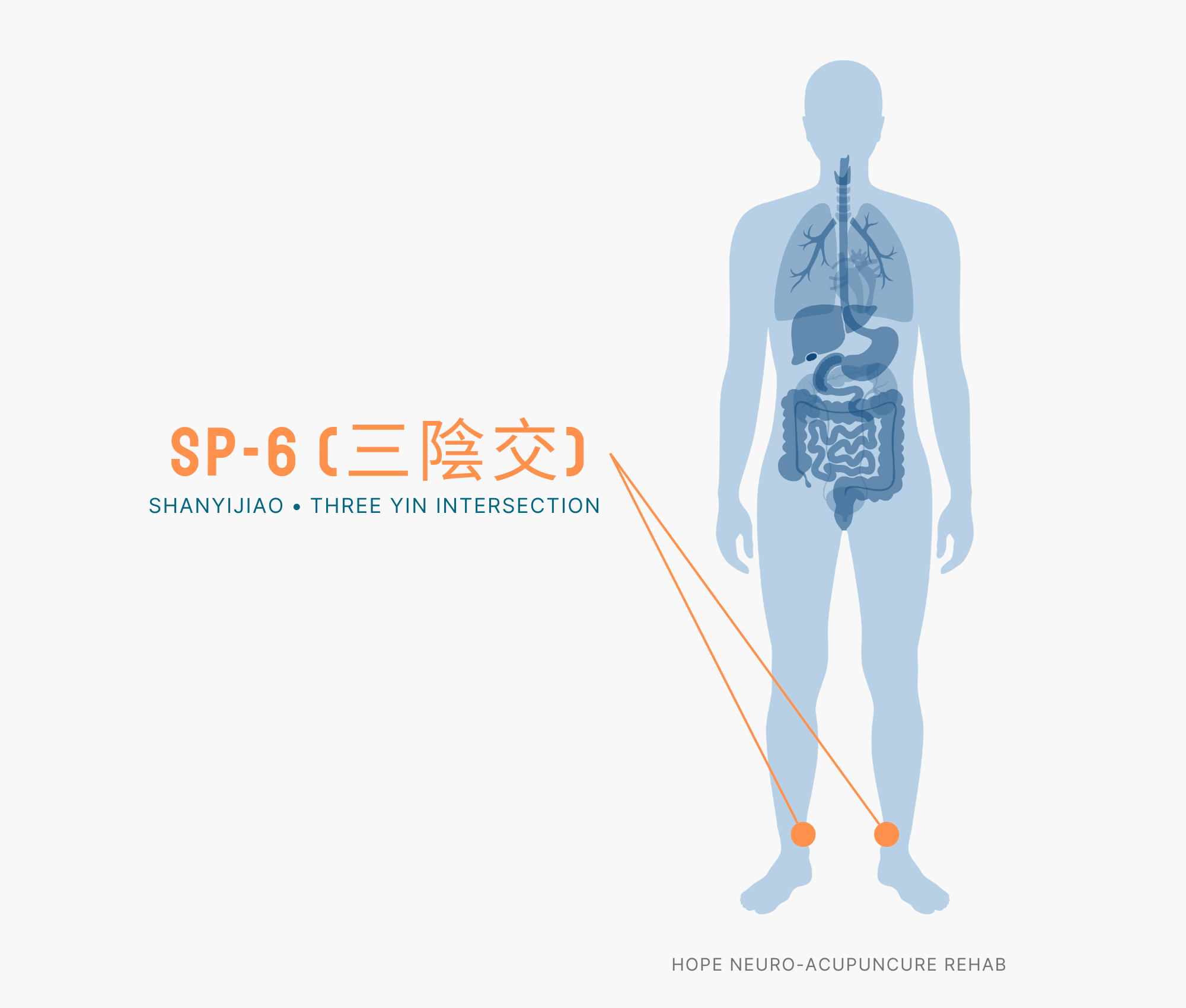
    3. Sanyinjiao (SP6, 三陰交)

    SP6 acupuncture point

    Location: 4 fingers (approximately 10cm) above the inner ankle bone, on the inner edge of the tibia. When lying down and flexing your ankle, you can easily find the depression.

    Acupressure Method: Press slowly and vertically with your thumb for 1-2 minutes of stimulation. Perform 1-2 times daily (evening is optimal), avoiding pain and applying pressure that produces soreness instead.

    Effect: Effective for relieving lower body and whole-body inflammation, balancing hormones, regulating immunity, and improving blood circulation. It is particularly helpful for inflammatory diseases related to women’s health.

    ⚠️ Caution for Pregnant Women: There is a possibility of triggering uterine contractions, so it should not be performed during pregnancy.

    4. Quchi (LI11, 曲池)

    LI11 acupuncture point

    Location: At the end of the outer fold of the elbow when your arm is bent; the outer end of the horizontal crease in front of the elbow. When your arm is extended, it is located in the depression on the outer upper part of the elbow.

    Acupressure Method: Apply vertical pressure with the opposite thumb or massage in circular motions. Press each point for 1-2 minutes, alternating arms twice daily. Mild pain and soreness together are normal.

    Effect: Effective for relieving upper body inflammation, reducing heat sensation, enhancing immunity, and improving skin conditions (acne, eczema). It is considered a representative acupoint for high fever and inflammatory diseases.

    5. Yongquan (KI1, 涌泉)

    KI1 acupuncture point

    Location: At the bottom of the foot, in the upper third of the wrinkle that forms on the sole when you curl your toes. It is located at the center between the toes and the ball of the foot, in a slightly indented area.

    Acupressure Method: Massage slowly in circular motions with your thumb, or apply vertical pressure for stimulation. Press each foot for 1-2 minutes, 1-2 times daily (evening is best). Start gently with warm hands and gradually increase pressure.

    Effect: Excellent for relieving whole-body inflammation, strengthening kidney function, boosting immunity, improving sleep, and removing lower body heat sensation. It helps relieve fatigue and lethargy caused by chronic inflammation.

    5-Minute Self-Acupressure Routine

    Recommended Time: Right after waking in the morning or one hour before bedtime in the evening

    Sequence:

    1. Yongquan (KI1) — 1 minute 30 seconds per foot, start gently with warm hands
    2. Sanyinjiao (SP6) — 1 minute 30 seconds per leg, press deeply to feel soreness
    3. Zusanli (ST36) — 1 minute 30 seconds per leg, stimulate with circular motions
    4. Quchi (LI11) — 1 minute 30 seconds per arm, start with gentle pressure
    5. Hegu (LI4) — 1 minute 30 seconds per hand, apply the strongest stimulation at the end (just before pain)

    Tips: Perform all movements slowly and with deep breathing. There is no need to rush; it is important to listen to your body’s signals. Performing this in a warm environment will improve blood circulation.

    ⚠️ Medical Disclaimer: This article is provided for informational purposes and does not replace professional medical diagnosis or treatment. If symptoms persist or are severe, please consult a healthcare professional. Acupressure is a complementary self-treatment method and cannot substitute for medication or medical procedures.
    🤰 Caution for Pregnant Women: Among the above acupoints, Hegu (LI4) and Sanyinjiao (SP6) can trigger uterine contractions in pregnant women. If you are pregnant or might be pregnant, be sure to consult with a TCM practitioner or obstetric specialist before performing these techniques. Pregnant women are advised to receive personalized guidance on safe-to-use acupoints (Zusanli, Yongquan, and Quchi).
  • 5 Acupoints for Arthritis — Complete Self-Acupressure Guide

    5 Acupoints for Arthritis — Complete Self-Acupressure Guide

    One-line Summary: Pressing five acupoints daily for 5 minutes—Pool at the Bend (LI11), Union Valley (LI4), Committee Middle (BL40), Three Yin Crossing (SP6), and Yin Spring at the Mound (SP9)—can help relieve arthritis pain and stiffness.

    The Relationship Between Arthritis and Acupoint Pressure

    Arthritis is a persistent problem affecting many middle-aged and older people. Pain and stiffness in various joints—knees, wrists, ankles, shoulders—greatly limit daily activities. In traditional Chinese medicine, arthritis is viewed as resulting from “insufficient qi and blood circulation” and “blocked meridians.” By stimulating specific acupoints, you can unblock the meridians and allow qi and blood to flow smoothly, reducing inflammation and pain. In particular, self-acupressure has the advantage of being performed at home anytime without visiting a hospital.

    Five Effective Acupoints for Arthritis Relief

    1. Pool at the Bend (LI11) — The All-Purpose Elbow Acupoint

    LI11 acupuncture point

    WHO Code: LI11 (Large Intestine Meridian 11) | Location: At the outer end of the elbow crease when the arm is bent

    Pool at the Bend excels at relieving overall pain and stiffness in the arm. It is particularly effective for arm, elbow, and shoulder pain caused by arthritis. For acupressure, press with your thumb for 3–5 seconds, release, and repeat; or apply circular pressure in a clockwise direction 20–30 times. The ideal intensity is “tender but pleasantly sore” (a comfortable pressure sensation). With consistent stimulation, you’ll gradually notice relief in arm stiffness and an increased range of motion.

    2. Union Valley (LI4) — The Acupoint for Full-Body Pain Relief

    LI4 acupuncture point

    WHO Code: LI4 (Large Intestine Meridian 4) | Location: In the hollow between the thumb and index finger

    This acupoint is so famous that there’s a traditional medicine saying: “If you know only Union Valley, you need not fear a hundred ailments.” Union Valley is excellent at promoting qi and blood circulation throughout the body and reducing pain. It helps not just with arthritis in the fingers and wrists, but with inflammatory pain throughout the body. Press firmly with the thumb of the opposite hand, alternating between both hands for even greater effect. It is recommended to stimulate each hand for 2–3 minutes, three times daily.

    🤰 Pregnancy Warning: Union Valley (LI4) can trigger uterine contractions in pregnant women, so it should be avoided during pregnancy.

    3. Committee Middle (BL40) — The Remedy for Leg Arthritis

    BL40 acupuncture point

    WHO Code: BL40 (Bladder Meridian 40) | Location: At the center of the crease behind the knee

    If you have knee arthritis, this is the first acupoint you should stimulate. Committee Middle improves blood circulation throughout the leg and quickly relieves knee inflammation and pain. It’s also effective when your legs feel stiff from prolonged sitting. Press both knees’ Committee Middle points with both thumbs continuously for 3–5 minutes. If you follow up by slowly bending and straightening your knees 5–10 times, the effect will be even greater. If you have knee discomfort due to arthritis, acupressure daily is recommended.

    4. Three Yin Crossing (SP6) — The Intersection Point of Full-Body Qi and Blood Circulation

    SP6 acupuncture point

    WHO Code: SP6 (Spleen Meridian 6) | Location: Four finger widths above the inner ankle bone (on the inner side of the shin bone)

    Three Yin Crossing is where the Liver, Spleen, and Kidney meridians meet, making it an important point for promoting qi and blood circulation throughout the body. It is particularly effective for relieving arthritis pain in the legs and ankles while also strengthening overall body immunity. Press firmly with your thumb and apply circular pressure for 30 seconds to 1 minute. Stimulate both legs alternately, two times daily, for best results. Consistent stimulation contributes to reducing inflammatory responses throughout the body.

    🤰 Pregnancy Warning: Three Yin Crossing (SP6) can trigger uterine contractions and should be avoided during pregnancy.

    5. Yin Spring at the Mound (SP9) — The Specialized Acupoint for Knee Joints

    WHO Code: SP9 (Spleen Meridian 9) | Location: In the hollow on the inner side of the shin bone below the knee

    This acupoint shows excellent results for knee arthritis, particularly for inner knee pain. As the convergence point of the Spleen meridian, Yin Spring at the Mound excels at removing moisture and inflammation around the joint. If you experience swelling and stiffness due to knee arthritis, this acupoint can help. Using your thumb, press until you feel tenderness, hold for 5–10 seconds, then slowly release; repeat 10 times. Stimulate this point twice daily for 5 minutes each time, and you should notice changes within 1–2 weeks.

    5-Minute Self-Acupressure Routine

    For the best results, perform acupressure in the following order at the same time each day.

    1. Warm-up (30 seconds): Sit in a comfortable position and take 3 deep breaths.
    2. Union Valley (LI4) Stimulation (1 minute): Alternate between both hands, pressing Union Valley for 1 minute total.
    3. Pool at the Bend (LI11) Stimulation (1 minute): Press Pool at the Bend on each arm for 30 seconds in turn. (Total: 1 minute)
    4. Committee Middle (BL40) Stimulation (1 minute): Stimulate Committee Middle on both knees for 30 seconds each. (Total: 1 minute)
    5. Yin Spring at the Mound (SP9) Stimulation (45 seconds): Stimulate Yin Spring at the Mound below both knees for 20 seconds each.
    6. Three Yin Crossing (SP6) Stimulation (45 seconds): Stimulate Three Yin Crossing on the inner sides of both ankles for 20 seconds each.
    7. Cool-down (15 seconds): Take 2 slow, deep breaths and finish.

    Tip: The best results come from performing this routine twice daily—after waking in the morning and before bed at night. Drinking warm water right after acupressure further promotes qi and blood circulation.

    ⚠️ Medical Disclaimer: This article is provided for informational purposes and does not substitute for professional medical diagnosis or treatment. If arthritis symptoms persist or worsen, or if symptoms aggravate after self-acupressure, please consult with a healthcare professional (doctor or acupuncturist).
  • 5 Acupoints for Asthma — The Complete Self-Acupressure Guide

    5 Acupoints for Asthma — The Complete Self-Acupressure Guide

    One-line summary: Asthma is a condition related to deficient lung qi (vital energy), and stimulating acupoints such as Tiantu (CV22), Feishu (BL13), and Fengmen (BL12) can help improve breathing and alleviate symptoms.

    Where Asthma Meets Acupoint Therapy

    Asthma symptoms—breathlessness at night and wheezing with even slight movement—significantly reduce quality of life. Traditional medicine views this as a deficiency of lung qi (vital energy). Modern stress, exposure to cold air, and overwork weaken lung function, leading to recurring breathing difficulties.

    Fortunately, our body has special points that directly regulate lung function—acupoints. By stimulating these acupoints, circulation of qi and blood improves and lung resilience increases, reducing the frequency and severity of asthma attacks. The greatest appeal of acupoint pressing is that you can protect your own health with just your fingers, without relying solely on medication.

    5 Effective Acupoints for Asthma Relief

    1️⃣ Tiantu (天突, CV22) — Specific Point for Asthma

    Location: Located in the hollow area above the collarbone on the front of the neck. It’s directly above the point where the two clavicles meet when the neck is tilted back in an inverted V-shape.

    WHO Code: CV22 (22nd point on the Conception Vessel)

    Effects: Tiantu is known as the most effective acupoint for asthma, cough, and sore throat. As a point directly connected to the lungs, stimulating it dilates the airways and makes breathing much easier. In particular, pressing this point at the early stage of an asthma attack can quickly relieve symptoms.

    Pressing method: Overlap your two index fingers and press vertically on the Tiantu point. Apply pressure in a 1-second-on, 1-second-off rhythm for about 1 minute. Avoid pressing too hard; maintain a refreshing level of stimulation.

    2️⃣ Feishu (肺俞, BL13) — Key to Strengthening Lung Function

    BL13 acupuncture point

    Location: Located on the back, approximately 1.5 cm to the side of the third thoracic vertebra. It’s at the level of the upper border of the scapula when the arms are brought across the chest.

    WHO Code: BL13 (13th point on the Bladder Meridian)

    Effects: Feishu directly replenishes lung qi. It’s effective not just for asthma but for all respiratory conditions like pneumonia and bronchitis. With sustained stimulation, lung resilience increases and it has disease prevention benefits.

    Pressing method: Since it’s difficult to reach alone, it’s recommended to ask someone else for help or to lie on a tennis ball placed on your back and use your body weight for stimulation. Apply gentle pressure for 3-5 minutes.

    3️⃣ Fengmen (風門, BL12) — Respiratory Protective Shield

    BL12 acupuncture point

    Location: Located on the back, approximately 1.5 cm to the side of the second thoracic vertebra. It’s at the level of the upper border of the shoulders.

    WHO Code: BL12 (12th point on the Bladder Meridian)

    Effects: In traditional medicine, “wind” refers to the cause of disease. Fengmen blocks external pathogenic influences (cold air, cold viruses, etc.) from entering the body. Since asthma symptoms worsen when patients catch a cold, it’s important to stimulate this acupoint to protect the respiratory system.

    Pressing method: Like Feishu, this point is located on both sides of the back. If possible, seek help from someone else, or use the tennis ball method described above if pressing alone.

    4️⃣ Dingchuan (定喘, EX-HN16) — Emergency Point for Asthma Attacks

    Location: Located on the back of the neck, approximately 1 cm to the outside of the thick neck muscle (sternocleidomastoid muscle). It’s right next to the muscle that protrudes when the neck is tilted to the side.

    WHO Code: EX-HN16 (Extra-point at the head-neck region)

    Effects: The name “Dingchuan” itself means “stopping asthma.” This is an emergency point for rapid response when asthma attacks occur suddenly. It acts very quickly to improve oxygen supply and relieve airway spasms.

    Pressing method: Simultaneously press both Dingchuan points on the sides of the neck with your thumbs. Press slowly, but in an acute attack situation, slightly stronger stimulation is acceptable. Continue for 2-3 minutes until breathing returns to normal.

    5️⃣ Zusanli (足三里, ST36) — Boosting Immunity and Physical Strength

    ST36 acupuncture point

    Location: Located below the knee, approximately 1 cm to the outside of the tibia (shinbone). It’s about 10 cm below the hollow point beneath the kneecap.

    WHO Code: ST36 (36th point on the Stomach Meridian)

    Effects: Zusanli is called the “universal healing point” because it enhances immunity and physical strength throughout the body. Since asthma often stems from weak lungs and overall low immunity, consistently stimulating Zusanli improves your constitution to resist disease.

    Pressing method: Press Zusanli on both legs using your thumb or knuckle. Repeat circular, gentle pressing motions for 1-2 minutes. This point benefits from stronger stimulation, so apply pressure at a level that produces noticeable sensation but remains tolerable.

    Maximize Results! 5-Minute Self-Massage Routine

    Stimulating all acupoints together is more effective. Follow the sequence below and perform once in the morning and once in the evening:

    1. Tiantu (CV22) — 1 minute: Press Tiantu on the front of the neck with both index fingers. Press deeply and slowly.
    2. Dingchuan (EX-HN16) — 1 minute: Press Dingchuan on the sides of the neck with both thumbs.
    3. Zusanli (ST36) — 1.5 minutes: Alternate pressing both legs. You can do this sitting or lying down.
    4. Feishu (BL13) + Fengmen (BL12) — 1.5 minutes: Stimulate the back using a tennis ball or roller. You can do this leaning against a wall or lying on a bed.
    5. Closing breathing — 0.5 minute: Perform 10 slow, deep breaths to oxygenate your body.

    ⏰ Tip: Doing this before bed is effective for preventing nighttime attacks, and doing it in the morning helps you start the day with energy.

    ⚠️ Medical Disclaimer: This article is written for informational purposes and does not replace professional medical diagnosis or treatment. Asthma is a serious respiratory condition; if you experience acute attacks or symptom worsening, be sure to consult a healthcare professional or visit an emergency room. Acupoint pressing is recommended as a complementary aid to medical treatment, not as a replacement.
  • 5 Acupoints for Atopy — Complete Self-Acupressure Guide

    5 Acupoints for Atopy — Complete Self-Acupressure Guide

    One-line summary: Atopic dermatitis is a skin condition caused by poor qi-blood circulation and weakened immunity. Stimulating 5 key acupoints—Sanyinjiao, Quchi, Xuehai, Hegu, and Feishu—can help relieve itching and improve skin condition.

    Introduction

    Have you ever experienced scratching so much at night that it bleeds, or insomnia due to unbearable itching? Atopic dermatitis is not just a skin condition but a systemic symptom caused by immune system imbalance. In traditional Chinese medicine, atopy is viewed as ‘Spleen Qi Deficiency with Excess Dampness (Pi Xu Shi Sheng)’—a condition where the spleen weakens and moisture accumulates in the body. Acupoint pressure therapy effectively promotes qi-blood circulation, restores immune function, and naturally alleviates atopic symptoms. In particular, self-massage is a great supplementary method to medical treatment since it can be done anytime and anywhere.

    5 Effective Acupoints for Atopy Relief

    1. Sanyinjiao (SP6) — The Center for Hormonal Balance

    SP6 acupuncture point

    Location: Four finger-widths above the highest point on the inner ankle, toward the shin

    WHO Code: SP6

    Benefits: Sanyinjiao is where the Spleen, Liver, and Kidney meridians converge. It excels at balancing female hormones, enhancing immunity, and improving digestion. It strengthens spleen function—the root cause of atopy—and eliminates dampness. It also prevents atopy flare-ups by relieving stress.

    Massage technique: Press with your thumb for 3 seconds, then release for 2 seconds, and repeat. Perform for 3 minutes at a time, twice daily (morning and evening). Start gently and gradually increase pressure.

    2. Quchi (LI11) — The Premier Point for Inflammation and Itching Relief

    LI11 acupuncture point

    Location: The outer end of the elbow crease when the elbow is bent at 90 degrees (thumb side)

    WHO Code: LI11

    Benefits: This point clears heat from the Large Intestine meridian, directly alleviating skin inflammation and suppressing itching. It calms overactive immune responses and reduces irritation by lowering skin temperature.

    Massage technique: Slowly press with your opposite thumb while making small circles. Massage for about 1 minute in the morning and 1 minute in the evening. It’s more effective if done after soaking your arm in warm water in a bathtub.

    3. Xuehai (SP10) — The Fundamental Point for Skin Improvement

    SP10 acupuncture point

    Location: Two to three finger-widths above the inner side of the knee, on the inner thigh

    WHO Code: SP10

    Benefits: Known as ‘The Blood Point,’ Xuehai purifies the blood and nourishes the skin. It restores skin dryness and depletion caused by atopy and repairs the skin barrier damaged by prolonged irritation.

    Massage technique: Sit down, bend your knee slightly for comfort, and repeatedly press with your thumb for 3 seconds each time. Perform for 3 minutes once daily.

    4. Hegu (LI4) — The Versatile Point for Immunity Enhancement

    LI4 acupuncture point

    Location: The hollow between the thumb and index finger (where a crease forms when the fingers are together)

    WHO Code: LI4

    Benefits: One of the most widely used acupoints in traditional medicine, it’s effective at enhancing immunity, relieving stress, and suppressing inflammation. It alleviates excessive stress—a major atopy aggravator—and promotes qi-blood circulation throughout the body.

    Massage technique: Slowly press with your opposite thumb while making circles. Alternate between both hands, pressing for 1 minute each, twice daily. It’s best to do this when you wake up and before bed.

    5. Feishu (BL13) — Improving Lung Function and Skin Respiration

    BL13 acupuncture point

    Location: Between the shoulder blades on the back of the body, two finger-widths lateral to the spine at the level of the 3rd thoracic vertebra

    WHO Code: BL13

    Benefits: This point strengthens lung function and improves skin nourishment. The respiratory system and skin are closely related; enhancing lung function improves skin metabolism and oxygen supply, helping relieve atopic symptoms.

    Massage technique: Since it may be difficult to do alone, seek help from someone else or stimulate by placing a tennis ball against your back and rolling it slowly. Alternatively, receiving regular moxibustion therapy from a professional is also beneficial.

    5-Minute Self-Massage Routine

    Preparation: Sit comfortably and expose your hands and legs. Apply a small amount of lotion or essential oil to reduce friction.

    1. Sanyinjiao (SP6) – 1 minute (30 seconds on each side or 1 minute on one side)
    2. Xuehai (SP10) – 1 minute (30 seconds on each side)
    3. Quchi (LI11) – 1 minute (30 seconds on each side)
    4. Hegu (LI4) – 1 minute (30 seconds on each side)
    5. Feishu (BL13) – 1 minute (use a tennis ball for 1 minute if doing it alone is difficult)

    Frequency: Perform daily, or twice daily (morning and evening) during atopy flare-ups. Practice on an empty stomach or at least 2 hours after meals.

    🤰 Pregnancy Warning: Sanyinjiao (SP6) and Hegu (LI4) can trigger uterine contractions in pregnant women. If you are pregnant or might be pregnant, consult a professional before practicing. Feishu (BL13) also requires careful stimulation, so confirm with a healthcare provider before performing.
    ⚠️ Medical Disclaimer: This article is provided for informational purposes and does not substitute for professional medical diagnosis or treatment. If symptoms persist or are severe, consult a healthcare professional (dermatologist or acupuncturist). Since individual differences are significant, please consider your constitution and health status before practicing.
  • 5 Acupoints for Abdominal Bloating — Complete Self-Acupressure Guide

    5 Acupoints for Abdominal Bloating — Complete Self-Acupressure Guide

    One-line summary: Abdominal bloating can be effectively relieved by accurately stimulating five acupoints: CV12, CV6, ST36, SP6, and LR3. With just 5 minutes of daily self-acupressure, digestive function improves and gas release becomes easier.

    Abdominal bloating: Why does it happen, and how can acupoints help?

    After eating a meal, your belly feels uncomfortably bloated and tight in your clothes, and digestion seems sluggish. This is abdominal bloating. Western medicine diagnoses it as indigestion, gas retention, or decreased intestinal motility, but in traditional Eastern medicine, it’s viewed as “disrupted qi circulation.” In other words, the qi (vital life energy) in your stomach, small intestine, and large intestine cannot flow smoothly, causing delays in food digestion and elimination.

    Acupressure works by stimulating specific meridian points to normalize qi flow through the meridians, promote peristalsis in the digestive organs, and activate the enteric nervous system (the second brain). This allows you to naturally relieve abdominal bloating without medication. It’s especially effective for bloating caused by eating after meals, stress, and irregular eating habits.

    Five effective acupoints for abdominal bloating

    1. CV12 (Zhongwan) — The center of the stomach, the hub of digestion

    Location: Located four finger-widths (approximately 10cm) above the navel, at the midpoint between the lower end of the sternum and the navel. You can think of it as being directly below the epigastrium.

    Acupressure technique: Apply slow, steady pressure using your thumb or middle finger while the abdomen is relaxed. Press for 5 seconds while exhaling, then slowly release while inhaling. Repeat for 1-2 minutes.

    Effects: Normalizes stomach function, promotes food digestion, and directly alleviates bloating caused by excess stomach acid or indigestion. It also relieves epigastric discomfort, loss of appetite, and belching. This acupoint is recorded in the Donguibogam (Principles and Practice of Eastern Medicine) as a “special acupoint for chronic indigestion.”

    2. CV6 (Qihai) — The sea of vital energy

    Location: Located one-and-a-half finger-widths (approximately 1.5cm) below the navel, in the small depression directly below the navel.

    Acupressure technique: Gently massage in circular motions clockwise using your middle or index finger, or apply slow pressure for 3-5 seconds. Practice 1-2 times daily, 1-2 minutes each time. Avoid pressing too hard, as excessive pressure can increase abdominal discomfort.

    Effects: Activates the qi energy of the entire digestive system and promotes intestinal movement to facilitate gas expulsion. It’s particularly effective for those with naturally weak digestive function, and consistent acupressure improves immunity as well. Especially beneficial for bloating accompanied by chronic fatigue and abdominal coldness.

    3. ST36 (Zusanli) — A tonic for immunity and digestion

    ST36 acupuncture point

    Location: Located four finger-widths (approximately 10cm) below the outer side of the knee, in the center of the outer calf. You can find it by moving downward from the depression below the knee.

    Acupressure technique: Apply slow, steady pressure using your thumb or finger knuckles, aiming for a slight, pleasant tenderness. Press for 5 seconds, rest for 5 seconds, and repeat 5-10 times. Alternatively, gently massage the area for 1-2 minutes.

    Effects: Strengthens the function of the entire digestive system and promotes enteric nerve activity to normalize peristalsis. It also activates the immune system to reduce digestive inflammation, improving not only abdominal bloating but also chronic diarrhea and constipation. You can stimulate this acupoint anytime during the day.

    4. SP6 (Sanyinjiao) — The intersection of digestion, reproduction, and urinary function

    SP6 acupuncture point

    Location: Located four finger-widths (approximately 10cm) above the inner ankle bone, in the center of the inner calf. Find it by following the inner edge of the tibia upward.

    Acupressure technique: Slowly press and release with your thumb for 3-5 seconds at a time, or gently massage in circular motions for 1-2 minutes. If you feel a warm sensation or lightness after acupressure, you’re stimulating the point correctly.

    Effects: This acupoint comprehensively regulates the digestive, urinary, and reproductive systems. Besides relieving abdominal bloating, it also improves uterine contractions, irregular menstruation, and coldness in the pelvic area. It’s particularly effective for bloating caused by hormonal changes in women, such as premenstrual syndrome.

    5. LR3 (Taichong) — The connection between stress and digestion

    Location: Located between the first and second toes on the top of the foot, approximately one-and-a-half finger-widths above the foot’s surface. You’ll feel a slight depression and tenderness when you touch it.

    Acupressure technique: Slowly press and release with your thumb for 3-5 seconds at a time, or massage in circular motions using your finger knuckles. Apply enough pressure to feel a slight ache, but avoid excessive force. 1-2 minutes is sufficient.

    Effects: Promotes qi circulation in the liver and improves intestinal movement impaired by stress. It’s especially effective for abdominal bloating caused by emotional stress and work fatigue, while simultaneously relieving headaches, eye strain, and menstrual cramps. It normalizes nerve regulation of digestive organs and restores balance to the gut-brain axis.

    5-minute self-acupressure routine — Actual sequence and time distribution

    Preparation (1 minute): Sit or lie down in a comfortable position and allow your abdomen to fully relax. Take 3 deep breaths, inhaling and exhaling slowly to prepare your body and mind.

    Acupressure sequence:

    • Step 1 (1 minute): CV12 (Zhongwan) — Place your middle fingers, one on top of the other, on CV12 and press for 5 seconds while exhaling, then release for 5 seconds while inhaling. Repeat this cycle.
    • Step 2 (1 minute): CV6 (Qihai) — Gently massage CV6 below the navel in clockwise circular motions, or press and release repeatedly for 5 seconds at a time.
    • Step 3 (1 minute): ST36 (Zusanli) on both sides — Stimulate the left leg’s ST36 for 30 seconds, then the right leg for 30 seconds. With your knee bent, apply slow pressure using your thumb.
    • Step 4 (1 minute): SP6 (Sanyinjiao) and LR3 (Taichong) on both sides — Alternately stimulate the left SP6 for 30 seconds and the right SP6 for 30 seconds. (LR3 can be included or excluded depending on your situation.)

    Closing (1 minute): Place your hands on your abdomen and slowly massage in clockwise circular motions to activate blood circulation and digestive function. Drink warm water to enhance the effects.

    Frequency: Practice 1-2 times daily, preferably at least 1 hour after eating or before bed. With consistent daily practice, you should notice easier gas expulsion within 1-2 weeks, and significant improvement in chronic bloating after 4 or more weeks of continued practice.

    ⚠️ Medical disclaimer: This article is provided for informational purposes and does not replace professional medical diagnosis or treatment. If you experience severe abdominal bloating, pain, vomiting, constipation or diarrhea, or symptoms lasting more than 2 weeks, please consult a healthcare professional (acupuncturist, gastroenterologist, or doctor). If you have a specific condition such as irritable bowel syndrome, inflammatory bowel disease, or bowel obstruction, please obtain a diagnosis before performing acupressure.
    🤰 Pregnancy warning: Among the acupoints mentioned above, SP6 (Sanyinjiao) and LR3 (Taichong) can trigger uterine contractions and should not be used during pregnancy. CV12 (Zhongwan), CV6 (Qihai), and ST36 (Zusanli) are relatively safe; however, if you are pregnant or may be pregnant, please consult a healthcare professional before practicing acupressure. During pregnancy, it is best to minimize abdominal stimulation.
  • 5 نقاط ضغط مفيدة لارتجاع المريء — دليل العلاج بالضغط الذاتي الشامل

    5 نقاط ضغط مفيدة لارتجاع المريء — دليل العلاج بالضغط الذاتي الشامل

    ملخص بسطة: يمكن تخفيف أعراض ارتجاع المريء من خلال الضغط الذاتي على 5 نقاط ضغط (CV12 و ST36 و PC6 و SP6 و LR3)، وتحسين وظائف الجهاز الهضمي من خلال الممارسة المنتظمة.

    المقدمة

    هل سبق لك أن عانيت من حموضة ترتفع في الليل أو شعور بحرقة في منطقة الصدر؟ ارتجاع المريء هو مشكلة هضمية شائعة لدى الإنسان الحديث، ويتزايد بسبب الإجهاد والعادات الغذائية غير المنتظمة وتناول الأطعمة المثيرة للتهيج. بينما العلاج الدوائي مهم، فإن الضغط على نقاط الضغط في الطب الصيني التقليدي يعزز القدرة الطبيعية للجسم على الشفاء ويساعد في تخفيف أعراض ارتجاع المريء بشكل جذري. على وجه الخصوص، يفضل كثير من الناس الضغط الذاتي لأنه يمكن تطبيقه في أي وقت وفي أي مكان بدون تكلفة. يشرح هذا المقال بالتفصيل 5 نقاط ضغط الأكثر فعالية لتخفيف ارتجاع المريء وتقنية الضغط الصحيحة.

    5 نقاط ضغط فعالة لارتجاع المريء

    1. المعدة الوسطى (中脘) — CV12

    الموقع: نقطة تقع حوالي 4 مسافات (4 عروض أصابع، حوالي 12 سم) مباشرة فوق السرة. إنها في منتصف الطريق بين نهاية عظمة الصدر والسرة.

    الفوائد: نقطة CV12 هي مركز وظائف الجهاز الهضمي، حيث تعيد تطبيع إفراز حمض المعدة وتعزز حركات المعدة الزاحفة. تخفف على الفور من ارتجاع المريء والهضم السيء والانتفاخ، وتحسن صحة المعدة على المدى الطويل من خلال الضغط المستمر.

    تقنية الضغط: في وضعية مريحة جالساً أو مستلقياً، ضع طرف الإبهام رأسياً على موقع CV12. اضغط ببطء لمدة 5 ثوانٍ ثم حرر لمدة 5 ثوانٍ، وكرر حوالي 10-15 مرة في المرة الواحدة. ابدأ بضغط خفيف وزد الضغط تدريجياً.

    2. الرجل الثالث (足三里) — ST36

    ST36 acupuncture point

    الموقع: نقطة تقع حوالي 4 مسافات (حوالي 12 سم) أسفل الجزء الخارجي من الركبة. عندما تنزل من المنطقة المحفورة أسفل الركبة باتجاه القدم، ستجد حيث تبدأ العضلة بجانب عظم الساق.

    الفوائد: تعرف نقطة ST36 باسم “نقطة المناعة”، وتحسن وظائف الجهاز الهضمي وتعزز المناعة العامة. تستعيد وظائف الجهاز الهضمي الضعيفة من ارتجاع المريء وتزيد طاقة الجسم لحل السبب الجذري لأعراض الهضم.

    تقنية الضغط: في وضعية جلوس مريحة مع تمديد الساق، ضع ضغطاً بطيئاً على ST36 بالإبهام. اضغط لمدة 3-5 ثوانٍ ثم حرر، وكرر 15-20 مرة، وطبق على كلا الرجلين للمدة نفسها.

    3. البوابة الداخلية (內關) — PC6

    PC6 acupuncture point

    الموقع: على الجزء الداخلي من المعصم، حوالي 3 مسافات (حوالي 6-7 سم) من الأصابع باتجاه الكوع. إنها بين الوترين اللذين يظهران عند ثني المعصم (في الجزء الأجوف بين الأوتار).

    الفوائد: تخفف نقطة PC6 من الغثيان والقيء بسرعة وتهدئ الجهاز العصبي لتحسين أعراض المعدة المرتبطة بالإجهاد. تعالج الانزعاج من ارتجاع المريء وتوازن الجهاز العصبي اللاإرادي لتطبيع وظائف الجهاز الهضمي.

    تقنية الضغط: مد ذراعاً واحدة وابحث عن موقع PC6 باستخدام الإبهام من اليد الأخرى، ثم اضغط ببطء حتى تشعر بألم طفيف. كرر الضغط لمدة 3-5 ثوانٍ 10-15 مرة، وطبق على كلا الذراعين. يكون التحفيز المتكرر قبل الذهاب للعمل أو عند الشعور بالإجهاد فعالاً.

    4. تقاطع الأين الثلاث (三陰交) — SP6

    SP6 acupuncture point

    الموقع: نقطة تقع حوالي 4 مسافات (حوالي 12 سم) فوق الكعب الداخلي على الجزء الداخلي من الكاحل. إنها النقطة التي تواجهها عندما تصعد على طول الحافة الداخلية لعظم الساق.

    الفوائد: نقطة SP6 هي نقطة ضغط مهمة تنظم الطحال والجهاز الهضمي، وتقوي وظائف المعدة وتحسن امتصاص الجهاز الهضمي. تظهر تأثيراً ممتازاً في تخفيف ارتجاع المريء والهضم السيء المزمن والانزعاج البطني.

    تقنية الضغط: في وضعية الجلوس، اثنِ إحدى الرجلين ثم ضعها فوق الركبة الأخرى، وابحث عن SP6 باستخدام الإبهام. كرر الضغط ببطء لمدة 5 ثوانٍ 15-20 مرة، وطبق على كلا الرجلين بنفس الشدة.

    5. النقطة الكبرى (太衝) — LR3

    الموقع: بين الإصبع الأول والثاني على ظهر القدم، فوق المفصل في قاعدة الأصابع. إنها على بعد طول إصبع تقريباً فوق النقطة التي تلتقي فيها العظام.

    الفوائد: نقطة LR3 تنظم الكبد وتحل مشكلة ارتجاع المريء الناجم عن الإجهاد بشكل جذري. تهدئ أعراض الهضم المفاقمة بسبب عدم استقرار الأعصاب وتحسن تدفق الطاقة في الجسم لتطبيع وظائف المعدة.

    تقنية الضغط: اجلس براحة وضع إحدى الساقين فوق الركبة الأخرى، وابحث عن LR3 باستخدام الإبهام. كرر الضغط ببطء وعمق لمدة 3-5 ثوانٍ 10-15 مرة، وطبق على كلا القدمين بنفس الشدة.

    روتين الضغط الذاتي لمدة 5 دقائق

    سأقدم لك روتين ضغط بسيط لمدة 5 دقائق لتخفيف ارتجاع المريء يمكنك تطبيقه بسهولة حتى في يومك المزدحم.

    الوقت الإجمالي: حوالي 5 دقائق

    • المرحلة 1 (دقيقة واحدة): الضغط على CV12 — اضغط ببطء باستخدام الإبهام 10-15 مرة في وضعية مريحة
    • المرحلة 2 (دقيقة واحدة): الضغط على PC6 (كلا الذراعين) — اضغط 10-15 مرة لمدة 30 ثانية لكل ذراع
    • المرحلة 3 (1.5 دقيقة): الضغط على ST36 (كلا الرجلين) — اضغط 15-20 مرة لمدة 45 ثانية لكل رجل
    • المرحلة 4 (دقيقة واحدة): الضغط على LR3 (كلا القدمين) — اضغط 10-15 مرة لمدة 30 ثانية لكل قدم
    • المرحلة 5 (0.5 دقيقة): الضغط على SP6 (كلا الرجلين) — اضغط 5-10 مرات لمدة 15 ثانية لكل رجل

    الوقت الموصى به: مارس هذا الروتين 1-2 مرة يومياً، في الصباح على معدة فارغة، وقبل النوم، أو عند ظهور أعراض ارتجاع المريء. ستشعر بتأثير واضح إذا استمررت بشكل منتظم لمدة 2-4 أسابيع على الأقل.

    🤰 تحذير للحوامل: قد تسبب نقاط الضغط أعلاه، بما في ذلك SP6 و LR3 و LI4، تقلصات الرحم عند الحوامل. إذا كنتِ حاملاً أو قد تكونين حاملاً، يجب عليكِ استشارة طبيب الطب الصيني التقليدي أو متخصص طبي قبل المتابعة.
    ⚠️ إخلاء المسؤولية الطبي: كُتب هذا المقال لأغراض توفير معلومات صحية ولا يحل محل التشخيص الطبي المهني أو العلاج. إذا استمرت الأعراض أو كانت شديدة، أو إذا كنت تشك في وجود مرض في الجهاز الهضمي، يجب عليك استشارة متخصص طبي. قد لا يكون تحفيز نقاط الضغط مناسباً لحالتك الصحية الفردية، لذا يُنصح بطلب إرشادات من متخصص طبي.
  • 5 نقاط ضغط لحب الشباب — دليلك الكامل للعلاج الذاتي بالضغط

    5 نقاط ضغط لحب الشباب — دليلك الكامل للعلاج الذاتي بالضغط

    ملخص واحد: حب الشباب ناتج بشكل أساسي عن الحرارة الزائدة في الجسم وعدم التوازن الهرموني. من خلال الضغط على نقاط الضغط الخمس (LI4، SP6، LR3، LI11، ST36) لمدة دقيقتين يومياً، يمكن توقع تحسن البشرة وتعزيز المناعة.

    المقدمة

    هل تقلقك حبوب الشباب التي تظهر باستمرار على وجهك؟ حب الشباب ليس مشكلة سطحية في الجلد فحسب، بل هو إشارة على عدم توازن في الجسم. في الطب الصيني التقليدي، يُنظر إلى حب الشباب على أنه نتيجة للحرارة الزائدة في الجسم، وعدم التوازن الهرموني، وضعف وظائف الهضم، وضعف الدورة الدموية والطاقة بسبب الإجهاد.

    خاصة عندما تظهر حبوب الشباب بشكل متكرر على الذقن والجبين والصدغ، فإنها ليست التهاباً بسيطاً فقط، بل ترتبط ارتباطاً وثيقاً بالهرمونات ووظائف الكبد. نقاط الضغط الخمس المقدمة هنا هي نقاط استخدمها الطب الشرقي منذ آلاف السنين لتحسين البشرة وتعزيز وظائف الأعضاء الداخلية. بدون الحاجة إلى المضادات الحيوية أو المواد الكيميائية القوية، يمكن لمدة 5 دقائق يومياً من الضغط الذاتي أن تساعد على طرد السموم من الجسم وموازنة الهرمونات.

    نقاط الضغط الخمس لتحسين حب الشباب

    1. LI4 — قناة الأمعاء الغليظة

    LI4 acupuncture point

    الموقع: النقطة حيث يلتقي الإبهام والسبابة (النقطة التي تظهر عادة في البحث عبر الإنترنت) قليلاً نحو الداخل

    طريقة الضغط: استخدم إبهام اليد الأخرى واضغط ببطء بدرجة “مؤلمة لكن مريحة” مع التدليك بحركة دائرية. حوالي دقيقة واحدة

    الفوائد: تقلل الحرارة من الأمعاء الغليظة وتعزز طرد السموم. لأن البشرة والأمعاء الغليظة متصلتان من خلال خطوط الطاقة، فإن تحفيز LI4 يهدئ التهاب الجلد بسرعة ويعزز المناعة. لا يحسن فقط حب الشباب بل أيضاً يخفف الإمساك وضعف الهضم الذي يسبب تدهور البشرة.

    2. SP6 — قناة الطحال

    SP6 acupuncture point

    الموقع: النقطة على الجانب الداخلي من الكاحل، على بعد عرض أربعة أصابع فوق عظم الكاحل (الجزء الداخلي من عظم الساق)

    طريقة الضغط: اضغط ببطء باستخدام الإبهام، مع الضغط لمدة 5 ثوان والراحة لمدة 5 ثوان بالتكرار. من 1 إلى 2 دقيقة على كل جانب

    الفوائد: نقطة ضغط مهمة تنظم الهرمونات الأنثوية ووظائف الجهاز التناسلي. تمنع تفاقم حب الشباب الناجم عن عدم انتظام الدورة الشهرية أو عدم التوازن الهرموني. تعزز وظائف الطحال والكلى لتحسين الهضم والإخراج، وتطبيع استقلاب السوائل في الجسم.

    3. LR3 — قناة الكبد

    الموقع: النقطة المجوفة بين الإصبع الكبير والإصبع الثاني على ظهر القدم

    طريقة الضغط: اضغط ببطء باستخدام الإبهام، مع سحب خفيف نحو الأصابع. دقيقة واحدة على كل جانب

    الفوائد: الكبد هو العضو المركزي لأيض الهرمونات والتحكم في المشاعر. تحفز LR3 دوران الطاقة في الكبد وتحسن عدم التوازن الهرموني الناجم عن الإجهاد. كما تحسن لون الوجه وتضيف إشراقاً للبشرة، وتحل مشكلة الإرهاق الناجم عن حب الشباب المزمن.

    4. LI11 — قناة الأمعاء الغليظة

    LI11 acupuncture point

    الموقع: طرف الطية التي تتكون عند ثني الكوع (الجزء الخارجي من الذراع)

    طريقة الضغط: اضغط عمودياً باستخدام إبهام اليد الأخرى بدرجة “مؤلمة لكن مريحة”. دقيقة واحدة على كل جانب

    الفوائد: نقطة ضغط تخفض الحرارة من الأمعاء الغليظة مباشرة. تهدئ بسرعة حب الشباب الالتهابي الناجم عن الحرارة الزائدة في الجسم. فعالة بشكل خاص لحب الشباب المصاب بالعدوى أو حب الشباب القيحي، وتحسن طبيعة البشرة الملتهبة من خلال التحفيز المستمر.

    5. ST36 — قناة المعدة

    ST36 acupuncture point

    الموقع: النقطة تحت الجزء المجوف على الجانب الخارجي من الركبة، على بعد عرض أربعة أصابع لأسفل (الجزء الأمامي من عظم الساق)

    طريقة الضغط: اضغط ببطء باستخدام الإبهام، مع الضغط لمدة 3 ثوان والراحة لمدة 3 ثوان بالتكرار. من 1 إلى 2 دقيقة على كل جانب

    الفوائد: “نقطة الضغط الشاملة” التي تعزز المناعة وتحفز وظائف الهضم. تحسن الهضم السيء ونقص امتصاص المغذيات، وهما من أسباب حب الشباب، وترفع القدرة البدنية العامة ومقاومة الجسم. كما تفتح لون البشرة وتحسن أيضاً حب الشباب الرطب والأكزيما.

    روتين الضغط الذاتي لمدة 5 دقائق

    الوقت الأمثل: اختر إما الصباح (بعد الاستيقاظ) أو المساء (قبل النوم)

    الترتيب وتوزيع الوقت:

    1. LI4 — دقيقة واحدة على كل جانب (إجمالي دقيقتان)
    2. LI11 — دقيقة واحدة على كل جانب (إجمالي دقيقتان)
    3. SP6 — دقيقة واحدة على كل جانب (إجمالي دقيقة واحدة)
    4. LR3 — دقيقة واحدة على كل جانب (إجمالي دقيقة واحدة)
    5. ST36 — من 1 إلى 2 دقيقة على كل جانب (إجمالي 1-2 دقيقة)

    نصائح إضافية: شرب كوب من الماء الدافئ بعد الضغط ينشط دوران الطاقة في الجسم. القيام بذلك في نفس الوقت كل يوم يجعل الجسم يتذكر الإيقاع، مما يعزز الفعالية.

    ⚠️ تحذير طبي: تم كتابة هذا المقال لأغراض تقديم معلومات صحية، وليس بديلاً عن التشخيص أو العلاج الطبي المهني. إذا استمرت الأعراض أو كانت شديدة، يرجى استشارة متخصص طبي.
    🤰 تحذير للحوامل: من بين نقاط الضغط أعلاه، قد تسبب نقاط LI4 و SP6 و LR3 انقباضات الرحم عند النساء الحوامل. إذا كنتِ حاملاً أو قد تكونين حاملاً، يرجى استشارة متخصص قبل تطبيق هذه النقاط.